EFFECTS / COMPARISON
A repeat that supports the phrase, then gradually settles behind it: this is the appeal of Carbon Copy. The standard, Mini and Deluxe versions solve different problems. Here is how to choose for the way you actually play.
SoundsGood editorial · 5 September 2026
Why players choose Carbon Copy
Dunlop describes the original Carbon Copy as the world’s bestselling analog delay. That is the manufacturer’s description: it establishes the family’s reputation rather than proving that every version leads current sales.
The practical aim is to create space around a part. When comparing pedals, listen beyond the first repeat to how later echoes interact with new notes. If the lead line remains clear and the gaps become more expressive, the delay is doing useful work.

What an analogue character means in practice
A delay repeats the played signal after an interval, but the musical result depends on more than milliseconds. The balance of dry sound and repeats, their brightness, their behaviour as they continue and their place in the arrangement all matter. Carbon Copy appeals to players who want an audible space behind the original note. Listen during pauses: the end of a phrase reveals how the effect fills the gap.
The M169 uses an analogue BBD delay circuit. Dunlop describes its voice as warm and the Mini's default repeats as dark and mellow. This is a particular approach, not a verdict on digital pedals. Digital delays can be precise, coloured or highly versatile. If you want numerous algorithms and elaborate stored setups, compare the functions of another format separately from the character of its repeats.
A softer repeat may compete less with the initial attack, but it can still be mixed too loudly. When a new chord overlaps the previous chord's long tail, even an attractive sound can crowd an arrangement. Try several tempos and different gaps between phrases. A setting that supports a slow lead may be much less useful under a fast, densely played verse.
MXR Carbon Copy M169 — official demo
Official manufacturer video. Manufacturer page · Watch on YouTube
Delay, Mix and Regen work as a system
Delay sets the interval between repetitions. At short settings the result can feel like thickening or a brief echo; longer intervals turn the repeats into a separate rhythmic element. Mix controls the balance of dry and processed sound. Regen controls repetition through feedback. Adjusting any one changes how you perceive the other two, so a sequential approach makes the process easier.
Start with a small number of repeats and a moderate effect level, then find the interval you want. Add enough Regen for the desired tail and make the final Mix adjustment afterwards. Turning everything up together makes an unclear result hard to diagnose: too many repeats, the wrong spacing and excessive wet level can all be responsible. A simple order gives you a dependable place to return to.
High feedback can push an analogue delay into self-oscillation. That can be a creative effect, but approach rising repeats at a moderate listening level. For normal accompaniment, leave sufficient room between the tail and the next phrase. A knob at “ten o'clock” is not an exact time value. For rhythmic accuracy, use your ears or the Deluxe's tap-tempo facilities.

Three versions: the differences that matter
The table focuses on features that affect everyday use. Bright gives the repeats more high-frequency presence; tap tempo lets you set the timing with foot taps. These are separate functions, and not every version has them.
| Feature | M169 | Mini M299 | Deluxe M292 |
|---|---|---|---|
| Format | Standard | Compact | Expanded |
| Delay time | Up to 600 ms | Up to 600 ms | Up to 1.2 s |
| Tap tempo | No | No | Yes |
| Bright | No | Yes | Yes |
| Modulation | Yes | Yes | Yes |
| 9 V battery | Yes | No | Yes |
Dunlop: Carbon Copy M169 · Dunlop: Carbon Copy Mini M299 · Dunlop: Carbon Copy Deluxe M292

Modulation and Bright do different jobs
Modulation adds movement to the delayed signal. At low depth this can be a gentle variation; stronger settings make pitch movement and a chorus-like character more obvious. Switch Mod on and off while a long chord decays and focus on the tail. Then check a melody. An effect that flatters one sustained chord may become too prominent during a precise lead passage.
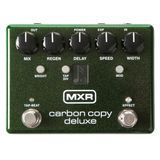
The M169 and Mini place modulation adjustments inside the enclosure, while the Deluxe brings Speed and Width to the panel. The difference is modest if you find one preferred setting and leave it there. External controls become more useful when you change the effect's character regularly between songs. Follow the specific model's instructions for internal adjustments; opening a pedal is unnecessary for a basic shop audition.
Bright on the Mini and Deluxe changes the repeats' brightness. It does a different job from Mod: Bright makes the repeat more distinct, while modulation adds movement. Compare Bright at the same Mix setting so that a change in apparent level does not confuse the judgement. Clearer repeats may help a rhythmic figure; a softer default voice may be preferable for space behind a vocal.

Choose for your playing situation
One core sound. If you rarely change delay settings in rehearsal, the M169’s simplicity may matter more than extra options. Establish the balance between dry sound and repeats, then check it with the band.
A small pedalboard. Mini makes sense when space is limited. Measure the complete footprint with plugs and the power lead attached, however: enclosure dimensions are not the same as occupied board space.
Changing tempos on stage. Deluxe is more useful when the repeats need to follow a particular song. Do not choose it simply because the enclosure is bigger. Decide whether tap tempo and the expanded controls will actually be part of your workflow.
MXR Carbon Copy Mini M299 — official demo
Official manufacturer video. Manufacturer page · Watch on YouTube
Before the amplifier or in its effects loop
When a separate overdrive pedal feeds a clean amp, delay is often placed after the drive. Carbon Copy then repeats the already distorted sound. Moving it before overdrive sends the repeats and dry signal through the distortion together, producing a different interaction. Either arrangement can be musically useful. Start with the clarity you want rather than assuming there is one mandatory order.
If the amplifier's preamp creates the distortion, its effects loop may give more separated repeats after that stage. Check the loop's signal level against the pedal's requirements. Dunlop explicitly provides an internal Instrument/Line switch on the Deluxe. Do not assume the M169 or Mini has the same facility simply because all three carry the Carbon Copy name.
Loop design matters too. In a parallel arrangement the dry sound may travel along two paths, so the blend needs attention. The Deluxe's internal Dry Kill setting provides a processed-only signal for suitable applications. This is a specialised tool, not a mode every player needs. For a conventional serial pedalboard, a simpler configuration can be easier to manage.
Three useful starting points
For a short slapback, try roughly 80–130 ms, a small number of repeats and a restrained Mix. These are suggested starting values, not factory presets. Play short chords and leave a gap. The echo should add dimension without becoming a separate musical line. If the rhythm loses definition, lower the repeat level before changing the interval.
For a singing lead, begin around 280–400 ms with a few decaying repeats. Add modulation after the original phrase is already clear. Atmospheric chords can use longer intervals and more feedback, but check what happens when the harmony changes. These suggested ranges fit within the M169 and Mini's capabilities; the Deluxe offers additional time for longer delays.
For rhythmic delay, a quarter note in milliseconds equals 60,000 divided by BPM. At 120 BPM it lasts 500 ms, and a dotted eighth lasts 375 ms. The calculation explains the relationship, although the M169 and Mini have no digital readout for exact time. If you need quick changes alongside a live drummer, tap tempo and rhythmic subdivisions on the Deluxe offer a practical advantage.
MXR Carbon Copy Deluxe M292 — official demo
Official manufacturer video. Manufacturer page · Watch on YouTube
Three ways to start setting it up
- Short slapback. Start with one clearly audible short repeat and a low Mix setting. The part should feel fuller while retaining its attack.
- Lead support. Extend the delay and add repeats gradually. Play a phrase with gaps; if the next note disappears, reduce Mix or Regen.
- Atmospheric background. Turn on modulation and leave more space between notes. Increase the repeat count gradually while listening for signal build-up.
These are starting approaches, not factory presets. Knob positions depend on the guitar, amplifier, signal level and desired effect balance.
Connection and power checks
If a pedal supplies your distortion, try placing delay after it. If the amplifier supplies the main distortion, check its effects loop and signal level. Deluxe includes an internal Instrument/Line switch; this does not mean the M169 or Mini has the same feature.
Use compatible 9 V DC power according to the individual pedal’s instructions. The M169 and Deluxe accept a 9 V battery; Mini requires external power. Do not assume an adapter is included. Confirm polarity, connector type and current requirements before buying.
If unwanted noise appears, simplify the rig to guitar, delay and amplifier. Add the other pedals back one at a time. This helps distinguish a power or cable issue from a setting that simply does not suit the part.
Choose the version for the job
The M169 makes sense when you want one preferred character and very little setup before playing. The Mini saves space and adds Bright but requires external power. Choose the Deluxe for specific needs: tempo control, panel access to modulation, longer repeats or a more involved signal path. The differences are primarily about control and use, so the more expensive version is not automatically the best fit for your pedalboard.
Common questions
Is Mini a digital delay?
No. It is an analog Carbon Copy in a compact enclosure. Bright changes the repeat character without turning the pedal into a digital processor.
Does the standard Carbon Copy have tap tempo?
The M169 does not. Of the three versions compared here, Deluxe M292 provides tap tempo.
Which should be my first version?
Choose M169 for simple operation, Mini when space is decisive, and Deluxe when timing control and extra functions are part of your playing.
Compare Carbon Copy pedals
Open the version you want, check price and included accessories, and select compatible power. SoundsGood can also assemble equipment packages for studios, rehearsal spaces and educational institutions.
- Official manufacturer or importer warranty
- PrivatBank and monobank instalment options
- Ukraine delivery; free from UAH 4,000
- Equipment selection for your needs
Check the selected product page for current price, stock, warranty terms and instalment eligibility. Payment and delivery terms.