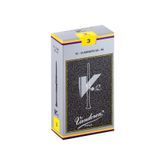

V•12 construction, strength selection and comparison with Traditional and 56 rue Lepic, illustrated by the CR193 strength 3 clarinet reed.
Key details
| Series | Vandoren V•12 |
|---|---|
| Instrument | B♭ clarinet |
| Example strength | 3 |
| SoundsGood item code | Vandoren-CR193 |
Which instrument is this version for?
The V•12 name covers several reed sizes, so a silver box is not enough to identify the right product. This review concerns the B♭ clarinet version, specifically CR193 in strength 3. E♭ clarinet, bass clarinet and saxophone versions are separate products. For a nonstandard or German mouthpiece, consult its maker about suitable reed width and cut. The B♭ designation identifies the intended instrument, but does not replace a fit check on your particular mouthpiece. Make that check before comparing the response of different series.

How the profile differs from Traditional
Vandoren specifies a thicker heel, a longer vibrating area and a slightly thicker tip than Traditional, relating these differences to body in the attack and sound. In your own trial, check a quiet entrance after a rest and whether it develops comfortably into a long phrase. More material does not automatically mean you should select a lower strength. Cut and resistance are connected but distinct characteristics. Base the decision on playing comfort at a suitable strength rather than the thickness visible in a photograph.

Understanding 3½+
The 3½+ marking is a distinct intermediate step in the V•12 strength scale, not a quality rating or an extra reed in the box. It can help refine a choice when familiar neighbouring strengths leave different compromises. Do not turn the plus sign into a mathematical conversion for another brand or series. Check mouthpiece guidance and compare several specimens. If moving up makes quiet entrances unreliable or adds unnecessary tension, the higher number is not progress. The goal is manageable resistance throughout your normal repertoire.

V•12 or 56 rue Lepic
These are different construction approaches, not successive quality grades. Keep the ligature and reed placement consistent wherever correct alignment allows it. Begin in the middle register, then add a passage across the break and quiet entrances. In chamber music, assess how easily you match a partner’s dynamics; for orchestral use, also test an entrance after a longer rest. Two or three specific observations are more valuable than declaring one series universally superior. The strength you find comfortable may differ between them.

Study, ensemble work and solo repertoire
Include V•12 in a trial when you want a different balance of response and support on a familiar mouthpiece. Students should test actual exercises as well as sustained notes: a pleasing sound during slow playing can conceal difficulty with faster articulation. For a performance, try selected reeds in several passages well in advance. The concert day is a poor time for your first encounter with a new cut. Retain a reliable familiar reed as both a comparison point and a backup while evaluating the alternative.
How to compare reeds
Compare reeds on the same mouthpiece, with the same ligature and in a familiar room. First check alignment and inspect the tip for damage. Play sustained notes, several quiet attacks, slow legato across a register change and a short passage you know well. Repeat that sequence on the other reed. Record both your impression of the tone and the effort needed to start notes, sustain phrases and change dynamics. Recordings made from the same distance can help: a louder take is easily mistaken for a better one. Avoid judging an entire series from a single specimen, because natural cane varies. If the same difficulty persists with several undamaged reeds, ask a teacher to help check the mouthpiece, instrument sealing and playing setup.
Preparation, rotation and storage
Moisten the playing surface evenly with clean water before playing and allow the cane to adjust; there is no single preparation time that suits every reed and environment. Begin with a short, gentle trial. Afterwards, remove the reed carefully, remove excess moisture without pressing on its delicate tip, and place it in a suitable holder that supports its flat surface. Avoid leaving a wet reed clamped to the mouthpiece inside a closed case. Rotate several prepared reeds and note when each entered use, making gradual changes easier to recognise. Keep them away from heat and abrupt humidity changes. A split tip or distortion is a reason to replace a reed; trimming or sanding without experience can damage its profile. Judge service life by condition and reliable response rather than a promised number of days.
CR193 and purchasing details
CR193 identifies the B♭ clarinet V•12 in strength 3. Other strengths, including a plus option, have different reference endings, so read the complete code. Silver packaging alone does not identify the size or quantity. Before paying, confirm the unit of sale: a factory-box photograph is not evidence that the displayed price covers a complete box. Check current availability and minimum quantities in the listing. When buying for a student, provide the mouthpiece model and exact previous reed series; those details are more useful than the player’s age alone.
View the product, sale unit and availability at SoundsGood
Editorial review based on manufacturer documentation, without a claim of personal testing. The cover is an illustration; packaging photographs and diagrams come from the catalog and manufacturer.