A guitar pick seems insignificant until a familiar riff suddenly feels clearer, or a simple strumming pattern starts demanding unnecessary effort. The explanation is not always the guitar or its strings: a small, flexible object sits between your fingers and the instrument. Its thickness, outline, surface and position in your hand work together to shape the attack. This practical guide explains how to choose picks for acoustic guitar, electric guitar and bass, compare Dunlop Tortex, Nylon and Ultex sensibly, and build a short personal test. Model specifications have been checked against manufacturer information, while the exercises help you assess comfort for yourself. The aim is to find an option that lets your hand confidently express the intended rhythm, dynamics and character of the part.

1. Start with a musical task, rather than a favourite colour
Before buying anything, choose three passages you play regularly. These might be a steady acoustic strum, a melody across two adjacent strings, and a palm-muted riff. Identify one problem in each passage: the pick rotates, catches unwanted strings, feels slow to recover after a stroke, or produces an intrusive click. A specific description is more useful than a general wish for professional tone. If the difficulty appears in only one technique, there is no immediate reason to replace every accessory or rebuild your entire playing approach.
A useful starting selection contains two or three related options, rather than ten completely different designs. Note which guitar and strings you are using, and keep your normal playing position. Assess tone and physical comfort separately: an attack you enjoy on a recording may accompany a movement that tires your hand over a long rehearsal. A good choice lets you repeat the intended phrase calmly without continually correcting your grip. Colour and an artist signature can be enjoyable features, but neither explains whether a design suits your hand. Treat them as preferences alongside the practical evidence, rather than substitutes for it.
2. What thickness in millimetres actually tells you
Numbers such as 0.50, 0.73 and 1.38 mm identify a pick's nominal thickness. They are useful reference points, but they do not provide a universal stiffness scale across every material. Two equally thick pieces made from nylon and another polymer can feel different. The length of the exposed tip, overall outline, surface relief and edge design also matter. Labels such as Thin, Medium and Heavy should not automatically be treated as equivalent between manufacturers. When comparing products online, look for the numerical gauge together with the complete series name.
A sensible experiment begins with neighbouring gauges instead of jumping from the thinnest available pick to a very substantial one. Tortex Standard 0.50 and 0.60 mm, for example, let you compare thickness within the same series. Nylon Standard 0.88 and Ultex Standard 0.88 mm help explore material differences with broadly similar shapes. Avoid testing flexibility by forcefully bending a pick between your fingers: that does not reproduce string contact and can damage it. Play the same short passage with a similar stroke instead. The printed number becomes useful when connected to a repeatable playing situation, rather than being treated as a quality rating on its own.
3. Thin picks: flowing strums and the trade-offs
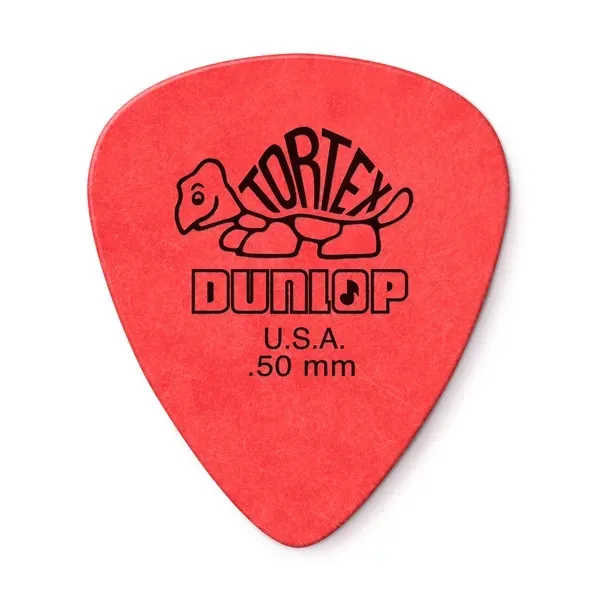
A thin pick can be a comfortable introduction to chord strumming because it bends more noticeably as it passes across several strings. Try Tortex Standard 0.50 mm with a relaxed down-up pattern. Your aim is to keep the movement and beat lengths even, rather than strike every string as loudly as possible. Listen for a mechanical click that might cover the chord itself. A pick that reaches too far between the strings can still catch and twist, even when its material is quite flexible.
The trade-off becomes clearer in other passages. During rapid single-note playing, a player may experience the tip bending as an extra movement between the hand and string. That does not make thin picks inherently unsuitable for lead work, but it does make a test at your actual tempo valuable. Do not compensate for every difference by squeezing harder. First reduce how deeply the tip enters the strings and slow the phrase slightly. If the rhythm remains stable and you like the sound, there is no need to move to a heavier gauge merely because a beginner's list recommends one. Judge the pick by your own repertoire: controlled accents, consistent movement and the ability to finish a song comfortably.
4. Medium gauges as a starting point for comparison
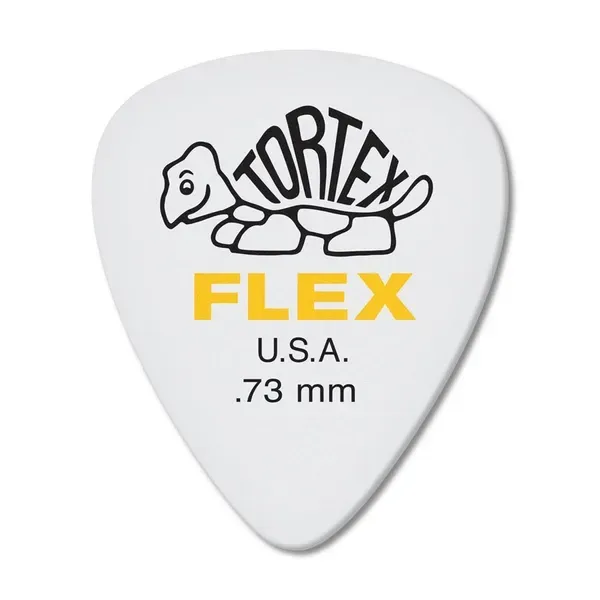
The word medium describes a practical grouping, not one universal international standard. For an initial trial, several picks around 0.60 to 0.88 mm can be useful, provided you account for material differences. Tortex Standard 0.60 mm is a logical comparison with a thinner Standard. Tortex Flex Standard 0.73 mm introduces a different flexibility characteristic, so it should not simply be treated as the next step on the Standard scale. Test chords, arpeggios and a short melody separately, without changing amplifier settings halfway through the comparison.
This general range can provide a useful everyday option for someone combining accompaniment with straightforward lead phrases. Include quiet playing in the test: can you keep the rhythm clear without exaggerating the movement? Next accent one beat and return to the previous level. If control remains consistent, the pick offers a useful working range for your dynamics. Repeat the exercise after a few minutes of normal playing before making a decision. A design that seems ideal for ten seconds can start slipping or turning as the feel of your fingers changes. That second check helps distinguish a promising first impression from reliable comfort across a complete musical passage.

5. Thick picks: control without compulsory hard strokes
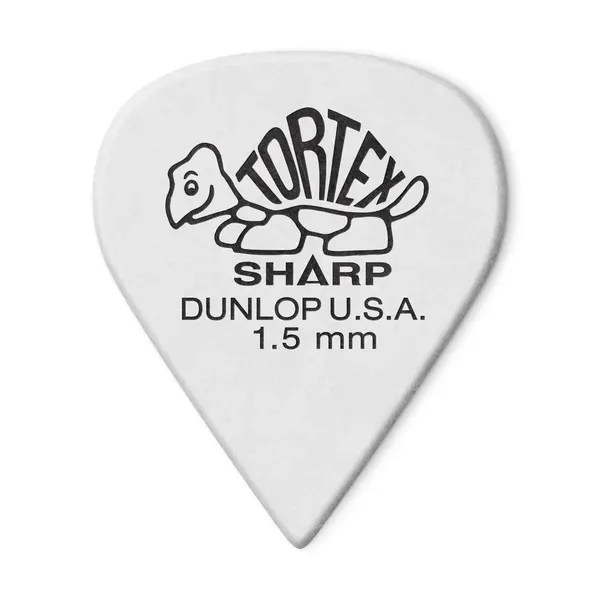
Gauges above a millimetre often interest players working on clear single notes, substantial riffs or bass lines. However, the formula thicker means louder is too simplistic. Sound depends on hand movement, angle and contact depth; a thick pick transmits that movement differently. With Ultex Jazz III 1.38 mm or Tortex Sharp 1.50 mm, begin by producing very quiet notes. If every note sounds excessively aggressive, inspect your stroke before deciding that the model is unsuitable. A rigid-feeling pick does not require a forceful attack to function properly.
A stiffer design can make an awkward path more noticeable: digging deeply into the string is easier to feel. Try a slow phrase on one string with only a small working tip exposed, then add a move to the next string. Keep your shoulder and wrist comfortable instead of pushing the pick through by force. If the new gauge improves precision but makes extended acoustic accompaniment less comfortable, keep different picks for those two jobs. An accessory does not have to serve every technique equally well. A practical kit may contain several deliberately chosen options rather than one supposedly professional model that makes half your repertoire harder to play.
6. Tortex Standard: material and matte surface
Dunlop describes Tortex as a Delrin-based series with a specialised surface treatment. For selection, the useful features are its standard outline, matte finger contact area and available gauges, rather than promotional adjectives. This guide includes the red Tortex Standard 0.50 mm and orange 0.60 mm. Colour helps identify these particular models quickly, but their gauge coding must not be transferred to every red or orange pick from another series. Check both the name and printed thickness when ordering replacements.
To assess the matte surface, hold the pick normally and play a sequence alternating soft strokes with accents. Count how often you need to readjust its position. This is more useful than judging grip between dry fingers without an instrument. Look at the tip after use as well: gradual changes to its outline can change how the string seems to release. Compare new picks or examples with roughly similar wear when trying to understand material differences. A heavily worn Tortex and a freshly opened Nylon do not create equal conditions, even when their nominal gauges seem close. Rule out wear before attributing a change in feel entirely to the series or material.
7. Nylon Standard: texture and flexibility
Nylon Standard 0.88 mm is a useful example of a conventional outline with a raised grip surface. The manufacturer identifies nylon and describes a rounded edge and raised markings intended to help control the pick. The actual product photograph shows the textured upper area. Do not automatically equate that texture with the separate Max-Grip series: the names relate to similar practical concerns but describe different designs. Order by the complete name and thickness, rather than only asking for a nylon Dunlop pick.
During your trial, check whether your thumb naturally rests on the textured area. If your normal grip sits lower, the relief may contribute less to your experience. Compare several short groups of strokes using ordinary finger pressure instead of squeezing harder because the surface is unfamiliar. For accompaniment, assess the consistency of travel across the strings; for melody, focus on the predictability of the initial attack. A manufacturer's warm-tone description cannot replace this exercise. The guitar, strings, picking location and recording microphone can all substantially change the overall tonal impression. Establish a comfortable grip first, then refine your sound preferences through playing rather than trying to infer the complete experience from a photograph.

8. Ultex Standard: comparing broadly similar shapes
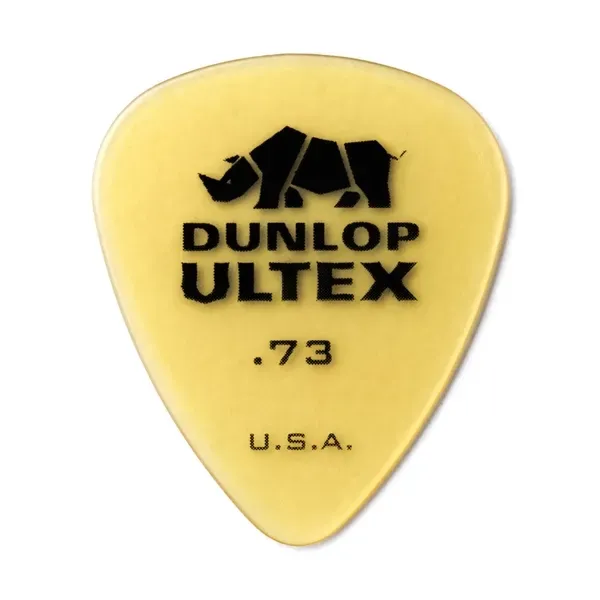
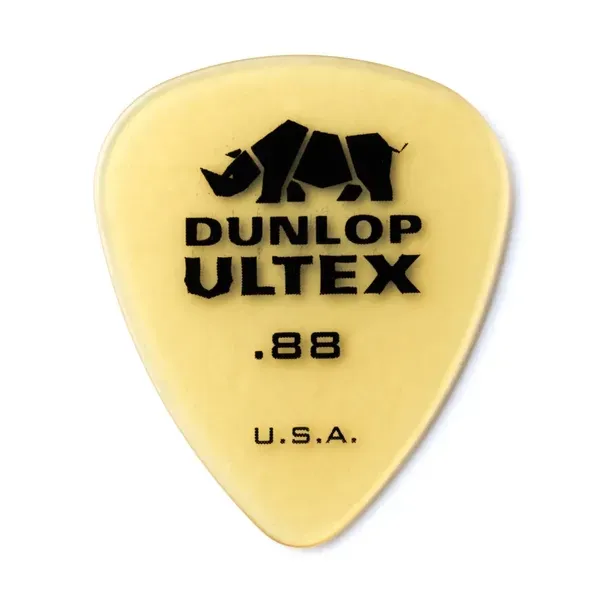
The selection includes Ultex Standard in 0.73 and 0.88 mm. Compare those two first, then consider putting the 0.88 mm version alongside Nylon Standard of the same nominal gauge. This is not a laboratory experiment with perfectly identical geometry, but it helps separate questions about thickness from questions about material. Ultex's translucent amber appearance does not imply softness: evaluate it in use. Equally, a claim about enhanced articulation remains a broad manufacturer description, not a guaranteed result for every hand and instrument.
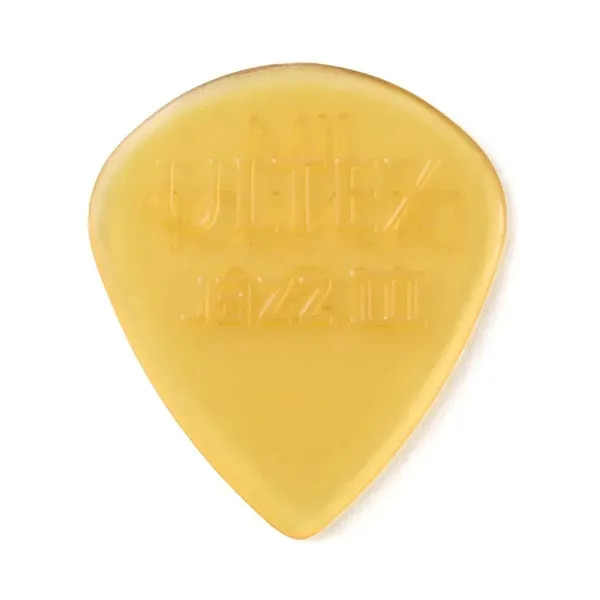
Play a familiar phrase with a clean sound, followed by your usual driven sound. A clean setting makes note onsets easier to hear, while distortion helps reveal whether unwanted neighbouring strings are being caught in your real playing context. Do not turn up the volume when changing picks: a louder example is easily mistaken for a better one. Include pauses and consistency of repeated notes in a short recording, not just the brightness of the first attack. If you enjoy the material but find the standard outline too large, an Ultex Jazz III can be a separate next experiment. Keep the purpose clear: you are investigating a different shape and size rather than expecting every performance detail to improve at once.
9. Tortex Flex is a distinct series
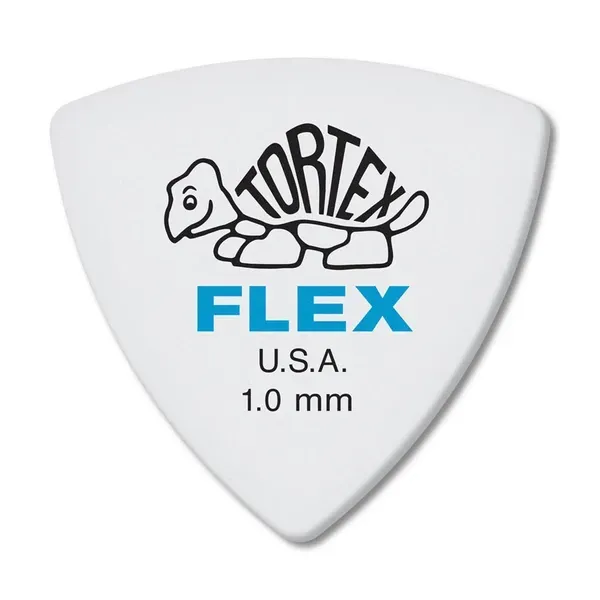
The Flex name describes this series' playing characteristics. Dunlop combines the textured gripping surface associated with Tortex with flexibility and tonal qualities associated with nylon in its description. This does not justify calling it an ordinary Nylon Standard in another colour, or claiming a particular percentage blend of materials. No such formulation is asserted here. For a practical choice, comparing the specific products is sufficient. Flex Standard 0.73 mm has the familiar standard outline, whereas Flex Triangle 1.0 mm changes the shape as well.
Start with Standard if you want to avoid changing your grip at the same time. Play identical accompaniment with regular Tortex and Flex, then try a melody that skips a string. Notice whether returning the tip to its starting position after a stronger accent feels comfortable. This tells you how the design works with your movement, rather than establishing an abstract winner. If the main problem is the area available under your fingers, investigate Triangle later as a separate change. Keeping those questions separate lets you understand the result instead of crediting every difference to one word on a packet. Record the exact model in your notes, because a series name alone does not describe every shape within it.
10. Standard, Jazz III and Sharp outlines
A standard teardrop outline offers a familiar holding area and a moderately pointed working end. The compact Jazz III leaves a smaller body between the fingers and presents a clearly defined tip. Sharp uses a pointed profile within a different outline. The Jazz name does not restrict musical style: you can try it with any repertoire. However, a small body does not guarantee speed, and a sharp tip does not correct uneven timing. When comparing Ultex Jazz III 1.38 mm with Tortex Sharp 1.50 mm, remember that several variables change together.
The useful question is how much material you need between your fingers to orient the tip confidently. One player finds a small body direct and easy to control; another continually has to reposition it. Begin with a slow move between two strings without watching your picking hand, then repeat with pauses and accents. If a compact pick feels awkward, do not force yourself to adopt it just because the format is popular. A larger body with a suitable tip can also provide precise control. Finger size alone does not settle the issue. Your habitual grip and the movement required by the passage are more informative than a simple small-hand or large-hand rule.
11. Triangle shapes and a larger gripping area
A triangular pick is worth investigating when a standard pick feels too small across its upper section or turns too readily. Tortex Flex Triangle 1.0 mm illustrates a wider body with several usable corners. Being able to select another corner is useful, but it does not mean uneven wear can be ignored: check which tip you are actually using before playing. Triangular picks are not exclusively for bass. They may suit a guitarist who wants a different area beneath the fingers, whatever the style of music.
For the first comparison, avoid pushing the pick farther between the strings merely because its body is larger. Leave a similar working length exposed to your usual pick and compare stability. If a broad edge touches an adjacent string, adjust finger position or angle rather than hitting harder. Next move from a wide chord to a single note. That change of task reveals whether the extra gripping area helps or complicates orientation. Make your decision after several musical passages, not solely from holding the object in an open palm. Comfort away from the instrument matters, but it is not the same as predictable behaviour while the strings push against the working edge.
| Model | Gauge, mm | Shape |
|---|---|---|
| Tortex Flex Standard 0.73 mm | 0.73 | Standard |
| Tortex Standard 0.50 mm | 0.50 | Standard |
| Tortex Standard 0.60 mm | 0.60 | Standard |
| Nylon Standard 0.88 mm | 0.88 | Standard |
| Ultex Standard 0.73 mm | 0.73 | Standard |
| Ultex Standard 0.88 mm | 0.88 | Standard |
| Ultex Jazz III 1.38 mm | 1.38 | Compact Jazz III |
| Tortex Flex Triangle 1.0 mm | 1.0 | Triangle |
| Tortex Sharp 1.50 mm | 1.50 | Pointed Sharp |
12. Tip shape, edge condition and wear
Two picks from the same series can feel different when one has already seen extensive use. The tip gradually changes outline, and irregularities may develop along the edge. Before buying a new material because your pick has suddenly started catching, compare it with a fresh example of the same model and gauge. Examine the edge under light from the side and check gently for damage. Cracks, sharp burrs and chipped sections are good reasons to replace a pick rather than adapting your technique around the defect.
A bevelled or rounded edge affects string release together with the angle of your hand. This explains why thickness alone cannot predict the whole experience. Factory-finished examples are better for a straightforward comparison: personal sanding changes the shape, surface and edge simultaneously, making conclusions harder to interpret. There is no universal weekly or monthly replacement schedule. Playing frequency, stroke style and strings create different conditions for different players. Keep one fresh example as a reference and occasionally compare your working pick with it while leaving the instrument settings unchanged. That simple check can reveal wear before you begin blaming a new difficulty on your technique or on the strings.
13. Holding a pick without excessive pressure
Begin with a relaxed hand. Rest the pick against the side of a bent index finger and secure it with the thumb, leaving a small working tip exposed. This is a common starting position, not a compulsory arrangement for every hand and technique. Your fingers need to preserve the pick's orientation while allowing the stroke without a forceful clamp. If you continually increase the pressure, check contact depth and whether the shape suits your grip. An inconvenient outline is not always improved by gripping it more tightly.
Try several quiet strokes on one string with a brief pause after each. During the pause, notice whether your shoulder and forearm remain comfortable. Add alternating downstrokes and upstrokes at an easy tempo. Do not aim for a grip so loose that the pick falls out: you need sufficient stability, not a complete absence of pressure. Stop the exercise if pain or persistent discomfort appears; buying a stiffer accessory is not a solution to that problem. A teacher who can see your whole posture and movement can provide useful feedback on hand position. A small adjustment to an established habit may contribute more than replacing an entire collection of picks.
14. Contact depth and angle against the string
When a pick travels too deeply between the strings, every stroke asks more of your hand. Start with a small visible tip and slowly find a position where the note begins without a sensation of getting stuck. There is no need to measure the exposed length to a fraction of a millimetre. What matters is a depth that you can control and repeat. Check it again after changing gauge or outline, because the same finger placement may expose a different length of working edge on a new body.
A slight rotation relative to the string can change both resistance and contact noise. Play a series of strokes with the face nearly flat to the string, then change the angle a little. Choose the position that makes your intended tone manageable, rather than the most extreme angle you can produce. Excessive rotation may increase scraping along a wound string, something particularly easy to hear in a slow bass recording. Compare small changes separately. Altering grip, angle, picking location and material all at once makes it difficult to identify what helped or hurt. Describe a successful adjustment in your own words so that you can reproduce it at the next practice session.
15. Choosing a pick for acoustic guitar
For acoustic accompaniment, assess the balance of bass and treble strings within a chord as well as the comfort of a broad strum. If the lower notes dominate excessively, the movement path may be responsible rather than insufficient pick flexibility. Play a slow pattern with a modest stroke and listen for predictable contributions from the strings you intend to sound. Tortex Standard 0.50 or 0.60 mm can serve as initial candidates for this exercise, but neither is a compulsory standard for acoustic playing.
If your songs combine strumming with melodic fills, add a medium or stiffer option to the comparison. Test the transition within one phrase without stopping to reorganise your grip. For recording, keep the phone or microphone in one position; changing its distance from the soundboard can distort the attack comparison. Judge the mechanical click both in the room and in the recording. It may be a useful element of the rhythmic sound, but it should not unintentionally obscure the part. A helpful starting pick lets you accompany quietly and add clear accents while keeping the hand comfortable through the whole song. That is more meaningful than matching somebody else's preferred gauge number exactly.
16. Choosing for electric guitar and substantial riffs
Test an electric-guitar pick under two conditions: a clean sound and your working level of drive. The clean setting exposes uneven strokes and unwanted contact, while a familiar distorted riff lets you assess comfort in its real context. If the passage uses palm muting, keep the hand position near the bridge consistent. Moving the palm while switching picks may affect the result more strongly than the material difference. Resist adjusting the amplifier after every take; complete the comparison under equal settings first.
For a riff with repeated downstrokes, assess endurance at a moderate tempo instead of chasing maximum speed for two seconds. Then add alternating strokes and a skipped string. If Ultex Jazz III or Tortex Sharp makes the tip easier to locate precisely, also check quiet introductions and broad chords. A standard shape that already works well does not have to be replaced by a compact design. In rehearsal, listen with the other instruments: an attractive attack in isolation may not occupy the right place in the arrangement. Your final decision should account for dynamic control, clean pauses and comfort throughout the part, including less spectacular passages that repeat many times during a performance.
17. Bass guitar: support, attack and consistent note levels
A pick is a distinct approach to bass playing, rather than a simplified substitute for fingers. Check whether the chosen outline lets you attack substantial strings confidently without unnecessary movement. A broader triangular body may feel useful in the grip, but many players are comfortable with standard shapes too. Use a particular bass line containing pauses and string changes as your reference. Assess consistency of note level: an accidentally forceful stroke can disrupt a groove regardless of what the accessory costs. Control over silence between notes is part of the result as well.
As a starting comparison, try Ultex Standard 0.88 mm and Tortex Flex Triangle 1.0 mm while recognising that both material and geometry change. Do not describe the outcome as a pure thickness test. Listen to the attack together with note duration and the accuracy of muting. If you often catch an adjacent string, examine the exposed tip and movement path first. Buying the thickest available design does not automatically correct an unnecessarily deep stroke. Ordinary rhythm needs stable contact; a deliberate accent needs a controlled change in movement. Test both at a comfortable amplified level instead of relying entirely on how an unplugged bass feels under the fingers.
18. Nylon strings, ukulele and combined techniques
On a classical guitar, using a pick changes the familiar attack and the possibilities for sounding several independent notes together. If you are learning classical repertoire, discuss the technique with your teacher first: replacing fingers with one pick can change the basic organisation of a part. Trying a pick for a separate accompaniment task is possible, but start with light, controlled contact and avoid striking the soundboard. Nylon in a pick's material name does not mean that it is intended exclusively for nylon strings. Accessory material and string type are separate questions.
For ukulele, establish the intended sound and technique before applying a guitar recommendation. Soft specialist picks and conventional guitar picks can feel very different, so an electric-guitar preference should not simply be transferred without a trial. If you combine a pick with free fingers, check whether its body obstructs the movement and whether returning to your ordinary grip is easy. Label or store your working options separately when moving between instruments. This prevents differences in string tension from being confused with the properties of the pick itself. An adaptable accessory can be useful without becoming a compulsory solution for every musical task, particularly when the part calls for another kind of finger independence.
19. Why a pick slips or rotates
Slipping does not automatically mean you need the roughest possible surface. First check whether the exposed tip is too long or travels too far between the strings. A longer lever can turn the body even when the grip is relatively firm. Then inspect thumb placement: if support falls on an awkward area, changing the outline can be more useful than adding texture. Compare picks with clean hands, and repeat the check after ordinary playing under realistic conditions. A surface that feels secure for a short test should remain manageable through a complete song.
If the pick slowly shifts during broad strumming, try reducing contact depth while keeping tempo and dynamics unchanged. If it rotates only on an accent, isolate that stroke and repeat it slowly. Matte Tortex and textured Nylon designs may be useful candidates, but they do not replace setting up a workable grip. Avoid adding improvised abrasive layers immediately before an important performance: the extra thickness and edges change familiar support. It is better to test a factory-made option in advance and carry several identical spares. A consistent kit removes unexpected changes on stage and leaves your attention on the music instead of searching for another workable object after each song.
20. Clicking, scraping and unwanted string contact
Separate unwanted sound into three categories before trying to fix it: a short click at the attack, an extended scrape along winding, and an accidental note from a neighbouring string. Each calls for a different check. Compare clicks using similar stroke strength, scraping with small angle changes, and unwanted notes with slow movements between strings. Changing both material and technique at once can temporarily hide a symptom without explaining its cause. Start with one variable and note what actually changes after the adjustment.
For acoustic guitar, listen from the audience position or through a recording made under consistent conditions. Mechanical contact sounds different when heard directly above the instrument. On electric guitar, compare clean and driven sounds without adding compression specifically to hide uneven playing. Inspect the edge and string condition if the problem has appeared suddenly. Not every contact sound is a mistake: it may support the intended rhythmic character. The useful question is whether you control it deliberately and whether it serves the part. Removing accidental neighbouring notes matters more than pursuing an abstractly silent attack through an uncomfortable motion. Work toward a specific audible musical result instead of expecting every physical contact to produce no additional sound at all.
21. A fifteen-minute test before deciding
Use the first three minutes for your normal warm-up with one pick. Divide the next six minutes among three candidates, playing the same strum, melody and riff with each. Do not speed up, change strings or alter the sound settings. Write brief notes after each trial covering consistency, slipping, accuracy of string changes and control of quiet notes. Avoid ratings consisting only of pleasant or professional: those words do not explain what to reproduce next time. Your observations should be specific enough to check again at another session.
Spend a further three minutes comparing the two most comfortable candidates in reverse order. This helps reduce the influence of first impressions and the hand gradually warming up. For the final three minutes, play a genuine song excerpt that moves between techniques. The outcome should be a short list with reasons, such as stays more stable during strumming or makes quiet single notes easier to control. If the differences remain unclear, keep the more affordable or already familiar option and return to the comparison later. There is no need to manufacture a winner simply to justify a purchase, especially when your existing pick does not obstruct your playing. Deciding that no change is needed can also be a useful result.
22. Recording a comparison without misleading yourself
Place the phone or microphone on a fixed support and mark your chair position. For electric guitar, keep the same pickup, guitar volume and amplifier settings. Record short takes labelled A, B and C with roughly similar playing strength. Automatic level control on a phone can disguise or exaggerate differences, so do not use an everyday recording to make claims about precise decibel changes or frequency response. It is a practical comparison tool, not a measurement laboratory. Its purpose is to make repeatable features of the performance easier to hear.
During playback, compare rhythmic consistency and unwanted notes first, then the nature of the attack. If one take is noticeably louder, match playback levels for the tonal comparison while preserving the original files. Where practical, ask someone else to shuffle the labels: expectations about colour or branding can influence perception. However, blind listening cannot assess finger comfort, so combine it with your grip notes. Choose a model that supports consistent playing and produces a recording you enjoy. One unusually successful take does not prove that you have found a permanent working option. Repeat a short comparison at your next practice session, once novelty is no longer dominating your reaction to every small difference.
23. Pack contents, spares and checking an order
Before ordering, confirm the series, outline, gauge and quantity in the packet. A product title may use the singular word pick even though its description concerns a set. Do not assume that the pack contents of one listing apply to another because the packaging photographs look similar. A store SKU and manufacturer code may differ; retain both when they are provided. A clear photograph of your working pick with its gauge visible is useful for repeat orders, unlike a note saying only orange Dunlop. This becomes especially helpful when you own several series from the same brand.
A small selection is enough for an initial trial. After deciding, keeping identical spares in the case and near your practice area makes everyday use easier. Store them in a small container where fresh examples can be distinguished from heavily worn ones. Avoid leaving accessories on a hot surface or exposed to direct heat inside a car. If a holder attaches to an instrument with adhesive, check finish compatibility in the holder's own instructions. Prices and availability change, so consult the current product listing. A long guide should explain the choice without replacing live ordering information or promising pack contents that have not been checked for the particular item you intend to buy.
24. Short answers and a practical selection sequence
Does a beginner have to use a thin pick? No: start with a design that lets you perform the exercise without unnecessary tension, then compare neighbouring gauges. Does Jazz III mean jazz music only? No, a shape name does not restrict repertoire. Are two 0.88 mm picks equivalent? Not necessarily; their materials, outlines and edges can still differ. Should you replace a good working pick because of advice in a video? Only if you can identify a problem you want to address, or deliberately want a different attack. Another player's habit is an idea to test, rather than a substitute for your own result.
The selection process is straightforward: define the musical task, choose a few meaningful candidates, check grip and contact depth, play identical passages, and listen to a short recording. Then compare comfort with the result inside an actual song and verify the contents of the specific product listing. Acoustic strumming, rapid single notes and bass accompaniment may lead to different winners. That conclusion is more useful than chasing one best pick for every situation. Keep the option, or small set of options, that lets your hand consistently express the required rhythm, dynamics and sound. A good choice should simplify regular musical work instead of introducing an unnecessary struggle with an unfamiliar accessory.
Featured products
- Dunlop Tortex Flex Standard 0.73 mm
- Dunlop Tortex Standard 0.50 mm
- Dunlop Tortex Standard 0.60 mm
- Dunlop Nylon Standard 0.88 mm
- Dunlop Ultex Standard 0.73 mm
- Dunlop Ultex Standard 0.88 mm
- Dunlop Ultex Jazz III 1.38 mm
- Dunlop Tortex Flex Triangle 1.0 mm
- Dunlop Tortex Sharp 1.50 mm