


|
Quantity
|
Cost
|
||
|
|
|||
|
|
|||
Lute Thomann Renaissance Lute 8/15
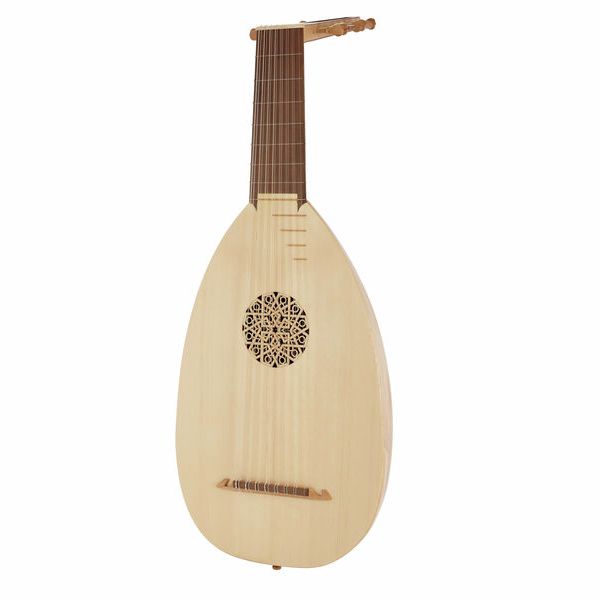
The Thomann Renaissance Lute 8/15 is a renaissance lute with 8 courses and 15 strings, featuring a spruce top and a body made from a combination of maple and lacewood. The eighth course is tuned to DD (low D) — the lowest note in the lineup — providing a wide bass range for late-renaissance and early-baroque repertoire.
Unlike the Deluxe 8C, this model's body combines maple and lacewood, with each wood contributing its own tonal character. The upper nut is bone, the bridge is lacewood and walnut, and the pegs are wooden. A bag is included (approx. 1.35 kg).
🎵 Sound Characteristics
- ✔️ Spruce top — clear, resonant tone with good projection
- ✔️ Maple + lacewood body — the clarity and brightness of maple combined with the warmth of lacewood
- ✔️ 8 courses, 15 strings — full late-renaissance range
- ✔️ Lowest course DD — extended bass for more complex repertoire
🔧 Materials and Construction
The soundboard is spruce. The body is built from a combination of maple and lacewood — maple contributes clarity and brightness, while lacewood provides warmth and openness. The bridge incorporates lacewood and walnut. The upper nut is bone. Pegs are friction-fit wooden pegs, as on all historical lutes. Scale length is 60 cm.
📊 Technical Specifications
| Parameter | Value |
|---|---|
| Brand | Thomann |
| Model | Renaissance Lute 8/15 |
| Type | Renaissance lute |
| Number of courses | 8 |
| Number of strings | 15 |
| Top material | Spruce |
| Body material | Maple and lacewood |
| Bridge | Lacewood and walnut |
| Pegs | Wooden (friction pegs) |
| Upper nut | Bone |
| Tuning | DD – FF – GG – CC' – FF – AA – D'D' – G' |
| Scale length | 60 cm |
| Dimensions (L × W × H) | 680 × 330 × 165 mm |
| Included | Bag (approx. 1.35 kg) |
📊 Tuning of the Thomann Renaissance Lute 8/15
| Course | Note | Number of strings |
|---|---|---|
| 1 (highest) | G' | 1 (single) |
| 2 | D'D' | 2 |
| 3 | AA | 2 |
| 4 | FF | 2 |
| 5 | CC' | 2 (octave course) |
| 6 | GG | 2 |
| 7 | FF | 2 |
| 8 (lowest) | DD | 2 |
| Total | 15 strings | |
📊 Thomann Renaissance Lute Models Compared
| Parameter | 8/15 | Deluxe 8C | 7/13 | 6/11 |
|---|---|---|---|---|
| Courses / strings | 8 / 15 | 8 / 15 | 7 / 13 | 6 / 11 |
| Top | Spruce | Spruce + rosette | Spruce | Spruce |
| Body | Maple + lacewood | Chinar (11 staves) | Lacewood | Lacewood |
| Lowest course | DD | — | FF | GG |
| Tied frets | — | 7 tied + 5 wooden | — | — |
🎯 Who Is This Instrument For
- ✔️ Late-renaissance and early-baroque performers — 8 courses with DD bass cover the full required range
- ✔️ Students moving from a 7-course to an 8-course lute
- ✔️ Players looking for an 8-course lute with a maple body for a brighter tonal character
- ✔️ Enthusiasts wanting to explore expanded late-renaissance repertoire
- ✔️ Players comparing the tonal properties of different body woods
🏭 About Thomann
Thomann is one of Europe's largest retailers and manufacturers of musical instruments. The Renaissance series offers accessible lutes for beginners and enthusiasts with standard renaissance tunings and traditional materials.
❓ Frequently Asked Questions (FAQ)
Why does an 8-course lute have 15 strings?
A course is one or two strings played together as a single voice. The first (highest) course is a single string; the remaining 7 are doubled: 1 + 7×2 = 15 strings.
What does DD in the tuning mean and why is the 8th course needed?
DD is low D — the lowest course on this lute. It extends the bass range compared to 7-course (lowest course FF) and 6-course (lowest course GG) models, allowing performance of more complex late-renaissance and early-baroque repertoire that requires a developed bass line.
How does maple differ from lacewood as a body material?
Maple is a denser, brighter wood that adds clarity and projection to the sound. Lacewood is lighter and warmer, softening the tone. Combining both in the body of the Renaissance Lute 8/15 produces a balanced result: the clarity of maple with the warmth of lacewood.
How does this model differ from the Deluxe 8C?
The 8/15 has a body made from maple and lacewood, while the Deluxe 8C uses 11-stave chinar wood. The Deluxe 8C has a rosette in the soundboard and 7 tied + 5 wooden frets; the 8/15 has a standard construction. The 8/15 specifies the lowest DD course clearly in its tuning.
What does the tuning DD – FF – GG – CC' – FF – AA – D'D' – G' mean?
This is the 8-course renaissance tuning written from the lowest (DD) to the highest (G') course. The four lowest courses (DD, FF, GG, CC') form the bass register, while the four upper courses (FF, AA, D'D', G') cover the melodic and harmonic range of the instrument.
What are friction wooden pegs?
Lute pegs have no mechanical gearing — the string is held by friction alone. Treating pegs with peg dope or chalk helps regulate their grip for stable tuning.
Is a bag included?
Yes. The Thomann Renaissance Lute 8/15 comes with a bag weighing approximately 1.35 kg for storage and transport.
What does a 60 cm scale length mean?
Scale length is the vibrating string length between the upper nut and the bridge. At 60 cm, this lute follows the standard renaissance scale, corresponding to the majority of historical lute tablature and fingering positions.
🚚 Delivery and Payment
🏪 In-store pickup at SoundsGood Kyiv — free of charge.
🚚 Delivery across Ukraine — Nova Poshta, Ukrposhta, Meest. Free shipping on orders from 4,000 UAH.
💳 Installment plan — from 25 UAH/month (Privatbank, Monobank, OschadPay).
✅ Official manufacturer warranty.
📦 Ships in original manufacturer packaging.