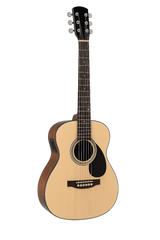
Electro-Acoustic Guitars — buy with Discount at SoundsGood
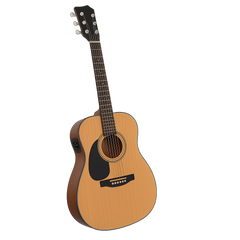
An acoustic-electric guitar keeps the character of a full acoustic instrument and adds a ready output for the stage, rehearsals, recording and streaming. At SoundsGood you can compare 6- and 12-string models, dreadnought, concert, jumbo, mini and left-handed instruments, then match the electronics to an acoustic amplifier, PA system or audio interface.
Warranty from the manufacturer or official importer for catalog products.
Installment payments
Up to 7 PrivatBank payments and up to 6 monobank payments.
Delivery across Ukraine
Nova Poshta, pickup and free delivery for orders from UAH 4,000.
Professional selection
We help compare body, scale, tonewoods, pickup system and stage features.
Electro-acoustic guitar selection at SoundsGood
The category selection is regularly updated and expanded. Availability, brand, series, finish, package and price depend on the individual product page, so check the current status before ordering or use the live catalog filters.
For a first acoustic-electric
Accessible production models with a basic piezo pickup or preamp, clear controls and a standard jack output.
For stage and rehearsals
Instruments with predictable connection, practical EQ, tuner, phase or notch controls; the exact feature set varies by model.
For recording and content
Guitars that can be recorded directly into an interface or combined with an external microphone for greater tonal control.
For travel
Mini and compact formats are easier to carry; always verify scale length, nut width and case compatibility separately.
Types of electro-acoustic guitars
Start with string count, body shape and playing position. Each format feels different, occupies a different place in a mix and responds differently when amplified.
A shape name does not guarantee a specific tone. Body volume, scale, bracing, materials, strings and the design of the particular series all matter. The format is still a useful way to narrow the search.
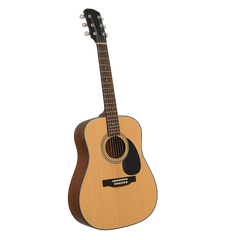
Dreadnought
Strong attack and an assertive midrange support strumming and accompaniment. On stage, the low end may need more careful EQ.
Grand Auditorium
A compromise between full chords and individual-note detail, popular for players who mix strumming and fingerstyle.
Concert / OM
A smaller body is often more comfortable seated and for fingerstyle, while controlled bass can be easier to fit into an ensemble.
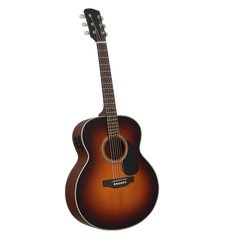
Jumbo
A large air volume gives broad acoustic scale, but it is worth testing the ergonomics in person.
Mini / travel
Compact size and a shorter scale can make transport and fretting easier, though the feel differs from a full-size instrument.
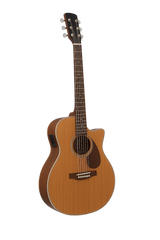
Cutaway
A cutaway improves access to upper frets. It is useful for lead playing but does not determine plugged-in sound quality by itself.
Pickup and preamp types
Electronics affect not only cable tone but also high-volume behavior, output level, available controls and power requirements. Check the exact model specification because guitars in one series may use different systems.
Undersaddle piezo
A sensor below the saddle captures a clear attack and is usually predictable on stage. Installation quality and a level saddle contact are important for string balance.
Bridge or soundboard transducer
Captures more body vibration and may sound softer, but performance depends strongly on construction and sensor placement.
Magnetic pickup
Fits in the soundhole and responds to steel strings. It is convenient for retrofits but has its own more electric tonal character.
Internal microphone
Adds air and body detail. At higher levels it can be more sensitive to monitors and room acoustics.
Blended system
Combines two sources such as piezo and microphone. Blend adds flexibility, but there is no single universally best setting for every venue.
Active or passive
An active system includes a preamp and requires a battery. A passive system is simpler but often benefits from a correctly matched DI box or external preamp.
Pickup system comparison
System
Signal character
Strengths
What to check
Piezo
Clear attack, focused signal
Stage, rhythm, reliable mix placement
EQ, string balance, suitable input impedance
Transducer
More body overtones
Fingerstyle, percussive technique
Installation, sensitivity to knocks and volume
Magnetic
Dense mid-focused character
Fast installation, effects, loud stages
Steel strings only, soundhole compatibility
Internal mic
Airy and spatial tone
Quiet stages, recording, natural detail
Feedback, monitor position, room acoustics
Hybrid
Adjustable balance of two sources
Flexible use in changing conditions
Blend, phase and EQ require setup
External mic
The most acoustic space
Studio and intimate performance
Player movement, room noise and feedback
On a loud stage, players often begin with the more controlled piezo or magnetic signal and add microphone content as conditions allow. For recording, capture a direct feed and an external microphone to separate tracks, then decide on the balance during mixing.
Tonewoods and top construction
Materials influence response, attack and overtone development, but they do not work independently from body shape and bracing. Compare guitars in a similar playing position, with comparable strings and at similar volume.
Laminated construction
Stable in everyday use and accessible in price. A practical choice for learning, rehearsals and frequent travel when the instrument is comfortable and well set up.
Solid top
A solid top often responds more sensitively than a fully laminated body, although thickness and bracing remain important.
All-solid body
All-solid builds can offer a more complex acoustic response while requiring closer attention to humidity.
Spruce
Often associated with clear attack and broad dynamic headroom; character changes with species and construction.
Cedar and mahogany
Cedar may respond quickly to a light touch, while mahogany can emphasize the midrange. These are guides, not fixed rules.
Composite and carbon
Modern materials are valued for stability and consistency. Judge their tone and feel on their own terms rather than as substitutes for traditional wood.
How to choose an electro-acoustic guitar
Establish acoustic comfort first, then compare electronic features. The guitar should feel right without a cable; amplification cannot fix an awkward body, excessive width or an uncomfortable neck profile.
1. Use and budget
Learning, stage work, worship, a cover band, fingerstyle, studio or travel lead to different priorities. Include a cable, case and possibly a DI box in the budget.
2. Body and scale
Check body width, seated and standing balance, scale length, cutaway and access to upper frets.
3. Neck and nut
Neck profile, nut width, string spacing and action affect comfort more directly than the body-shape label.
4. Acoustic tone
Listen for string balance, sustain, attack and low-to-mid balance. Compare without effects and with the same playing technique.
5. Electronics
Confirm pickup type, controls, tuner, phase, notch, battery format and compartment position. Not every model includes every feature.
6. Connection
Test through a signal path similar to yours: acoustic amp, mixer, DI box or audio interface with an appropriate input.
Stage monitoring and feedback control
The right input
Piezo systems often perform better into a high-impedance instrument input. If the signal path is not suitable, an acoustic preamp or DI box can help.
Phase and notch
A phase switch and narrow notch filter can reduce a problem frequency. They should be adjusted for the specific stage, not left permanently in one position.
Monitor placement
Avoid aiming a loud monitor directly into the soundhole. Lower stage volume and thoughtful placement can be more effective than radical EQ.
Equalization
Begin with neutral settings and remove excess rather than boosting everything. Low-mid frequencies often deserve particular attention.
Feedback suppressor
A soundhole cover may increase feedback margin, but fit depends on soundhole diameter and control placement.
Cable and power
Use a reliable instrument cable, carry a spare battery and check whether an inserted jack keeps the electronics active during storage.
No pickup can guarantee the complete absence of feedback. Results depend on volume, monitors, player position, room acoustics, the guitar body and settings across the entire signal chain.
Recording an acoustic-electric guitar
Direct to an interface
A fast and clean way to capture a performance. Choose a Hi-Z instrument input or DI box that matches the guitar output.
External microphone
Captures natural space and body. The 12th-fret area is a useful starting point, but position by ear and avoid excess bass at the soundhole.
Two signals at once
Direct retains attack and stability, while a mic adds air. Record to separate tracks and check phase relationships.
Effects
Reverb, delay, modulation and a looper expand the palette. On stage, manage low end and total gain so feedback margin is not lost.
Global acoustic-electric guitar and stage-electronics brands
This expanded reference covers leading production brands, European and Asian makers, American boutique workshops, composite and travel instruments, nylon crossover guitars, plus pickup, preamp and DI-system specialists.
This global list is provided for navigation, comparison and search. It does not mean every brand or model is available from SoundsGood. Always use the live catalog filters and product pages to check the current selection.
Recognized approaches to acoustic electronics
A system name is useful only together with the specification of the exact guitar. Different ranges within one brand may use different sensor and control architectures.
Taylor ES2
A proprietary system with three sensors positioned behind the saddle rather than under it. It is a distinct design and should not be described as an internal microphone or Fishman Aura.
Fishman Matrix
A family of undersaddle pickups and preamps. Versions differ in control layout, installation format and availability of microphone blending.
Yamaha SRT2
A Yamaha stage system that blends the piezo signal with modeled microphone character. The available functions depend on the guitar range.
Microphone plus piezo
Systems such as Anthem combine an internal microphone and a transducer. They are flexible, but the appropriate blend depends on performance conditions.
Who benefits from an acoustic-electric guitar
Beginner
A practical choice when one guitar is needed for home practice and future performances. Do not pay only for more controls; comfort and stable tuning come first.
Singer-guitarist
Direct connection to a mixer or amp simplifies soundcheck and allows more movement than a fixed external microphone.
Fingerstyle player
Look for note separation, comfortable nut width and a system that captures quiet dynamics and percussive techniques consistently.
Band or worship team
A predictable direct signal, tuner and feedback-control tools make regular work in different rooms easier.
Content creator
Record a clean feed quickly, use a looper and effects, then add a microphone on a separate track when a more natural space is needed.
Traveling musician
Mini formats or climate-stable materials can be practical, but a suitable case, scale length and electronics power still matter.
Connection, care and first checks
After purchase, let the instrument adjust to room temperature, then check tuning, action and electronics. Rapid temperature changes and excessively dry air can harm even an expensive guitar.
Before connecting
Lower volume on the guitar and channel, insert the cable, then raise the level gradually. This reduces the risk of a loud transient through the sound system.
Battery
Remove the cable after playing if the jack activates the circuit. Carry a compatible spare battery and do not leave an exhausted cell installed for long periods.
Humidity
For wooden acoustics, maintain moderate stable humidity and follow manufacturer guidance. A hygrometer is useful during a dry heating season.
Strings and setup
Use the correct string type and gauge. A large tension change may require professional truss-rod, saddle and intonation adjustment.
Transport
A gig bag suits lighter daily travel, while a hard case offers more impact protection. Exact body-shape and length compatibility is essential.
Service
If plugged-in string levels are uneven, piezo-to-saddle contact may be the cause. This diagnosis and correction are best handled by a technician.
Related categories and accessories
For a complete rig, consider amplification, transport protection and feedback control at the same time as the guitar.
We help select an instrument by the real task, not only by brand and price: ergonomics, playing style, stage conditions, signal path and the budget for a complete rig.
Official warranty from the manufacturer or importer.
Professional advice on body shape, electronics and connection.
Installments: up to 7 PrivatBank payments and up to 6 monobank payments.
Nova Poshta delivery across Ukraine and pickup.
Free delivery for orders from UAH 4,000.
Help matching an amp, cable, gig bag, case and feedback-control accessories.
Tender procurement of acoustic-electric guitars
SoundsGood supplies acoustic-electric guitars, amplification and accessories to music schools, arts lyceums, colleges, academies, studios, orchestras, theatres, cultural institutions, and public, municipal or private organizations.
Selection to a technical brief
We compare body shape, materials, scale, pickup, preamp controls, package and compatible equipment against the institution’s requirements.
Documents and specification
We prepare a commercial quotation, invoice, technical specification, product characteristics, warranty documents and proof of origin when required.
Cashless payment
We work with invoices, contracts and cashless payment, agreeing the package, delivery schedule and document flow before ordering.
Prozorro and direct contracts
We participate in public procurement through Prozorro and supply under direct contracts within the customer’s applicable procedures.
We can build a list of suitable models and compatible accessories without narrowing the technical requirements to a single trademark. Tender procurement information
Frequently asked questions about electro-acoustic guitars
How is an acoustic-electric different from an acoustic guitar?
It has an installed pickup and, depending on the model, a preamp with controls. Without a cable it remains an acoustic instrument; connection adds a convenient direct signal.
Can it be played without an amplifier?
Yes. A full-body acoustic-electric produces acoustic sound without power. Special thin-body or chambered designs are an exception and may be quieter acoustically.
Which is better, piezo or microphone?
Piezo is usually easier to control on a loud stage, a microphone captures more air, and a hybrid can blend both. The best fit depends on volume, signal path and desired tone.
Do I need a DI box?
Not always. A suitable instrument input and a short cable can work directly. A DI is useful for a long balanced run, level matching and ground lift.
Can I connect to a regular powered speaker?
Yes, if it has a suitable instrument or mixer input. An acoustic preamp, DI or compact mixer often provides better impedance matching, EQ and feedback control.
What do phase and notch controls do?
Phase changes the relationship between the instrument and sound system, while notch narrowly reduces a problem frequency. Both should be set at working volume in the actual room.
Does the guitar need a battery?
An active system does; a passive system does not. Check the specified battery type and activation method because an inserted jack powers many onboard circuits.
Which body is best for a beginner?
Choose the body, scale and neck profile that feel comfortable. A dreadnought is not mandatory; concert, OM or mini may suit the player better.
Need help choosing?
Tell us where and how you plan to play, which amplifier or interface you already own and your working budget. We will suggest a few relevant options without unnecessary features.