




|
Quantity
|
Cost
|
||
|
|
|||
|
|
|||
Digital Mixing Consoles — Buy at SoundsGood
Digital mixing consoles are the modern standard for professional sound. Full DSP on every channel, dozens of effects, scene store/recall, one cable to the stage, remote control from a tablet. More compact than analogue, more powerful in processing, more flexible in routing. From budget 16-channel units for cafés to 96-channel consoles for stadium tours. SoundsGood offers digital mixers for any scale — from an intimate event to a festival.
Per-Channel DSP
EQ, compressor, gate, effects
EQ, compressor, gate, effects
Free Shipping
Orders over ₴4,000
Orders over ₴4,000
Installment Plans
PrivatBank / monobank
PrivatBank / monobank
Tablet Control
Wi-Fi / Ethernet
Wi-Fi / Ethernet
💻 Why Go Digital
A digital mixing console processes audio in the digital domain: after A/D conversion every channel receives full DSP processing — no outboard gear, no compromises. This changes the game: less equipment, faster setup, perfect repeatability of settings.
🧠 Full Per-Channel Processing
Every channel: parametric EQ (4–8 bands), compressor, gate/expander, de-esser, HPF/LPF filters — no external rack gear needed. On an analogue desk the same processing would require a 20+ unit rack and dozens of patch cables.
💾 Scenes (Snapshots)
Store the complete mixer state — faders, EQ, effects, routing — in a single scene. At a 5-band festival: prepare 5 scenes offline → press a button at the event → instant recall. Zero risk of "lost settings".
📶 One Cable to the Stage
A stage box on stage connects to the mixer with a single Cat5e/Cat6 or fibre cable. Instead of a 32–64 XLR multicore: one thin Ethernet. Less weight, less space, less setup time. Protocols: Dante, AES50, MADI, AVB.
🔹 Compact Digital Mixers (16–24 Channels)
The entry point to digital mixing — maximum features in a minimal footprint.
📐 Design
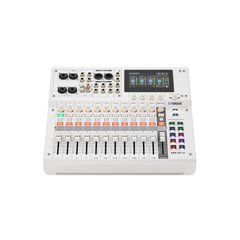
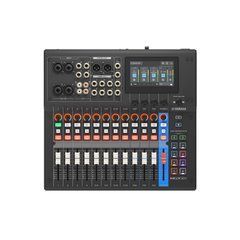
Desktop format, 16–24 inputs (built-in or via stage box). 8–16 motorised faders (one or two layers). Touchscreen or colour display. Built-in Wi-Fi for tablet control. USB for multitrack recording. Some feature on-board I/O (no separate stage box needed). Weight: 5–15 kg.
📊 Specifications
Inputs: 16–24 (mic XLR + line). Outputs: 8–16 (XLR). Buses: 6–16 AUX/bus + Main L/R + matrix. DSP: parametric EQ, compressor, gate per channel. Effects: 4–8 engines. Scenes: 50–100+. Latency: <1 ms. USB multitrack: 16–18 channels.
🎯 Best For
Small to medium events (50–300 people), cafés, bars, houses of worship, corporate events, mobile musicians. The first step up from analogue. Compact — fits on a desk or in a small case. Budget entry to digital mixing.
🔊 Mid-Range (32–48 Channels)
📐 Design
Larger console: 16–24 motorised faders, large display (7"–10"), extended encoders and buttons. I/O via stage box (Dante / AES50): 32–48 inputs, 16–24 outputs. Additional stage boxes for expansion. Built-in or optional Dante/MADI. Weight: 15–35 kg.
📊 Specifications
Processing channels: 32–48. Buses: 16–24 AUX/bus + subgroups + matrix (6–16). Effects: 8–16 engines (studio quality). Graphic EQ: 8–16 bands on outputs. Scenes: 100–500+. DCA/VCA groups: 8–16. Talkback, oscillator, RTA.
🎯 Best For
Medium to large events (300–2,000 people), concert halls, festival stages, theatres, large houses of worship, installations. Enough power for most professional tasks. The sweet spot of capability versus budget.
🏟️ Full-Size Digital Consoles (64–96+ Channels)
📐 Design
Large console: 24–48 motorised faders, multiple large displays. Powerful DSP engine (or multiple). Full any-to-any routing. Redundancy: dual network ports, dual PSU, dual DSP. Stage boxes: 2–8+ (up to 256 I/O). Weight: 40–100+ kg.
📊 Specifications
Processing channels: 64–96+ (up to 256 with expansion). Buses: 24–48 AUX/bus + subgroups + matrix (16–32). Effects: 16–32 engines. 96 kHz processing (some). MADI / Dante / Waves SoundGrid. Snapshots: 500–1,000+. Offline editor. Redundancy at every level.
🎯 Best For
Stadium tours, major festivals, broadcast, Broadway/West End, premium installations. When nothing less than the absolute maximum will do: channel count, processing, redundancy, audio quality. Separate FOH + monitor consoles — standard practice.
📱 Tablet-Controlled Mixers
📐 Design
A stage box or rack module with no physical console — controlled entirely from an iPad / Android tablet / laptop via Wi-Fi or Ethernet. Some feature a minimal physical surface (a few faders + encoder). Stage box weight: 3–10 kg. All DSP runs inside the stage box.
📊 Specifications
Channels: 16–32. I/O: 8–32. DSP: full (EQ, compressor, gate, effects) — processed in the stage box, not the tablet. Wi-Fi router: built-in or external. Wi-Fi latency: <5 ms (affects UI response, not audio). USB multitrack.
🎯 Best For
Mobile musicians, small houses of worship, cafés, corporate events. Minimal gear: stage box on stage + tablet in hand. The engineer walks the room and listens from every seat — adjusts on the spot. The most compact digital mixing option.
🔌 Stage Boxes (Digital Snake)
📐 Design
A remote unit with mic inputs (XLR) and line outputs (XLR). Sits on stage, connects to the mixer via a single Ethernet or fibre cable. Form factors: rack (19", 1U–4U), desktop, or portable. Built-in preamps with remote gain control from the mixer.
📊 Specifications
Inputs: 8–48 XLR (mic with phantom +48 V). Outputs: 4–24 XLR. Protocols: Dante, AES50, MADI, AVB, Waves SoundGrid. Cascading: link multiple stage boxes for expansion (up to 64–256 I/O). Weight: 3–15 kg. Redundancy: dual ports.
🎯 Best For
An essential component of most digital mixers. Replaces the analogue multicore. Benefits: one thin cable, no analogue interference, remote gain control, fast setup. For large events — multiple stage boxes in different zones.
🧠 DSP Processing
🎛️ Channel Processing
Every input channel: HPF/LPF filters, parametric EQ (4–8 bands), compressor, gate/expander, de-esser. All with full parametric control (frequency, Q, gain, attack, release, threshold, ratio, knee). On outputs: graphic EQ (31-band), limiter, alignment delay.
🎵 Built-in Effects
4–16+ effects engines: reverb (hall, plate, room, chamber), delay (mono, stereo, ping-pong), chorus, flanger, phaser, pitch shift, vocal doubler. Emulations of classic studio hardware. Quality rivalling plugins. Routing: insert or internal send/return.
📊 Metering & Analysis
RTA (Real-Time Analyser) on every channel or output. SPL metering. Oscilloscope. Automatic feedback finder. Phase correlation. All on the mixer's screen — no outboard analysers needed.
📶 Networked Audio
| Protocol | Cable | Channels | Latency | Compatibility | Best For |
|---|---|---|---|---|---|
| Dante | Cat5e/Cat6 Ethernet | Up to 512 | 0.15–5 ms | Multi-vendor | Installs, concerts, studios |
| AES50 | Cat5e Ethernet | 48 per port | <0.1 ms | Behringer / Midas | Live sound (Behringer/Midas) |
| MADI | Coax / fibre | 64 | <0.1 ms | Broad | Broadcast, large studios |
| AVB | Cat5e/Cat6 Ethernet | Up to 512 | 0.25–2 ms | IEEE standard | Installs (guaranteed QoS) |
| Waves SoundGrid | Cat5e/Cat6 Ethernet | Up to 128 | <0.8 ms | Waves-compatible | Real-time Waves plugins |
Dante is the most popular protocol: runs on standard Ethernet switches, plug-and-play, compatible across dozens of brands. For most new projects, Dante is the optimal choice.
💾 Scenes, Automation & Integration
💾 Scenes (Snapshots)
Store 50–1,000+ complete snapshots. Recall options: full or selective (safe/recall filters — e.g., keep gain unchanged when switching). Crossfade between scenes (smooth transitions). Offline editor — prepare the show on a laptop at home.
🤖 Automation
DCA/VCA groups (8–24): one fader controls a group of channels (all drums, entire choir, all backing vocals). Mute groups. MIDI integration: sync with DAW, lighting, video. GPIO: triggers for external devices (recording, paging).
🔗 Integration
USB multitrack recording (16–64 channels into a DAW). Virtual soundcheck: record the rehearsal → play back through the mixer without the band on stage → tweak at your leisure. Dante Virtual Soundcard — the computer becomes another node on the Dante network.
📊 Digital Mixer Class Comparison
| Class | Channels | Faders | Stage Box | Network | Best For |
|---|---|---|---|---|---|
| Compact | 16–24 | 8–16 | Built-in or optional | USB, some Dante | Cafés, worship, small events |
| Mid-Range | 32–48 | 16–24 | 1–2 stage boxes | AES50 / Dante | Concerts, theatres, large worship |
| Full-Size | 64–96+ | 24–48 | 2–8+ stage boxes | Dante / MADI | Tours, festivals, broadcast |
| Tablet-Controlled | 16–32 | 0–8 | Built-in (= stage box) | Wi-Fi / USB | Mobile musicians, minimalism |
🎯 How to Choose a Digital Mixing Console
🎤 Mobile Musician / MC
Compact or tablet-controlled, 16 channels. Built-in I/O. Wi-Fi. USB recording. Effects. Lightweight (5–10 kg). Budget entry point. iPad control — convenient without an assistant.
🎸 Band (Medium Events)
Compact or mid-range, 24–32 channels. Stage box on stage. 8+ AUX for monitors (or IEM). Scenes. USB multitrack for concert recording. DCA groups for fast control.
🏟️ Concert Tour
Mid-range or full-size, 48–96+ channels. Dante or MADI. Redundancy. Multiple stage boxes. Separate FOH + monitor consoles. Waves SoundGrid for external plugins. Offline editor.
⛪ House of Worship
Compact or mid-range, 24–32 channels. Scenes per service. Wi-Fi — engineer walks the room. Stage box on stage. USB recording for archives. IEM monitors via AUX. Simple UI (volunteers at the desk).
🎬 Theatre
Mid-range or full-size, 32–64 channels. Scenes with crossfade. MIDI — sync with lighting. Matrix outputs for house zones. Redundancy. Stage boxes in different stage areas.
🏢 Installation
Compact or tablet-controlled. Dante for network infrastructure. Auto-mix for microphones. Zoning. Scheduling. Crestron / Control4 integration. Rack format. "Set it and forget it".
🎙️ Recording Studio
Mid-range or full-size with premium preamps. Dante / MADI for DAW integration. Motorised faders for DAW control (HUI/Mackie Control). Talkback. Room routing (studio / control / iso booth).
📺 Broadcast
Full-size, 48–96+ channels. MADI or Dante. Redundancy at every level. GPIO for triggers. Video-mixer integration (tally, intercom). 5.1/7.1 mixing. Ultra-low latency.
❓ FAQ
Why is a digital mixer better than analogue?
Full DSP per channel, dozens of effects, scenes, compact size, one cable to the stage, remote control. Total system cost is often lower than analogue + effects + multicore.
What is a stage box?
A remote I/O unit on stage connected to the mixer by a single Ethernet cable. Replaces a multicore of dozens of XLRs. Protocols: Dante, AES50, MADI.
Can I control it from a tablet?
Yes — most digital mixers offer Wi-Fi and a dedicated app. Some operate entirely without a physical console — just a stage box plus a tablet.
Dante, AES50, MADI — which to choose?
Dante — most popular, multi-vendor, plug-and-play. AES50 — for Behringer/Midas. MADI — for broadcast and large studios. AVB — for installations with guaranteed QoS.
What are scenes?
A stored snapshot of every mixer parameter. Press a button — instant recall. Perfect for festivals, theatres, houses of worship with different programmes.
Is the switch from analogue hard?
There is a learning curve, but intuitive interfaces and tablet apps reduce it to 1–2 weeks. Most functions are the same (fader, EQ, AUX) — just in digital form.
🏆 Why SoundsGood
Full Selection
Compact, mid-range, full-size
Free Shipping
Orders over ₴4,000
Installment Plans
PrivatBank & monobank
Expert Advice
Matched to your needs
Leading Brands
Wide assortment
Showroom in Kyiv
15 Olzhycha St.
Fast Dispatch
Same day before 3 PM
📞 Contacts
📍 Address
15 Olzhycha St., Kyiv, 04116
Metro: Dorohozhychi
🕐 Hours
Mon–Fri: 11:00 AM – 6:00 PM
Sat–Sun: Closed