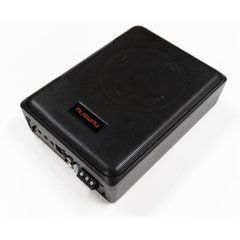
An integrated bass module with a defined purpose
A powered car subwoofer combines its driver, enclosure and amplification in one solution. This simplifies matching the components inside the bass module, but power wiring, signal connection and integration with the main speakers are still required. Choose it for a specific objective: supplement factory speakers, preserve luggage space or add a stronger low-frequency foundation without separately mounting a mono amplifier. Different objectives require different enclosure formats and output capability.
A compact under-seat model and a larger luggage-compartment enclosure do not have identical acoustic potential merely because both are powered. Consider the bass level you expect, available space and normal listening volume. A small module may be a useful compromise when retaining vehicle practicality is the priority. For substantially higher low-frequency output, compare solutions designed for that requirement. An integrated amplifier alone does not guarantee a particular extension or sound-pressure level, so evaluate the complete product rather than its active designation.
Choose a location before choosing the enclosure
Measure the installation space with the seat or luggage floor in every relevant position. Include brackets, connectors, cables and necessary clearance. ETON describes the USB 6 AR as an active under-seat subwoofer, while Ground Zero describes the GZIB 25BR-ACT as a powered vented enclosure. These examples illustrate different placement approaches, but neither description replaces checking fit in the actual vehicle.
Air ducts and factory wiring beneath a seat must not be trapped by the module. Check passenger space, full seat-runner movement and clearance from moving parts. In the luggage area, consider normal cargo and access to the spare wheel. A recess-mounted product must match the recess geometry, not simply a nominal speaker diameter. Mounting must retain the unit in its intended position. Leaving a subwoofer loose on a carpet is not a complete installation, even if it appears stable while the car is parked.
Allow the enclosure and port to work properly
The acoustic alignment is already part of a complete powered system. Do not obstruct a vent or driver surface with luggage. Check port clearance and permitted enclosure orientation against the documentation and actual layout. Turning the enclosure can change its interaction with the cabin, so establish its final position before completing the tuning. Moving the module elsewhere should be followed by another integration check rather than assuming the previous balance remains unchanged.
A slim metal enclosure still needs to dissipate heat from its electronics. Hiding it beneath dense trim or stored items may worsen operating conditions. A protective grille, where provided, does not make the subwoofer a support for heavy cargo. Ensure controls, indicators and connectors remain accessible. If regular removal is planned, define the disconnection and remounting procedure from the outset. Power connections must remain protected and arranged according to the manufacturer's instructions, including when the bass module is temporarily out of the vehicle.
Factory signal integration and turn-on behaviour
A powered subwoofer may accept line-level or speaker-level signals, but available inputs and permitted levels vary by model. Speaker wiring near the proposed location is not proof that it is the correct signal source. A factory channel may have restricted bass or volume-dependent processing. Check the signal that will actually reach the subwoofer before installation. Where required, choose a compatible interface rather than an arbitrary connector adapter.
Test automatic turn-on during ordinary vehicle use: startup, a brief stop, a call and shutdown at the end of a journey. If a separate control wire is required, connect it as specified. The remote level controller and its cable must also match the particular unit. Similar-looking sockets do not guarantee the same electrical arrangement. Place the control where it is accessible without obstructing vehicle controls. Confirm that the driver can reach it normally before deciding on its final mounting point and cable route.
Power supply and integration with the front speakers
The built-in amplifier requires an appropriate supply and protected wiring. A compact subwoofer is not automatically suitable for connection to any convenient power outlet. Select conductor size, fuse and connection points from the model's requirements and installation route. After basic operation is confirmed, adjust sensitivity, low-pass filtering and polarity or phase where provided. Do not begin by turning every bass-related adjustment to its maximum position.
The objective is a coherent combination of main speakers and subwoofer. An excessively high crossover can make the bass module noticeable as a separate source, while poor integration around the crossover can produce an uneven balance. Use familiar recordings with different bass content from the normal driving position. One test excerpt is not sufficient to judge the entire result. Reassess the system at moderate volume after changes and confirm that the everyday level control offers a useful, predictable adjustment range. Record the baseline so comparisons remain controlled rather than becoming a sequence of random changes.
Buying questions and installation handover
Is another amplifier required? The powered module already includes amplification for its own driver. This does not mean that its electronics will also power the door speakers; such outputs would need to be explicitly specified. If the front system is being upgraded at the same time, consider its amplification separately. Draw the complete system first to avoid buying unnecessary equipment or expecting features that the subwoofer does not provide.
What should be checked after installation? Verify secure mounting, unrestricted seat movement, luggage access, freedom from noise and correct startup and shutdown. Listen to the subwoofer together with the front speakers, test its controller and confirm retained vehicle functions. After a longer listening period, check stable operation and adequate cooling. Keep the wiring plan, settings and removal procedure if the module is detachable. The completed installation should provide the intended bass support while preserving everyday vehicle usability. Clarify which connections may be disconnected during normal removal and the required system power state before doing so.
SoundsGood supplies sound equipment for educational institutions, studios, concert halls, conference rooms, and public and private organisations. A technical brief can be used to agree on system components, specifications, a commercial quotation, documentation and delivery arrangements.