


|
Quantity
|
Cost
|
||
|
|
|||
|
|
|||
Cases for wireless audio and personal monitoring systems
A wireless system includes more than its main unit. The working kit may contain handheld or bodypack transmitters, antennas, a power supply, audio leads, mounting parts and small accessories. An in-ear monitoring system also includes a bodypack receiver and earphones. A dedicated bag keeps these components together and separates them from heavier equipment during transport. The right choice still depends on the actual dimensions and contents of your kit.
A description such as wireless system case does not guarantee compatibility with every receiver or transmitter. Compare the internal compartments, equipment shape, protruding parts and accessory space. Distinguish storage and transport from operating equipment inside the bag. Padding alone does not establish that a closed case is suitable for a powered device with connected leads, deployed antennas and its required ventilation clearance.
Three Gator options in this category
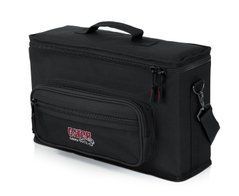
The Gator G-IN EAR SYSTEM is intended for compatible half-rack wireless personal monitoring systems. The manufacturer provides storage for the transmitter, bodypack receiver, earphones and power supply, with top antenna access. This is a useful layout for an IEM kit, but the specific device must still be checked against the main compartment dimensions.
GM-2W is described as a padded bag for two wireless microphone systems, with receiver compartments, two deep microphone spaces and external storage. GM-1WEVAA is a lightweight EVA case for one compatible half-rack wireless system. Choose between these arrangements according to the component count and transport conditions, rather than outside size or brand name alone.
Checking equipment dimensions
Measure width, height and depth in the configuration intended for transport. Feet, controls, connectors and fixed antennas may extend beyond the main housing. Rack mounting brackets can also change the shape. Half-rack is useful for an initial search, but it does not specify one universal equipment depth. The unit should fit without forced compression or lid pressure on its display, knobs or switches.
Gator lists internal dimensions of 8.75 × 8 × 1.71 inches for G-IN EAR SYSTEM and 8.5 × 8.5 × 3.25 inches for GM-2W. Relate these figures to the intended compartments instead of treating them as a promise to accommodate any combination of devices. When equipment is close to a stated limit, verify actual fit, allowing for padding, body shape and normal closure of the bag.
Microphone systems and IEM systems carry different parts
In a wireless microphone system, the stationary unit typically receives the signal while a handheld microphone or bodypack sends it. In wireless personal monitoring, the base unit transmits audio to a bodypack receiver. The associated parts consequently differ: microphone capsules, lavaliers, earphones, leads and power components. A similar base-unit shape is not enough to determine the most useful compartment arrangement.
List every item that must travel together. For handheld transmitters, check length and diameter with the installed capsule. For bodypacks, include belt clips, antennas and earphone or headset connections. A small device should not simply be pushed into any remaining gap. Protruding parts need clearance and protection from pressure caused by neighbouring components, particularly when the bag is carried on its side.
Antennas and connected cables during transport
An antenna or coaxial connector should not support the weight of the unit or press against the lid. If the equipment design calls for removing an antenna during transport, follow its instructions and store the part appropriately. Fixed elements need sufficient clearance. Pulling a zip closed with force is not a valid fit test; it may conceal pressure on a vulnerable component.
Connected plugs increase the required depth and can transfer leverage to equipment sockets. Assess the travel and operating configurations separately. Leaving cables connected is convenient only when the case design and available space support it. Each lead needs a gentle exit without tension. Surplus loops should not push against controls, antenna mounts or adjacent connections, even when the bag is closed and moved.
Operating equipment inside a bag
Live-in operation must be established for the specific bag and equipment. Check access to front and rear panels, antennas, indicators and ventilation areas. An antenna opening alone does not define all operating conditions. If required surfaces remain covered by padding, connection access may be awkward or the arrangement may conflict with the equipment placement requirements. Follow both sets of instructions.
Before the first event, assemble the working configuration on a table. Confirm that settings can be changed, indicators are visible and power connects without strain. Then carry out the normal wireless check at the venue. A case does not increase system range or replace suitable antenna placement and frequency setup. Its purpose is to organise and protect the kit without introducing new obstacles to operation.
Soft bags, EVA cases and transport conditions
A padded soft bag is convenient for hand carrying and local trips. EVA construction gives shape and separation from surrounding objects according to its particular design. Neither general description proves waterproofing, resistance to every drop or suitability for heavy loudspeakers stacked on top. Those properties require specific manufacturer information rather than assumptions based on a rugged appearance or a familiar brand.
Consider the actual journey: a personal car, shared loading area, repeated transfers or carrying on foot. Total packed weight, handle comfort and shoulder strap arrangement matter alongside dimensions. When stands and heavy cable reels share the vehicle, organise the load so they cannot press on the wireless equipment. Interior padding cannot compensate for poor packing of the whole load or turn a soft bag into a rigid freight container.
Power supplies, batteries and accessories
Store the adapter so its body and plugs cannot rub a display or microphone grille. Label it with the associated equipment model because similar-looking supplies may have different electrical specifications. Coil its lead without a sharp bend at the entry. With several systems, clear identification helps prevent the wrong adapter being connected during a hurried setup and keeps the original combinations easy to restore.
Separate spare batteries, rechargeable packs, adapters and clips by purpose. Charged and used cells should be easy to distinguish. For long-term storage, follow the device and battery instructions. An external pocket does not establish suitability for every storage condition; its purpose and the way contents are packed still matter. Small metal accessories should not move freely against sensitive components of the system.
Earphones and personal monitoring kits
In-ear monitors need their own organised space within the larger kit. Do not place them beneath a power supply or bodypack where their cable and housings can be compressed. Tips, cleaning accessories and spare small parts should be available without dismantling the whole bag. Separate clean and used items according to the earphone manufacturer's care guidance, rather than treating every pocket as interchangeable storage.
If several musicians share the base system, identify personal components. The equipment bag should not become a place where individual earphones and other users' tips are mixed together. Before packing, check each performer's receiver, earphones, required lead and power provision. A component list is more reliable than the visual impression that all compartments are occupied by something.
Checks before departure and after return
Before travel, compare the contents with the equipment list and inspect zips, handles, straps and device placement. The case should close without force on protruding parts. After returning, check leads and connectors, separate items needing care and record any faults. Prepare damp equipment appropriately before long-term storage. The next job then starts from a known condition rather than rediscovering problems that were left inside the bag.
A selection example for two presenters
For an event with two handheld wireless microphones, first establish whether the system uses one dual-channel receiver or two separate units. Those arrangements can require different main compartment shapes despite having the same microphone count. Add both transmitters with capsules, the correct supplies and output leads. Decide where spare batteries belong and how channels are identified, then compare the complete kit with the bag. A two-system label is useful, but it does not replace checking the actual configuration.
Frequently asked questions
Does half-rack mean every system will fit? No. Check internal dimensions, protrusions and all the kit contents.
Can antennas remain attached? Only when sufficient clearance and the equipment and bag instructions support that arrangement.
Does a nylon bag protect against rain? The material name does not establish waterproofing. Look for a specific stated property of the product.
What information is needed for selection? Provide the component models and dimensions, system count, accessories and expected transport conditions.