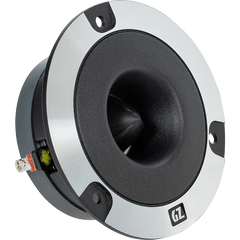
The tweeter's role and expectations for replacement
A tweeter handles the high-frequency portion of a car speaker system. Select it together with the other drivers and the method of dividing frequency bands. Before replacement, define the task: repairing a failed component, upgrading factory speakers or creating a new system. These situations require different solutions. If one side is quieter, establish the fault first instead of buying an arbitrary pair based on external size.
More tweeters do not independently guarantee better balance. What matters is how they work with the main speakers and listening positions. Do not judge a tweeter in isolation solely by loudness: compare it within the planned system using familiar recordings. Write down the change you want so selection does not become a search for the brightest demonstration unrelated to everyday listening.
Construction and mounting dimensions: read the complete specification
This category includes designs with different purposes and installation requirements. Ground Zero describes GZCT 3500XII, for example, as an aluminium-dome compression tweeter. It is not a universal replacement for every factory high-frequency driver. Match the construction to your system objective, permitted mounting position and documentation for the exact part number. A material designation alone cannot predict the complete result inside the cabin.
Distinguish dome size, outside cabinet diameter, mounting cutout and installation depth. When matching a factory position, check each dimension, the fixings and terminal clearance. Consider the grille and surrounding trim. If a mounting cup or another adapter is required, confirm compatibility and package contents. Do not order solely because a product says one inch: that does not mean every installation dimension is one inch.
Filtering and crossover compatibility
A tweeter requires the filtering arrangement specified by its manufacturer. Check crossover frequency, slope and permitted operating conditions in the particular model's documentation. The lower limit of an advertised frequency range is not automatically a ready-made crossover setting. Similarly, a power figure must be read together with the conditions under which it is specified. Do not connect a tweeter as a full-range speaker even for a brief test.
When replacing a component within an existing set, establish whether its passive crossover is suitable for the new model. Matching nominal impedance is not sufficient: the package must be coordinated as a system. Active division requires an appropriate processor output and amplifier channel. The installer should check routing and initial settings before playback. Save the working configuration so a restart or profile change does not remove the required filtering.
Placement, aiming and cabin balance
Plan the installation position before permanent fixing. Assess the left and right tweeter locations relative to the listener, grilles and surrounding surfaces together. Check available options against manufacturer instructions and vehicle construction. Do not choose an angle solely for visual symmetry: judge the intended balance from the actual listening position. Include other seats in the assessment if they matter to your use.
Keep the recording and level unchanged when comparing positions. Listen to voices, cymbals and other familiar high-frequency details without compensating for every difference by raising volume. Establish suitable placement first, then coordinate levels and other system parameters. Final mounting must leave factory mechanisms unobstructed and meet vehicle requirements. Installation practicality and correctness can constrain selection more than promotional specifications do.
Connection, testing and servicing
Before installation, compare markings, terminal condition and package completeness for both drivers. Check the connection method: a particular model may require soldering or a matching connector. Arrange connections without strain or contact with moving parts. Preserve channel identification in the diagram. When replacing a failed component, investigate the cause of the previous damage as well, so the new part does not face the same unsuitable operating conditions.
Perform the first check at a low level after confirming filtering. Test each channel, then listen to the complete system. Check for level differences, interruptions, unwanted sounds or mechanical rattles. If a problem appears, record the conditions and give them to the installer. Do not address a suspicious symptom by changing every setting randomly. Sequential checks help distinguish an installation problem from a signal or component characteristic.
Keep the exact part number, filtering diagram and installation photograph for future servicing. If the package includes high-frequency level adjustment, record its working position. Return to that position for later comparisons instead of judging a new component under accidentally altered conditions. Changing decorative trim or moving a tweeter also warrants another check because the installation conditions, not merely the cabin appearance, have changed.
Questions about car tweeters
Can I add a tweeter to coaxial speakers? That is not a universal upgrade method. First establish a plan for frequency division, load and level matching. An additional high-frequency section should perform a defined task rather than simply duplicate an existing one.
Will any capacitor work as a filter? No. An arbitrary component is not a validated solution. Use the parameters and arrangement specified for the particular driver and system, following documentation or the installer's design.
Should I replace only one driver? For a repair, confirm the availability of an exact replacement and the condition of the other side. If changing models, assess the matching of the pair and the remaining system. Visual similarity does not confirm identical characteristics.
What information helps with selection? Provide the exact vehicle, existing speaker and amplifier models, crossover or DSP information, mounting measurements and photographs. State whether the task is a repair, factory upgrade or new project and describe the result you expect.
SoundsGood supplies sound equipment for educational institutions, studios, concert halls, conference rooms, and public and private organisations. A technical brief can be used to agree on system components, specifications, a commercial quotation, documentation and delivery arrangements.