Prepare the instrument details, a description of the endpin tip, the floor type and the conditions in which you practise. For a strap system, include the chair it will be used with. Discuss a child's setup with the teacher. For a stage or hired room, check the venue's floor requirements. Successful use at home does not remove the need for a trial elsewhere.
How to choose floor protection and an endpin stop
Tip covers and separate stops
A cover fitted to the endpin and a support placed on the floor require different compatibility checks. For the cover, identify the relevant tip or connection. For a separate stop, assess the contact with both endpin and floor. Do not treat them as interchangeable spare parts. A clear photograph of the existing tip helps explain what the new accessory must accommodate.
Do not assume every rubber component is appropriate for every surface. Check the stated purpose and condition of the particular item. If a cover is lost, identify its system rather than choosing the first similar looking part. A rod slipping inside its fitting is a different problem: a floor stop does not replace having that mechanism inspected by a technician.
A compact support on the floor
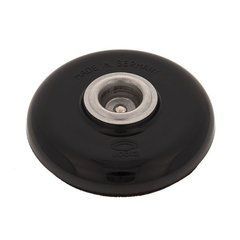
The manufacturer describes the Dycem Black Hole Cello Mat as a compact non-slip cello support that helps protect the floor. It illustrates an accessory for the endpin's contact with the surface. Check the actual fit and result on your floor rather than turning a general product description into a guarantee for every situation.
A small separate stop lets the player choose its position, but decide that position before the music begins. Check the normal seated setup and play a short phrase. If you repeatedly pull the instrument back or change your body position to suit the accessory, discuss the arrangement with the teacher. The stop should support the intended playing position rather than dictate an accidental one.
A strap used with the chair
The GEWA 415.315 has a chair-leg strap, length adjustment and a rubber underside on the endpin holder. This arrangement differs from a freely placed floor stop. Selection therefore includes the chair and the manufacturer's fitting method as well as the instrument.
Read the instructions and check whether the chair allows the system to be positioned correctly. Do not presume that every leg arrangement is equally suitable. After adjustment, consider access to the seat and the normal sequence for standing up. Plan how to move the setup rather than relocating it casually with the instrument in place. Rehearse the sequence without rushing.
Compatibility checklist
| Parameter | What to check |
|---|
| Tip | A cap for the specific endpin tip or fitting. |
| Floor stop | Endpin fit and performance on the actual floor. |
| Strap system | Compatible chair, length adjustment and attachment method. |
| Stand | A separate task: supporting the instrument during a break. |
A stand for a break is a different product
The word support can refer either to an endpin stop or to a stand for the whole instrument. For example, the Hercules DS580B is a cello stand with a pegbox holding system. Its purpose differs from supporting the endpin during playing. Specify the task before comparing offers.
To park an instrument during a break, check the stand's intended application, contact points and instructions. An endpin stop does not become a suitable stand simply because it holds the tip in place. Conversely, buying a stand does not resolve floor protection during performance. Separate the two requirements and assess the products against the conditions of each use.
Testing in a practice room
Inspect the accessory and the place where it will be used. Follow the manufacturer's surface and care requirements. Set the instrument in its usual position and make a short trial before a long practice session. If compatibility with a delicate finish is unclear, establish that before regular use. A good result in another room is not a universal test.
Do not glue the stop down with an unrelated adhesive or alter its surface following an unverified tip. If it slides, review installation, tip compatibility, product condition and the surface requirements. Do not compensate with an awkward playing position throughout the session. Show the complete combination to the teacher if necessary and reconsider the accessory for those conditions.
Lessons and shared instruments
At a music school, label a personal stop and choose a storage place. Recheck the working position when an instrument passes to another pupil. A strap system may need a different setting with another chair. Do not leave a child to guess how an unfamiliar product attaches immediately before the lesson. Demonstrate the normal preparation sequence in advance.
For shared equipment, agree who checks its condition and gathers it after classes. Keep items needing inspection or replacement separate from ready spares. When ordering for a group, list the actual instruments and conditions rather than buying identical accessories solely by the number of pupils. A small record of each setup makes later replacement decisions easier.
Ensemble rehearsals and unfamiliar stages
Consider nearby chairs, music stands and walkways. A strap or the edge of a support should not accidentally occupy another player's normal route. Agree the layout and try the setup. After furniture is moved, repeat the brief check instead of assuming the previous arrangement is unchanged. This is particularly useful when several groups share a rehearsal room or stage.
Confirm venue requirements before the performance and bring the familiar accessory with the instrument. Allow time to assess the actual surface during preparation. If there is a problem, discuss the placement before the number starts. Do not rely on correcting it while playing by continually repositioning the instrument or changing posture between phrases.
Using a support with double bass
Do not transfer a cello recommendation to double bass without checking the particular product's intended use. Explain whether you play standing or seated, which tip is fitted and how the bass is positioned. A catalogue section covering both instruments does not make every item suitable for both. Check the application and complete configuration before selecting a model.
Distinguish a transport wheel from a playing support. After travel, restore the intended playing configuration and check its floor contact. For an amplified instrument, make sure the cable is not trapped under the stop or obstructing normal placement. These practical arrangements should be resolved before the music rather than corrected during a performance.
Care and packing
Use the guidance for your particular model. Different materials should not all receive the same solvent, lubricant or household treatment. Similar colour does not make care instructions interchangeable. Inspect the endpin contact area and underside. If the item is damaged, clarify whether it can continue in use before the next rehearsal rather than attempting to restore grip with an improvised treatment.
Give the removed stop its own compartment so it cannot contact varnish or disappear among sheet music. Fold a strap as directed and avoid trapping it under other items. Retain the packaging or reference for a repeat purchase. Verify the current contents, availability and price of the actual version. Product examples in a guide are not promises about the shop's current stock.
Is an endpin stop the same as a rubber tip?
No. A tip fits the relevant endpin component, while a separate stop is placed on the floor. Check the purpose and compatibility of the particular product rather than choosing by material alone.
Will a chair strap work with any chair?
Check the instructions against the actual chair construction. Before the lesson, confirm the attachment method, required length range and convenience of the normal preparation sequence.
Can I leave the instrument on an endpin stop?
A stop beneath the tip is not a stand for a break. Supporting an instrument without the player requires a product intended for that purpose and compatible with the instrument.
What if the support slides?
Review installation, the surface, product condition and the tip. Do not compensate by playing awkwardly or applying an unrelated adhesive. Discuss the complete arrangement with the teacher if the result is uncertain.
Can a cello model be used for double bass?
Only when the particular product is suitable for that application and setup. A shared catalogue category does not make every item universal. Explain the instrument and playing conditions before selection.
What information helps when ordering?
Provide instrument, tip, floor type and intended use. Add chair details for a strap system. For replacement of an existing stop, include its reference or a clear photograph.