





|
Quantity
|
Cost
|
||
|
|
|||
|
|
|||
Connecting a power amplifier to a passive speaker
Speaker cable carries the output of a power amplifier to a passive loudspeaker. Selection depends on electrical properties, length, connectors and operating conditions. Home hi-fi benefits from convenient terminal connections; stage systems need practical handling and dependable assembly; permanent installations require a cable suited to the planned route. A single construction is not necessarily equally convenient for every application or installation method.
Begin with the amplifier and loudspeaker models and their documented connection arrangement. Establish whether the system uses a conventional low-impedance connection or another supported configuration. An active speaker already includes amplification, so its line input normally requires an appropriate signal cable. The presence of a loudspeaker does not mean every connection to that product uses speaker wire. Check the purpose of the specific input before ordering.
Why instrument cable is different
A connection from an instrument or mixer to a signal input performs a different task from the power-amplifier-to-speaker path. Similar jack plugs do not make the cables interchangeable. Check the purpose of both the cable and equipment socket. Yamaha's PA cable guide identifies dedicated speaker cable for passive loudspeaker connections. Physical connector compatibility does not replace this distinction.
Label different cable types clearly when preparing a stage kit. This is particularly useful for guitar amplifiers with separate cabinets and equipment using outwardly similar sockets. Do not choose a lead solely because its plug fits. A documented arrangement and readable labels reduce errors during a fast setup, when staff may have little time to examine small markings on every lead and connector.
Conductor area, core count and overall diameter
A designation such as 2 × 2.5 mm² describes two conductors, each with that nominal cross-sectional area. It is neither the overall cable diameter nor the combined area of both conductors. External diameter also depends on insulation and jacket construction. That measurement matters for connector clamps, conduits and handling. Electrical and mechanical properties therefore need separate checks, even when a short product title appears detailed.
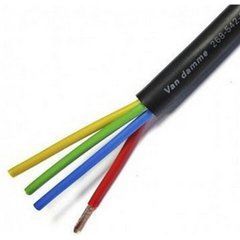
A four-core cable can serve a documented multichannel or specialised arrangement, but the number of cores does not define the wiring automatically. Both ends must follow the agreed pin assignment. Do not combine conductors arbitrarily or transfer a familiar layout to a different loudspeaker without checking. When replacing an assembly, record every contact and its function, not merely the length and general connector name.
Length and conductor resistance
A longer run has greater resistance when the conductor construction remains the same. Increasing the area of the same material helps reduce resistance, but selection is more useful than a rule that the thickest cable is always best. Consider distance, load, acceptable loss and terminal compatibility. Published cable resistance and amplifier guidance provide a better basis than promising one conductor size for every system.
Distinguish the resistance of a single conductor from the complete loop to the loudspeaker and back. A value in ohms per kilometre cannot be compared directly with loop resistance per metre without aligning units and definitions. QED explains loop resistance separately. Use the same basis when comparing specifications so a difference in notation is not mistaken for a difference in performance.
Conductor material and meaningful specifications
Check conductor material in the specification, particularly when comparing price ranges. Equal nominal sizes made from different materials do not guarantee equal resistance. A promotional name is not a substitute for measurable properties. Resistance, conductor construction, jacket and operating conditions are useful comparison points. Avoid assuming automatic improvements in bass or imaging simply from a brand, insulation colour or apparently substantial outer jacket.
Stranded conductors make flexible connections practical, but their ends need careful preparation. All strands must enter the intended termination instead of reaching adjacent contacts. Choose the termination method according to the terminal and equipment instructions. Where systems are frequently rearranged, a tested finished assembly may be more practical than repeated stripping on site. Its plugs and pin assignment must still match the actual installation.
Terminals, connectors and mechanical fit
Domestic equipment may provide terminals for bare wire, banana plugs or spades, while professional loudspeakers often use dedicated locking connectors. The equipment determines the appropriate choice. Check contact count, pin assignment, permitted conductor size and jacket diameter. A cable that suits the electrical task may not fit a particular connector clamp. Excessive compression or improvised housing modification is not a proper way to resolve incompatible dimensions.
Use the documentation for the exact connector, such as Neutrik speakON NL4FXX-W-L, when assembling professional leads. Appearance alone cannot establish the actual wiring. After assembly, verify contact assignments, absence of shorts and jacket retention. Strain relief must do its intended job so cable movement does not act directly on electrical terminations. Careful assembly also improves future service access.
Finished assemblies or bulk cable
A terminated cable is convenient when the length and plugs are known and equipment needs connecting promptly. Check whether the listing covers one cable or a pair, which terminations are installed and how channels are labelled. This avoids an incomplete domestic stereo set. Rental work also benefits from repeatable lengths and readable identification, allowing staff to assemble consistent kits without measuring every lead again.
Bulk cable lets the length follow the real route and permits suitable termination choices. Include connectors, assembly and testing in the cost. Measure the actual path, including bends and service access, before cutting. Avoid unnecessary excess without leaving a tight connection between devices. A practical allowance comes from the installation and required equipment movement, not simply rounding the measurement to a convenient number.
Stage handling and permanent installation jackets
Mobile systems benefit from flexibility, manageable coiling and construction suited to repeated handling within the stated conditions. Concealed installation calls for checking the jacket properties and documentation for the exact cable. An LSZH label does not automatically mean water resistance, sunlight resistance or suitability for every installation method. Compare route requirements with the project specification and product documentation rather than relying on a general material label.
QED offers distinct variants, including QX16/2 and QX16/4 LSZH. This illustrates why an exact version matters more than the family name alone. A similar-looking indoor cable should not be treated as an outdoor product without confirmation. In circulation areas, arrange the route so it does not obstruct people or become trapped under equipment. Installation should preserve the mechanical integrity of the connection.
Comparing VDC series and other options
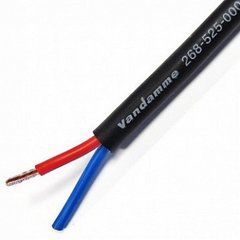
The range includes different conductor areas and core counts. For VDC/Van Damme, the Black Speaker Series specification lets you match an exact product code to construction, external size and resistance. This supports both electrical selection and connector-housing compatibility. A shortened listing title may omit important distinctions, especially where several closely related codes appear in one series.
Compare relevant properties using consistent units. A short home connection and a long stage run can have different priorities. Calculate the price of the complete required length, including terminations and labour if the assembly is unfinished. Do not transfer specifications from a neighbouring product code. Retain the exact reference for repeat orders so the same construction can be selected instead of a merely similar name.
Polarity, commissioning and maintenance
Follow the equipment wiring diagrams, observing polarity and channel assignments. Carry out the documented shutdown procedure before changing connections. Ensure exposed strands do not touch neighbouring contacts or enclosure parts where that is not intended. After installation, start at a moderate level and confirm that both speakers operate on the correct channels without interruptions. An unverified assembly should not receive its first test at full output.
Inspect plugs, clamps and cable sections near the terminations periodically. Set damaged cables aside for examination instead of keeping them in an accidental working position. For permanent systems, retain the diagram, product references and lengths; for mobile kits, maintain labels and compatible spares. This makes restoration possible without changing the complete system or rediscovering the required wiring at an inconvenient moment.
Questions that help with selection
Can an instrument jack lead be used? Do not substitute it for dedicated speaker cable between a power amplifier and a passive loudspeaker.
Which conductor size is best? It depends on run length, load, acceptable losses and the capabilities of the terminals and connectors.
What does an active speaker require? Its line input needs the appropriate signal connection specified for that equipment, rather than an assumed speaker-level feed.
What information should accompany an enquiry? Provide amplifier and loudspeaker models, route distance, terminal types, channel arrangement and operating conditions.