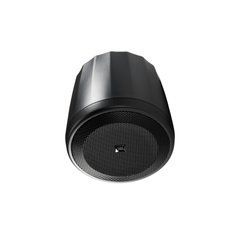
Start with the room's intended use
Installation speakers are intended to remain in a defined space. They are selected together with mounting, cabling, amplification and controls. A shop may need quiet background music, a classroom may reproduce speech and video, and a restaurant may need different levels in several areas. There is no single specification that suits all these tasks, even when the floor areas are identical.
Begin with a description of everyday operation. Who switches the system on, which sources are used, are announcements needed, and does the room's purpose change during the day? A café with quiet music and evening performances needs both scenarios checked. Designing only for background operation may leave insufficient event headroom. Designing only for concerts may make daily control unnecessarily complicated.
Information to prepare before selection
Provide a plan with dimensions, ceiling height, partitions, furniture and working positions. Mark suitable mounting surfaces, available ceiling void space, equipment locations and possible cable routes. Photographs help explain restrictions but do not replace accurate measurements. For refurbishment, include a list of existing speakers, amplifiers, cables and control panels.
Describe normal background noise and where people will be positioned. Ventilation, coffee equipment, open doors and production processes can affect the required level and intelligibility. Increasing volume is not always the best response to noise. Moving speakers closer to the listening area or changing their aiming may be more appropriate. Complex conditions justify a site survey before the final order.
Surface-mounted, ceiling, pendant and recessed options
Wall-mounted speakers are useful when sound must be directed towards a particular area or there is no suitable suspended ceiling. Ceiling models distribute sound above the audience and reduce visual prominence. Pendant enclosures can suit tall open spaces. Recessed products require checks of mounting depth, supporting material and maintenance access. Choose the format around the installation conditions rather than grille appearance alone.
Column and horn systems have their own applications. A slender column may help deliver directional speech, while horn loudspeakers are often considered for announcements over large or noisy areas. Designs and operating bandwidths differ, however. Check the particular model's capabilities if music quality matters. Similar-looking enclosures do not establish equivalent sound or intended use.
Low-impedance connections and distributed lines
A low-impedance system requires coordination of speaker impedance, connection topology and the amplifier's supported load. It may suit a separate room with a small number of cabinets. Distributed installations often use 70- or 100-volt speaker lines with compatible transformer-equipped loudspeakers. These figures describe an audio distribution system, not permission to connect a speaker to domestic mains electricity.
Not every model supports both connection methods. Where a mode or power-tap selector is fitted, set it according to the design and instructions. A low-impedance input must not be substituted arbitrarily for the transformer input on a distributed line. During an upgrade, inspect the actual settings and wiring at each enclosure. An old equipment schedule may no longer describe the installation as it stands.
Line power and future expansion
For a distributed system, account for the sum of the selected power taps on all connected speakers. Ten loudspeakers set to 6 watts, for example, represent a nominal total of 60 watts on a correctly matched line. This is an arithmetic example rather than a complete amplifier recommendation. The design must also allow for operating conditions, specified reserve and manufacturer guidance.
Decide before purchase whether additional rooms, a terrace or new working areas are likely. Expansion needs spare channels, inputs and cable routes as well as power capacity. There is no reason to overspecify every parameter without limit. Compare realistic expansion plans with the budget, preserving access to equipment and clear documentation for later changes.
Speaker distribution and consistent listening levels
Placement determines how much the sound changes between positions. Widely spaced loud speakers may produce excessive levels nearby and weak coverage farther away. More appropriately positioned speakers at moderate levels can sometimes provide greater comfort, but their number needs justification. Ceiling height, dispersion and listener position influence the required spacing.
Manufacturer-supported calculation tools can assist preliminary planning. Their results depend on the dimensions entered and the selected model. Do not treat a nominal coverage angle as a precise boundary of equal audibility at every frequency. After installation, check transitions between zones, positions beneath speakers and distant corners with speech and representative music.
Zones, sources and staff controls
A zone is an area that needs a defined system behaviour. Two rooms may share music at different levels or need entirely different sources. These requirements call for different amplifier, matrix and control-panel capabilities. Multiple output connectors do not always provide independent source selection. Describe the desired behaviour in everyday language before choosing equipment.
Daily users benefit from clear labels and only the controls they need. Agree on who may change volume, sources and system settings. A wall volume control must suit the system type and load; an arbitrary electrical control is not a universal substitute. If control relies on a network, consider staff access and how operation continues when the usual control device is unavailable.
Speech, announcements and conferencing
Announcements need to remain intelligible in the required areas without being masked by music. Microphone priority or automatic background attenuation may be needed where supported. Establish who makes announcements, from which position and whether they should reach every zone. A microphone input alone does not establish the required zone-selection logic.
In a meeting room, distinguish local playback, reinforcement of a speaker in the room and sound from remote participants. Loudspeakers alone do not provide microphone capture or acoustic echo cancellation for online meetings. They must be integrated with the complete conferencing system. Background music equipment should not automatically be considered suitable for specialised emergency voice systems either; those applications require a separate design and requirements assessment.
Musical balance and adding a subwoofer
Background sound should remain comfortable and balanced at moderate levels. Excessive bass in a restaurant or shop may interfere with conversation and travel into neighbouring rooms. If a fuller musical programme is required, assess provision for a subwoofer. It must be integrated with the main speakers, amplification and filtering rather than connected to an arbitrary spare output.
Agree on the bass enclosure's location before finishing work begins. Concealment must not obstruct drivers, ports or cooling. Check the result throughout the room and in adjoining zones. A level that sounds appropriate beside the controls may be excessive near a wall or insufficient elsewhere. Listening at several positions helps avoid commissioning the system around one unusually favourable location.
Environmental conditions and mounting restrictions
For terraces, exposed areas and humid rooms, verify the particular model's permitted operating conditions. Installation does not mean universal resistance to rain, sunlight or corrosion. Cable entries, brackets and their suitability for the environment also matter. Approved mounting orientation may affect protection, so do not change it contrary to the instructions.
A suspended ceiling, wall and structural support present different mounting requirements. Account for weight, specified supports and inspection access. Professional installation is needed where equipment is positioned above people or mounting requires specialist assessment. An included bracket does not establish the suitability of every wall. Agree on installation responsibilities so that the supporting surface and equipment are both properly addressed.
Cable routes and maintenance access
Plan cabling before refurbishment is finished. Length, conductor size, routing and site requirements must match the design. Leave clear labels at both ends and accessible service points. Do not conceal undocumented unknown connections. When replacing equipment, check existing lines first so that a new amplifier is not connected to an unverified load.
Equipment in a cupboard or rack needs access and the cooling conditions specified by its manufacturer. Establish who will maintain the system and how faults will be reported after handover. Prepare a short staff check covering power, selected source and the required zone's level. Settings affecting the complete installation should be handed to the responsible technician together with the documentation.
Accepting the finished system
At handover, test every source, zone, panel and operating mode in realistic scenarios. Listen to speech and music from working positions rather than only beside the equipment. Confirm that labels match the actual rooms and staff can perform everyday operations. Retain settings, the device schedule, connection drawings and test results. These make maintenance and expansion easier without requiring the whole installation to be investigated again.
Total cost and phased implementation
Compare quotations on an equivalent scope of work. Loudspeaker prices do not automatically include amplification, connections, cables, mounting, configuration or staff training. A site remaining open during refurbishment also needs an agreed schedule and workable stages by area. Decide what must be ready initially and which functions can be added later without dismantling installed equipment.
Ask for the supplied components, their individual purposes and each party's responsibilities to be documented. Two clear system proposals are easier to compare than separate speaker lists with different amounts of unlisted work. With a limited budget, discuss priority zones and applications while preserving a sound basic design. Postponing an additional source may be more practical than economising on necessary mounting or verification of the cable network.
For continuing operation, keep service contacts, equipment documentation and a backup of settings. Reassess coverage and control usability after changes to the layout, furniture or room purpose. The installation should reflect how the premises actually operate. Significant alterations are therefore a reason to check the system again even when every device remains functional.
SoundsGood supplies sound equipment for educational institutions, studios, concert halls, conference rooms, and public and private organisations. A technical brief can be used to agree on system components, specifications, a commercial quotation, documentation and delivery arrangements.