


|
Quantity
|
Cost
|
||
|
|
|||
|
|
|||
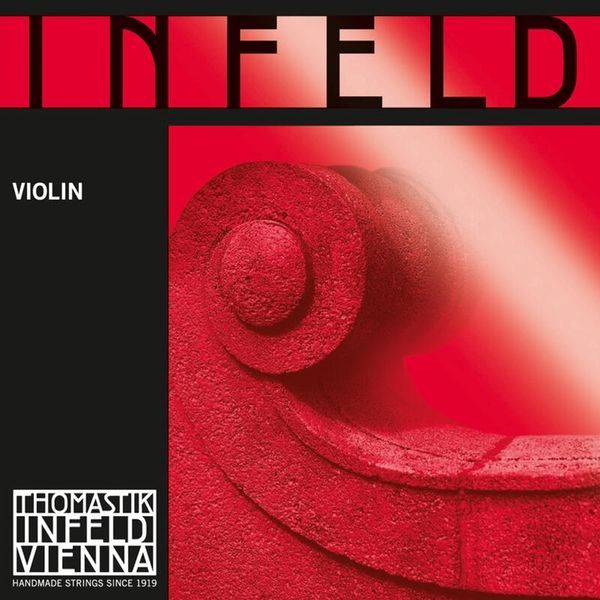
Set of Thomastik Infeld Red 4/4 violin strings
Infeld Red is the red branch of the Infeld system, and the maker leaves no room for interpretation: "Infeld Red stands for a warmer and broader sound while Infeld Blue represents a more focused and brilliant sound". Set IR100 exists in one configuration only — 4/4, medium gauge, 32.5 cm vibrating length. The E is the special one here: gold-plated stainless steel with a removable ball end and a nickel ferrule at 8.0 kp; A and D are hydronalium over a composite core at 5.5 and 4.6 kp; the G is silver over composite at 4.7 kp. That totals 22.8 kp, and the whole difference from the blue set sits in the bottom voice. This is the choice when you want warmth and breadth instead of edge — above all on an instrument that is bright to begin with.

🏆 SoundsGood — genuine Thomastik-Infeld strings only, made in Vienna.
Where the 22.8 kp Go
The steps between voices are held tight: 8.0 kp on the E, 5.5 on the A, 4.6 on the D and 4.7 kp on the G. Look at that fourth string — it is the only place where Thomastik specifies more than in Infeld Blue: 4.7 against 4.6 kp. A tenth of a kilopond is not something you weigh by ear, but under the bow it is real support: the G takes pressure in the lower positions better and does not deflate at forte, while the set as a whole stays moderate on the bridge at 22.8 kp.
Gold Over Stainless Steel
The IR01 E is a stainless steel monofilament with gold plating, not a wound string: plating adds no diameter, so the whole benefit lands on the surface. Gold does not oxidise, so the string does not dull from perspiration and holds its original colour longer — most noticeable precisely on the E, the string that fingers and bow punish hardest. The ball end is removable and the ferrule is nickel, so the same string serves a ball-end tailpiece and a loop-end fine tuner.
The Warmer Branch — and Free Mixing With Blue
Of the system as a whole Thomastik writes: "State of the art synthetic core strings with perfectly matched tensions enable customization of sound covering the entire tonal spectrum". Put into figures: Red and Blue share E, A and D tensions (8.0 / 5.5 / 4.6 kp) and differ by 0.1 kp on the G, which means the set can be rebuilt one string at a time without changing the load on the instrument. The most common route is to keep the warm Red on D and G and try Blue on the upper voices when more focus is wanted.
Specifications
| Purpose | Violin string set |
| Line | Infeld Red |
| Size | 4/4 (the line's only size) |
| Gauge | medium (mittel) — the line's only gauge |
| Core | E — stainless steel; A, D, G — composite (synthetic) |
| E string | Gold-plated stainless steel, removable ball end, 8.0 kp (17.6 lb), art. IR01 |
| A string | Hydronalium wound over composite, ball end, 5.5 kp (12.1 lb), art. IR02 |
| D string | Hydronalium wound over composite, ball end, 4.6 kp (10.1 lb), art. IR03 |
| G string | Silver wound over composite, ball end, 4.7 kp (10.4 lb), art. IR04 |
| Total tension | 22.8 kp (50.2 lb) |
| Vibrating length | 32.5 cm (12.8") |
| Thomastik article | IR100 |
| Included | 4 strings (IR01–IR04), each in its own branded pack marked with the article number |
| Country of Manufacture | Austria — developed and produced in Vienna (Thomastik-Infeld, since 1919) |
What's Included
The pack holds four strings — E (IR01), A (IR02), D (IR03) and G (IR04) — each in its own branded Thomastik envelope marked with the article number. It covers a complete restring with no single strings to add.
Who It's For
A set for the owner of a bright, ringing instrument who needs warmth and body; for the violinist doing a lot of solo and chamber work who wants a broader tone; and for the player who already knows the gold-plated IR01 E and wants the whole set built around it.
Frequently Asked Questions
What exactly is in set IR100?
Four 4/4 strings in medium gauge: a gold-plated stainless steel E with a removable ball end (8.0 kp, IR01), a hydronalium-wound A over composite (5.5 kp, IR02), a hydronalium-wound D (4.6 kp, IR03) and a silver-wound G (4.7 kp, IR04).
Why is the E in this set gold-plated?
The gold sits on stainless steel as a plating — it does not oxidise or dull from perspiration, so the E stays closer to how it sounded on day one. Its ball end is removable and the ferrule is nickel, so the string also suits a loop-end fine tuner.
What is the total tension, and is there a gauge choice?
22.8 kp (50.2 lb) in total at a 32.5 cm vibrating length. There is nothing to choose: Infeld Red is produced in medium gauge only and in 4/4 only.
What is the difference between Infeld Red and Infeld Blue?
The maker describes Red as the warmer and broader sound and Blue as the more focused and brilliant one. In figures the difference shows up in two places only: the E plating (gold versus tin) and the G tension — 4.7 kp on Red against 4.6 kp on Blue, hence 22.8 kp versus 22.7 kp in total.
Can the individual strings of this set be bought separately?
Yes, all four articles are sold as singles: IR01 (E), IR02 (A), IR03 (D), IR04 (G). And because tensions are matched across the two lines, Infeld Blue strings can be fitted into the set as well.
Are these genuine Thomastik strings?
Yes. SoundsGood supplies only genuine Thomastik-Infeld product in official packaging marked with article numbers.
🚚 Shipping and Payment
🏆 SoundsGood — full warranty and service support
✅ Quality guarantee — genuine strings only
🏪 Pickup — Kyiv, free
🚚 Nova Poshta / Ukrposhta / Meest — 1–3 days
💳 Installments — PrivatBank, Monobank
🎻 Order the Infeld Red set at SoundsGood! ⚡