

Complete Guide to Vandoren Clarinet Reed Lines
Traditional, V12, V21, 56 rue Lepic — a professional comparison of feel, specs, tone, and expert recommendations for players of every level
Choosing the right reed is an art that can shape most of your sound. Vandoren remains a global benchmark for clarinetists, and each of the four core lines—Traditional (Blue Box), V12, V21, and 56 rue Lepic—has its own character. Understanding the differences makes it much easier to find the response, color, and resistance that match your playing.
Vandoren History: from a Paris apartment to a world standard
Vandoren began in Paris in 1905, when clarinetist Eugène Van Doren started making reeds for colleagues. The earliest “workshop” was in his own apartment, where he built a pedal-powered machine to produce reeds more consistently.
Today, Vandoren is still a family business. Production is located in Bormes-les-Mimosas in the south of France, close to reed-growing areas suited to Arundo donax—the cane used for premium single reeds.
Production in brief
Cane takes years from field to finished reed. Each reed is quality-checked with very tight tolerances and sealed in flow-pack packaging to help maintain stable humidity and freshness.
Four Vandoren lines: quick overview
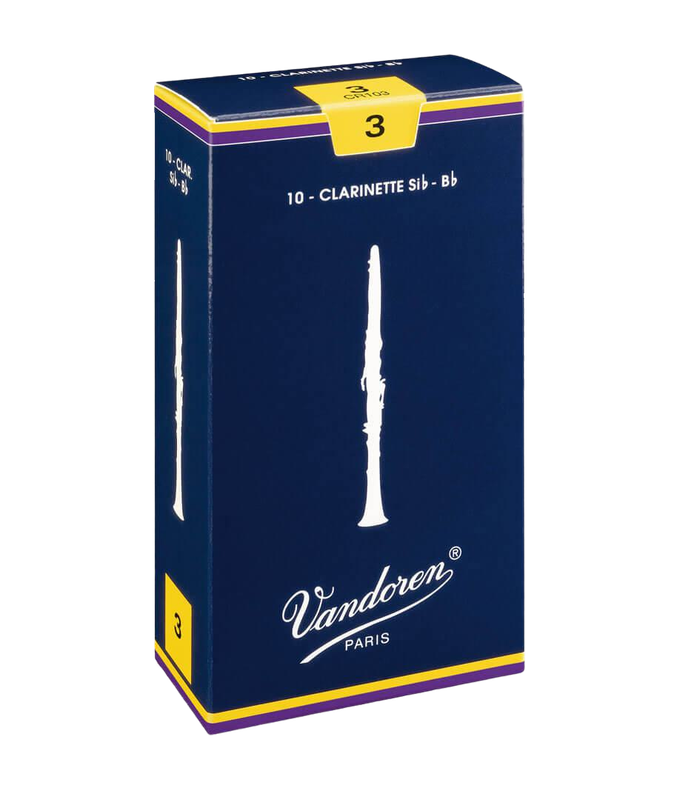
Traditional (Blue Box)
The classic all-rounder: bright, clear tone and quick response. The most popular clarinet reed line worldwide.
Browse catalog →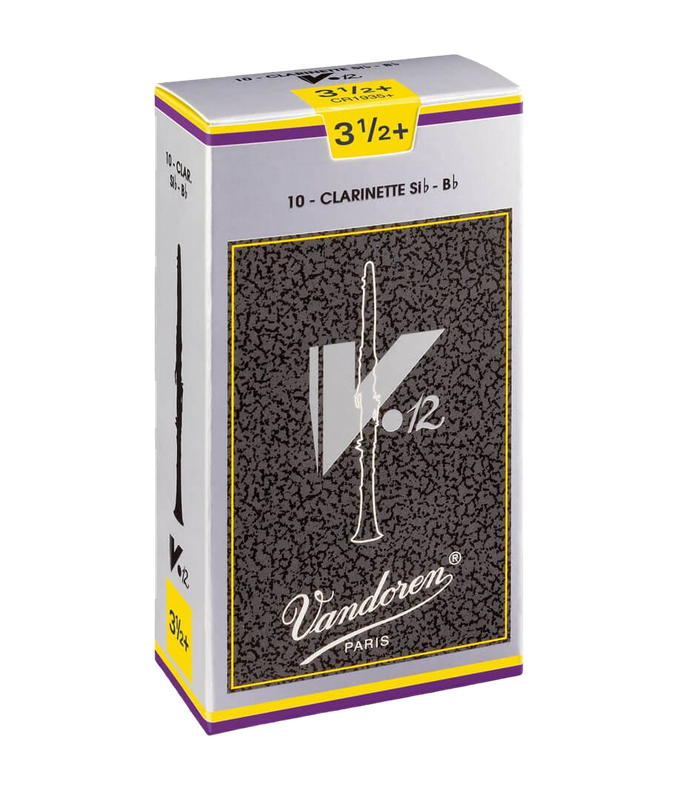
V12
Darker, richer color with more resistance—favored by advanced players and orchestral work.
Browse catalog →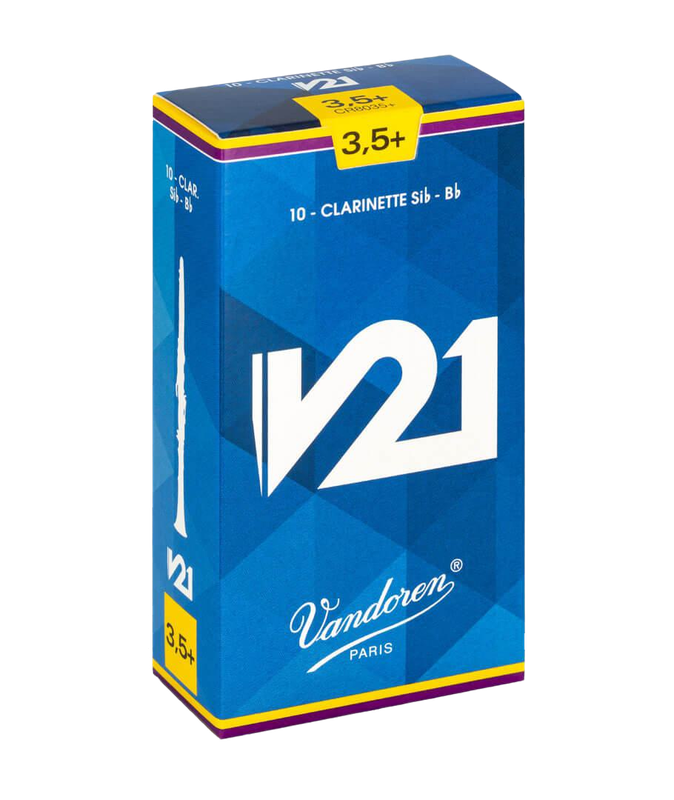
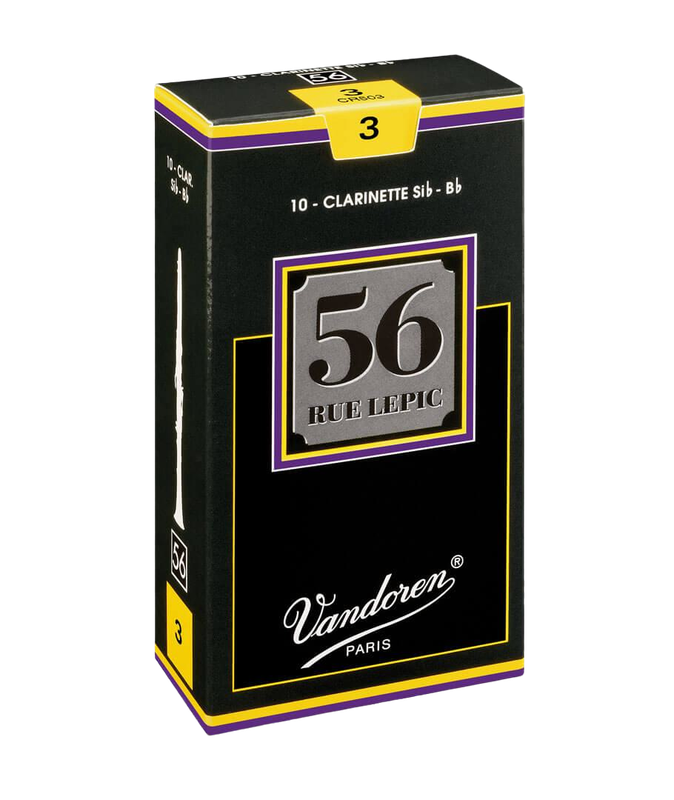
56 rue Lepic
Designed for a compact, “woody” core—often a great match for more open/US-style setups and jazz.
Browse catalog →Vandoren Traditional (Blue Box) — the classic that rarely disappoints
Traditional technical profile
Vandoren Traditional is the most widely used clarinet reed line—often simply called the “Blue Box”. Its profile became a reference point for the industry:
| Parameter | Typical value |
|---|---|
| Tip thickness | 0.09 mm — the thinnest among these four lines |
| Heel thickness | 2.8 mm — also the thinnest here |
| Cut type | Filed (French cut) |
| “Heart” profile | V-shaped with a solid core |
Thanks to a thin tip and a robust core, Traditional delivers a clean, focused sound with crisp articulation and quick response.
Tone & response
Traditional is known for a bright, clear, transparent sound and very easy speaking response. Players typically notice:
- Fast response across registers
- Clean attacks even at pianissimo
- Consistent tone from chalumeau through altissimo
- A strong balance between clarity and body
Who it fits
Many students start with Traditional because it offers softer strengths (like 1.5 and 2) and feels forgiving. Orchestral and chamber players value it for reliability and clear articulation.
Traditional strength range
Available strengths: 1.5 – 5 (0.5 steps) — the widest range among the four. Most common: 2.5, 3, 3.5.
Vandoren V12 — for a mature, darker sound
V12 technical profile
V12 targets players who want more density and depth. The name “V12” is commonly associated with a thicker blank/heel design (often described around 3.15 mm heel thickness):
| Parameter | V12 | Compared to Traditional |
|---|---|---|
| Tip thickness | 0.10 mm | Thicker |
| Heel thickness | 3.15 mm | Thicker / more resistance |
| Vibrating area | Longer | More “support” in the sound |
| Cut type | Filed (French cut) | Same cut type |
Good to know
V12 is often made from cane with a larger diameter, which can contribute to consistency from reed to reed.
How it feels vs Traditional
In practice, many players feel V12 plays about half a strength harder than Traditional:
- V12 3 ≈ Traditional 2.5
- V12 3.5 ≈ Traditional 3
- V12 4 ≈ Traditional 3.5
Tip: If you play Traditional 3 and want to try V12, start with 2.5 (or at most 3) and adjust from there.
Tone & response
V12 is valued for a darker, warmer, velvety color and stronger core, especially in bigger halls. Typical traits:
- Richer, “orchestral” sound
- Great projection in large rooms
- More stability at soft dynamics
- Less brightness, more depth
Who it fits
Popular with advanced students, conservatory players, and professionals who want a darker French-style sound, especially on naturally bright clarinets or more focused mouthpieces.
Vandoren V21 — modern balance and flexibility
What V21 is
V21 is often described as a “21st-century” hybrid feel—aiming to blend the core and projection of thicker blanks with quicker response. Many players consider it a bridge between V12 and 56 rue Lepic-style profiles.
Technical idea (practical view)
| Parameter | V21 | Why it matters |
|---|---|---|
| Tip profile | ~0.10 mm | Balanced resistance |
| Cut type | Unfiled (American cut) | Can pair well with more open facings |
| Blank/core | Thicker feel | More stability & longevity |
Unfiled cut (why you should care)
Unfiled reeds keep more bark area intact, often giving a stronger core and a “woodier” color. This can work especially well with more open or US-style mouthpieces.
Tone & response
Many players describe V21 as brighter than V12 but darker than Traditional—a true middle ground. Common impressions:
- Warm, centered sound
- Rich overtone content
- Quick response with a solid core
- Evenness across registers
Strengths: commonly used from 2.5 – 5 (including 3.5+ variants where available). Often feels slightly harder than Traditional.
Vandoren 56 rue Lepic — a strong core for open/US-style setups
Why the name “56 rue Lepic”
The line is named after Vandoren’s Paris address: 56, rue Lepic in the Montmartre area. This reed is often chosen for a compact core and stability, especially when pairing with more open mouthpiece facings.
Technical profile
| Parameter | 56 rue Lepic | Note |
|---|---|---|
| Tip thickness | 0.11 mm | Thicker tip feel |
| Heel thickness | 3.25 mm | Strong core / stability |
| Cut type | Unfiled (American cut) | More “woody” core |
What unfiled changes
- Often a deeper, “woodier” resonance
- Can feel great on more open facings
- Strong stability and projection
Note: Mouthpiece match matters. If you move from a filed reed to 56 rue Lepic, you may need to adjust strength and/or facing setup.
Who it fits
Commonly chosen by players who want a solid core for jazz, klezmer, or more open mouthpieces (including some US-style setups). Many also like it for stability and clean articulation.
Technical specs: visual comparison
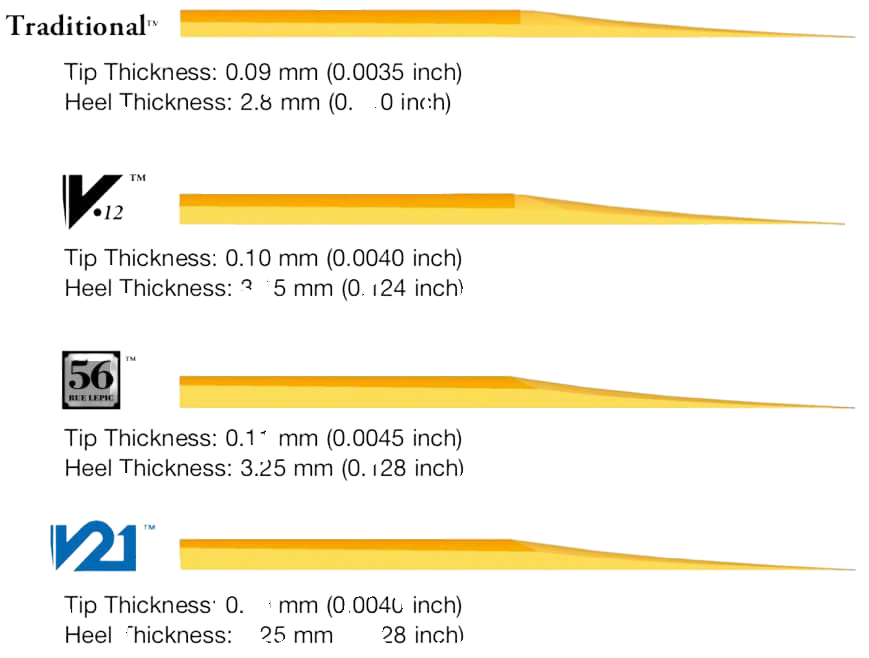
Side-by-side comparison table
| Parameter | Traditional | V12 | V21 | 56 rue Lepic |
|---|---|---|---|---|
| Tip thickness | 0.09 mm | 0.10 mm | 0.10 mm | 0.11 mm |
| Heel thickness | 2.8 mm | 3.15 mm | Conical feel | 3.25 mm |
| Cut type | Filed | Filed | Unfiled | Unfiled |
| Sound character | Bright, clear | Dark, warm | Balanced | Rich core |
| Brightness (1–10) | 8 | 4 | 6 | 5 |
| Darkness (1–10) | 4 | 9 | 7 | 6 |
| Ease (1–10) | 9 | 6 | 8 | 7 |
| Resistance | Low | High | Medium | Medium |
| Best for | All levels | Advanced / orchestral | Versatile | Jazz / open setups |
| Strength range | 1.5 – 5 | 2.5 – 5 | 2.5 – 5 | 2.5 – 5 |
Reed strength comparison index
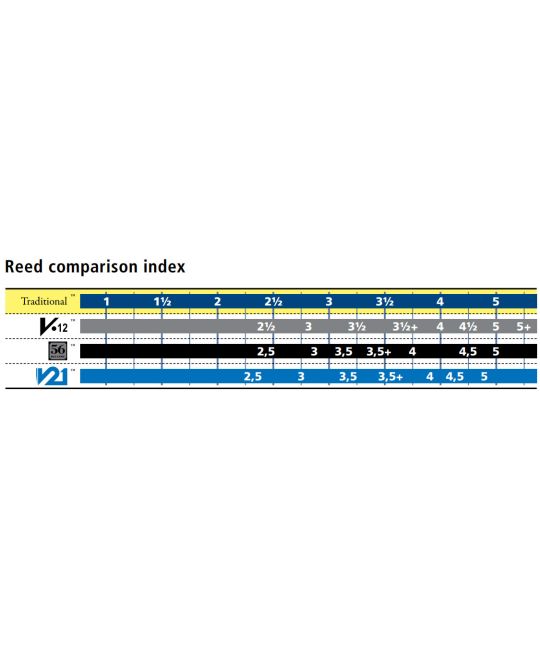
How to choose the right Vandoren line for your playing
Classical & orchestra
For orchestral playing, many choose V12 for its darker color and strong projection. If you prefer more clarity and a brighter edge, Traditional is often the safest all-round choice.
Solo performance
V12 is a strong option for larger halls thanks to projection and core. V21 can be more flexible across different acoustics, while Traditional can feel effortless and clean in chamber settings.
Chamber music
Traditional gives clean articulation and blend. V21 can be ideal for modern repertoire where you want more color without losing clarity.
Jazz & commercial styles
56 rue Lepic is often favored for jazz—especially with more open or US-style mouthpieces. Traditional can also work if you want a brighter, more “classical jazz” edge.
Switching lines: practical tips
Moving from Traditional to V12
- Drop strength by 0.5–1: if you play Traditional 3, try V12 2.5
- Expect an adaptation period of 1–2 weeks
- V12 may require stronger air support due to higher resistance
- Check mouthpiece match—V12 often works great on focused “French” facings
Moving from Traditional to V21
- Keep the same strength or drop by 0.5
- Adaptation can feel quicker than V12
- V21 can be flexible across different setups
Moving to 56 rue Lepic
- Consider whether your mouthpiece is more “open/US-style”
- You may need a different strength due to the unfiled feel
- Give yourself time to adjust articulation and air support
Mouthpiece compatibility: a practical starting point
| Mouthpiece | Suggested reeds (starting point) |
|---|---|
| Vandoren 5RV, 5RV Lyre | Traditional 3–3.5; V12 3 |
| Vandoren B40, B45, B45 Lyre | Traditional 3–3.5; V12 3–3.5 |
| Vandoren M13, M15, M30 | 56 rue Lepic 3–3.5; V21 3–3.5 |
| Vandoren BD5 | 56 rue Lepic 3; V21 3 |
| Backun | V12 3.5–4 |
| Clark Fobes | V21 3–3.5 |
| Meyer, Morgan, Portnoy | 56 rue Lepic 3 |
Common mistakes when choosing a Vandoren line
Mistake #1: Choosing V12 “because it’s pro”
V12 isn’t “better” than Traditional—it’s different. Choose by sound and feel, not reputation.
Mistake #2: Ignoring your mouthpiece
Reed cut type and mouthpiece facing interact a lot. If something feels wrong, check the pairing first.
Mistake #3: Not adjusting strength when switching lines
V12/V21/56 rue Lepic often feel harder than Traditional at the same printed strength.
Mistake #4: Expecting instant results
Give yourself 1–3 weeks to adapt technique, air support, and articulation.
Mistake #5: Overlooking 56 rue Lepic for jazz
If you play jazz or use a more open setup, this line is worth trying.
Reed care: how to get longer life and better consistency
Rotation
Rotation is key. Keep 4–6 reeds in active use and rotate daily. Avoid playing one reed for more than 30–60 minutes straight.
Breaking in new reeds
- Day 1 — only a few minutes
- Day 2 — 5–10 minutes
- Day 3 — 15 minutes
- Full sessions — from day 4
Storage
Use a reed case and aim for stable humidity (around 50%). Humidity-controlled cases can help a lot.
Typical lifespan
Many players get about 15–20 full sessions per reed, sometimes more with thicker blanks and good rotation habits.
What pros say: quick notes
Many orchestral clarinetists value the stability and depth of darker reed profiles (often pointing to V12-type feels) for section work.
Jazz players often like a strong core and flexibility for articulation—this is where unfiled lines (like 56 rue Lepic) can shine.
Ultimately, the “best” line is the one that matches your mouthpiece, clarinet, and the sound you hear in your head.
FAQ: 10 common questions about Vandoren lines
Conclusion: find your ideal setup
Each Vandoren line has its personality: Traditional for clarity and ease, V12 for depth and projection, V21 for balanced flexibility, 56 rue Lepic for a strong core on open setups.
Don’t be afraid to experiment. Try a few reeds across the lines and let your sound and comfort guide you. The best reed is the one that helps you express your musical voice without fighting your setup.
Ready to find your perfect sound?
Visit our Vandoren catalog and order professional reeds with delivery across Ukraine. Official dealer, authenticity guaranteed, expert advice.
Go to Vandoren Catalog


