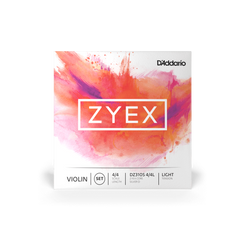
For Zyex, pay particular attention to the D version. The manufacturer offers different D windings in full-size sets, so the familiar name on a box does not fully identify its contents. This guide explains configurations, size information and a comparison that avoids unnecessary variables. A useful result is a recognisable improvement in the task you care about, not merely the pleasant novelty of newly installed strings.
How to choose D’Addario Zyex
Understanding a set with Aluminum D
The current D’Addario listing identifies DZ310A 4/4M as a full-size Medium violin set with Aluminum D. The selector also includes a Silver D set and the corresponding individual D options. This difference concerns the winding of that position, not an additional string automatically included in every standard box.
Read the complete description of the selected item. Do not expect both D strings unless the package contents explicitly say so. Photograph the label and add the winding choice to your own setup list. Zyex Medium alone does not preserve every important detail. A small distinction can determine whether the next purchase recreates a familiar result or unintentionally starts another experiment.
Synthetic cores and the top E
Zyex belongs to the synthetic-core families for the lower violin strings. Do not automatically extend a general set description to E. The D’Addario catalogue listing Zyex item codes describes DZ311 E as steel, alongside the wound A, D and G positions. For a specific E replacement, check the individual product specification.
This avoids assuming that all four strings share the same core because the set carries a Synthetic Core label. It is useful to understand what is actually changing from the previous configuration. If the main concern lies in the lower register, assess that area with its crossings to neighbouring strings. Do not attribute every difference to the new core material when another element of the setup may also have changed.
Why compare the two D windings?
The D connects G and A in many melodies, so selecting it influences the way transitions are perceived. A metal name does not predetermine the better choice. Start with the present task: note beginning, sensation under the bow or continuity between registers. A precise question makes a trial more useful.
Choose a slow phrase placing D beside its neighbours and a short motif with familiar articulation. Repeat both after changing it. An open D can be attractive alone yet behave differently in the musical context. Test one position at a time and keep the previous label. This makes it easier to return to a known configuration and to explain to a teacher which step changed the playing experience.
Compatibility checklist
| Parameter | What to check |
|---|
| Set | DZ310A 4/4M: full size, Medium, aluminium D. |
| Alternative D | Silver D is a different configuration; check the complete product code. |
| Core | Synthetic lower strings; DZ311 E is steel. |
| Fractional sizes | Check size and contents separately; full-size options do not establish every fractional configuration. |
Read size and tension together
The family includes full-size and fractional violin sets. For example, the official DZ310 1/8M is a Medium set for a 1/8 instrument. Full-size D alternatives do not establish that every option is repeated across all fractional sizes.
Check the actual violin rather than the pupil's age or packet appearance. Update the string record and case spares when changing to a larger instrument. An old catalogue or a different version's description does not confirm today's package contents. An unusual request needs verification of the actual item and availability, not an assumption that every tension exists in every size because it appeared somewhere in the family.
Moving from a steel set
Before making the change, note what you like about the installed strings and what you want to investigate. Perhaps clear beginnings already work well, but you want another colour in a sustained melody; perhaps you want a different D response without redesigning the whole instrument. Such observations support a comparison of specific qualities instead of declaring every new construction automatically better.
Avoid changing rosin, bow and your usual sound production at the same time. Too many variables make the cause of a result difficult to identify. Return to a familiar scale, short melody and normal strokes. Discuss unfamiliar sensations with a teacher. A change should support musical work, not create a need for continual extra effort merely to justify purchasing another family.
A tonal palette within real repertoire
D’Addario positions Zyex as a direction for warm, rich sound. Test that intention through your actual programme. Play one melody with several dynamic shades and consider control over beginning, development and ending. A beautiful isolated note is not a substitute for comfortable management of the entire phrase.
For ensemble use, add a passage with accompaniment. Ask someone to assess clarity from a distance while your partner maintains the usual balance. Do not rely only on what you hear close to the instrument. A warmer character should coexist with the definition you need in your room and ensemble. If a trade-off emerges, record it so that the next decision is deliberate rather than another step in an undefined search.
Stability in ordinary work and travel
A description of quick settling and stability should not become a guarantee of the same number of hours on every violin. Consider whether tuning and response have become predictable through normal practice. Leave enough time before an important performance for a rehearsal and a check of the actual setup.
During travel, think about the entire violin rather than the string material alone. Follow the luthier's storage guidance and do not treat a synthetic core as permission for abrupt environmental changes. If a new problem appears suddenly, inspect the instrument and fittings. Different behaviour does not necessarily mean the family is unsuitable. Establish what happened before replacing a working configuration because another part of the instrument needs attention.
Fittings and one-string replacements
The verified set listings specify ball ends. Match these to the particular fine tuner and tailpiece. If E previously used another attachment, confirm compatibility separately. Do not force an unsuitable ending into place or judge compatibility from a similar-looking envelope alone.
An individual string can solve a local need, but identify the note, size, tension and D winding where relevant first. One new position beside older strings does not represent the whole character of a fresh set. Record the date and reason for replacement. Recurring damage at one point calls for inspection of the contact area rather than merely ordering another family. This keeps the action connected to the actual problem.
Recording the result for a repeat order
After several sessions, record three observations: quiet-start comfort, the D's behaviour between its neighbours and clarity with accompaniment. Keep the complete installed list beside them. These notes help repeat a successful combination months later and prevent an accidental change of winding in the next purchase.
Compare other constructions in the violin strings catalogue. Use the SoundsGood contact page to check contents, item identity and current availability. If an alternative is proposed, clarify its difference before agreeing. The familiar word Zyex cannot replace all the required order details, especially when the purpose is to reproduce a configuration you already like.
Useful questions for a lesson
Bring specific passages rather than only an overall verdict: where the sound begins more easily, which crossing still feels awkward and what changed in a long phrase. Show the labels of the installed strings. This lets a teacher discuss the next step without guessing about the setup. Sometimes the useful action is to retain the current set and refine a stroke; sometimes testing one alternative D is worthwhile.
Keep the decision tied to an observation, not an obligation to keep upgrading equipment. A successful lesson does not require a new purchase, and a new set does not remove the need to understand the musical task. A clear record helps you recognise when the current configuration is doing its job and when a specific, limited change deserves a trial.