

|
Quantity
|
Cost
|
||
|
|
|||
|
|
|||
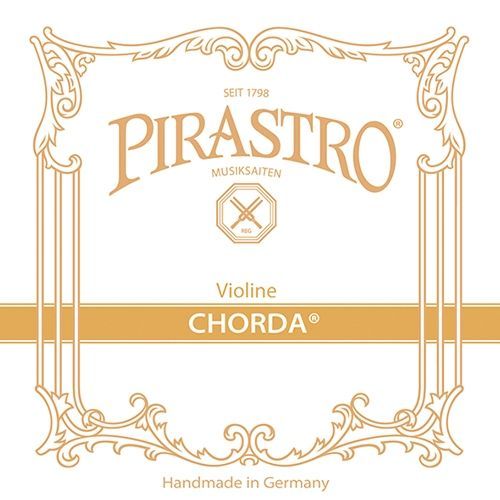
Set of strings Pirastro Chorda 4/4 for violin
Pirastro sums Chorda up in one line: authentic strings for baroque instruments. Three of the four strings here are plain gut with no winding at all, the way they were made before metal wire existed; only the G is wound with silver-plated copper wire, and deliberately left unpolished. Total tension is 18.2 kp, and that low figure is the point — the maker speaks plainly of very low string tension and a comfortable left hand feeling. The mittel gauges are E 11 1/2, A 14 1/2, D 19 1/2 and G 16. The set is designed for 440 Hz tuning.

🏆 SoundsGood — genuine Pirastro strings only, handmade in Germany.
Plain Gut: What the Composer Actually Heard
The Chorda E, A and D carry no winding whatsoever — they are gut, and they sound like it: soft on the attack, with a short natural decay and the matte warmth that a metal jacket inevitably brightens away. That is also why the D here is gauge 19 1/2 — without heavy metal the only way to reach a lower pitch is thickness, so the string comes out nearly twice as thick as the gut A. For historically informed playing this is not a compromise but the goal: the colour the repertoire was written for before the nineteenth century.
A G Under Silver-Plated Copper, Left Unpolished
The only wound string in the set: gut under silver-plated copper wire, gauge 16, 3.7 kp. The wire is left unpolished, so the surface is not glass-smooth like a modern string — and that is part of the sound rather than an oversight. A rough winding grips the bow hair differently and gives the bottom that slightly grainy edge which sets a baroque G apart from an orchestral one. If you want a darker character, the range also offers a plain copper G without silver, and Chordaflex — a twisted gut G at 29 PM with no winding at all.
18.2 kp: a Set That Barely Presses
For a comparison inside the same factory: the Oliv gut set pulls 22.2 kp, Chorda 18.2 kp — four kilopond less. The left hand notices first, since the strings take much less effort to stop, and Pirastro puts it simply: very low string tension, comfortable left hand feeling. The second consequence is less load on an old or lightly built instrument. The set is designed for 440 Hz; for baroque 415 Hz the factory directs you to the strong gauge, and for rosin it recommends Eudoxa.
Specifications
| Application | Violin string set |
| Series | Chorda |
| Size | 4/4 |
| Gauge | mittel (medium) |
| Core | Gut: E, A and D plain unwound gut; G wound gut |
| E String | Plain gut, gauge 11 1/2, 6.6 kp, art. 112141 |
| A String | Plain gut, gauge 14 1/2, 4.6 kp, art. 112241 |
| D String | Plain gut, gauge 19 1/2, 3.3 kp, art. 112341 |
| G String | Gut wound with unpolished silver-plated copper wire, gauge 16, 3.7 kp, art. 212441 |
| Total Tension | 18.2 kp |
| End Type | E, A and D without knot; G with knot. No ball or loop ends in the range |
| Tuning | 440 Hz; for 415 Hz Pirastro recommends the strong gauge |
| Pirastro Article | 112021 |
| Included | 4 strings in branded Pirastro envelopes marked with article numbers |
| Country of Manufacture | Germany (handmade) |
What's Included
The set holds four strings — E, A, D and G — each in its own branded Pirastro envelope marked with article number and gauge. The E, A and D arrive without a ready-made knot, so the player forms the tailpiece end themselves.
Who It's For
A set for the historically informed player, for the owner of a baroque or unconverted violin that finds modern tension too much, and for the musician who wants to hear what the instrument does on real plain gut rather than an imitation of it.
Frequently Asked Questions
What is in set 112021?
Four 4/4 strings in mittel gauge: E plain gut 11 1/2 at 6.6 kp (art. 112141), A plain gut 14 1/2 at 4.6 kp (art. 112241), D plain gut 19 1/2 at 3.3 kp (art. 112341) and G gut under silver-plated copper, gauge 16, at 3.7 kp (art. 212441).
Why do the E, A and D come without a knot?
That is how Chorda supplies plain gut: the player ties the knot to suit their own tailpiece. Only the G comes knotted, and the range has no ball or loop ends at all.
What tuning is the set designed for?
440 Hz. For baroque 415 Hz pitch Pirastro explicitly recommends taking the strong gauge instead of mittel.
How does Chorda differ from the Oliv gut range?
In degree of authenticity and in tension. Chorda has three completely unwound strings and a 18.2 kp total; Oliv has metal windings on every string, a steel E and 22.2 kp overall. Chorda is built for baroque repertoire, Oliv for modern concert playing on gut.
What G string options does the range offer?
Three different ones: silver-plated copper in gauges 15 1/2 (3.5 kp), 16 (3.7 kp) and 16 1/2 (3.9 kp); plain copper without silver in the same gauges (3.3 / 3.4 / 3.7 kp) for a darker sound; and Chordaflex, a twisted gut G at 29 PM with no winding, 4.0 kp (art. 112441).
Are these genuine Pirastro strings?
Yes. SoundsGood supplies only genuine Pirastro product, handmade in Germany, in branded envelopes marked with article numbers.
🚚 Shipping and Payment
🏆 SoundsGood — full warranty and service support
✅ Quality guarantee — genuine strings only
🏪 Pickup — Kyiv, free
🚚 Nova Poshta / Ukrposhta / Meest — 1–3 days
💳 Installments — PrivatBank, Monobank
🎻 Order the Chorda set at SoundsGood! ⚡