


|
Quantity
|
Cost
|
||
|
|
|||
|
|
|||
Set of strings Thomastik Dominant (medium) 4/4 for violin E-aluminum, D-aluminum
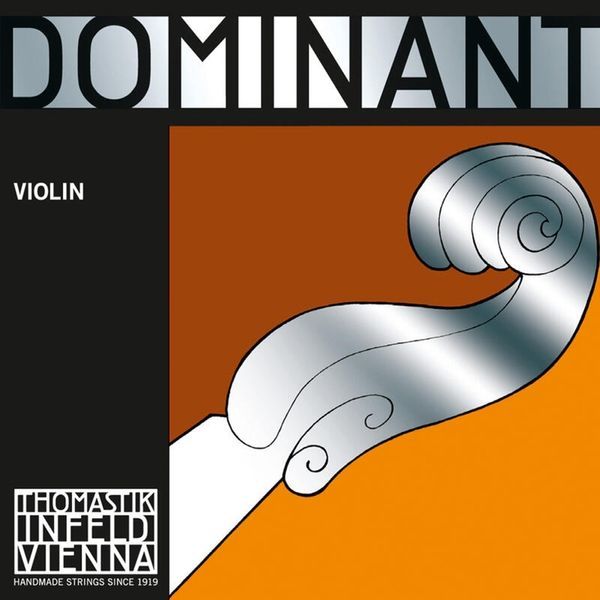
Dominant is the synthetic classic of the Viennese house Thomastik-Infeld, and the maker describes it soberly: since 1970 these strings have been "a reliable partner for generations of diverse violin players" and "rank among the worlds most used violin strings". Set 135 is the baseline 4/4 configuration in mittel gauge: E 130 with an aluminum winding over carbon steel (7.2 kp), A 131 aluminum (5.5 kp), D 132 also aluminum (4.1 kp) and G 133 silver (4.4 kp). Together that is 21.2 kp (46.74 lb) at a vibrating length of 32.5 cm — deliberately kept in low-tension territory, below the line's own stark version 135ST (23.7 kp). Thomastik sums up the sound in a single line: these strings "emphasize an instrument's individual character", and low tension is the main tool for that. A, D and G sit on a synthetic multifilament core (perlon) — the very construction that started the synthetic era.

🏆 SoundsGood — genuine Thomastik-Infeld strings only, made in Vienna.
How 21.2 kp Is Split Across Four Voices
The E is the tightest at 7.2 kp: a steel voice has to withstand bow pressure in the upper positions, otherwise it hisses instead of singing. Tension then drops straight to 5.5 kp on the A, and the lowest figure in the set is the D at 4.1 kp, with the G slightly firmer at 4.4 kp. In practice the middle and the bottom answer the bow very easily: neither D nor G has to be forced into speaking, and vibrato on them asks less of the left wrist. The flip side is worth knowing too — on a hard forte this D is the first string that wants a careful right hand.
Aluminum Twice, Silver Only on the G
The set is deliberately not unified by winding metal. The E is aluminum over carbon steel: the winding sits between finger and steel core, so the voice comes out more even than a plain steel string and the finger does not slide on bare metal. A and D carry that same aluminum — the lightest metal used here, adding almost no mass, which keeps the middle register transparent and quick. Only the G gets silver: it is denser, and the bottom needs exactly that mass, otherwise the string booms and blurs instead of holding the foundation of a chord.
Low Tension Is the Line's Stance, Not a Saving
21.2 kp on a full-size violin is deliberately modest, and the whole line is built on it: the less load on bridge and soundpost, the more of the instrument itself you hear rather than the strings. That is why Dominant so often ends up on older violins with thin tops and on instruments that close up under a stiff set. If you want more resistance under the bow, the same combination exists as the stark 135ST (23.7 kp) and as a light version (18.8 kp) — only the tension changes, not the construction.
Specifications
| Purpose | Violin string set |
| Line | Dominant |
| Size | 4/4 (full) |
| Gauge | medium (mittel) |
| Vibrating length | 32.5 cm (12.8") |
| E string | Carbon steel, aluminum winding, brass crimp ball end, 7.2 kp (15.87 lb), art. 130 |
| A string | Synthetic multifilament core (perlon), aluminum winding, brass ball end, 5.5 kp (12.13 lb), art. 131 |
| D string | Synthetic multifilament core (perlon), aluminum winding, copper ball end, 4.1 kp (9.04 lb), art. 132 |
| G string | Synthetic multifilament core (perlon), silver winding, nickel ball end, 4.4 kp (9.7 lb), art. 133 |
| Total tension | 21.2 kp (46.74 lb) — Thomastik publishes tension in kilograms (kg = kp) and pounds |
| Same set in other gauges | light 18.8 kp, stark 23.7 kp (art. 135ST) |
| Related sets in the line | 135A — silver D 132A, 21.6 kp; 135B — plain stainless steel E 129, 21.8 kp; 135BA — 129 + 132A, 22.2 kp |
| Thomastik article | 135 |
| Included | 4 strings in official Thomastik packaging, each marked with its article number |
| Country of Manufacture | Austria, Vienna (Thomastik-Infeld has been developing and producing strings in Vienna since 1919) |
What's Included
The pack holds four strings — E 130, A 131, D 132 and G 133, each in its own Thomastik envelope with the article number. It covers a complete restringing with nothing to buy separately.
Who It's For
For the violinist who wants proven synthetics with no experiments; for the owner of an old or sensitive instrument who needs low tension; and for the student moving from steel to synthetic strings who wants to hear what the violin itself actually sounds like.
Frequently Asked Questions
What exactly is in set 135?
Four 4/4 strings in mittel gauge: E 130 — aluminum winding over carbon steel with a brass crimp ball end (7.2 kp), A 131 — aluminum (5.5 kp), D 132 — aluminum (4.1 kp) and G 133 — silver (4.4 kp).
What is the total tension and are other gauges available?
21.2 kp (46.74 lb) in mittel gauge. The same set is also made in light (18.8 kp) and in stark (23.7 kp, sold under its own article 135ST).
Is the E in this set a plain steel string?
No. It is article 130 — carbon steel with an aluminum winding and a brass crimp ball end. The plain stainless steel E in the Dominant line is 129 (used in set 135B), and the tin-plated one is 129SN.
How does 135 differ from 135A, 135B and 135BA?
By two positions only. 135A swaps the aluminum D for the silver 132A, totalling 21.6 kp. 135B uses a different E — the plain stainless 129 with a removable ball, 21.8 kp. 135BA combines both changes, 22.2 kp. The A is always 131 and the G always 133.
Can I buy the strings from this set one at a time?
Yes, all four articles are sold separately — 130, 131, 132 and 133 at the same tensions. Replacing a single string therefore does not tilt the balance: the load on the bridge stays the same.
Are these genuine Thomastik strings?
Yes. SoundsGood supplies only genuine Thomastik-Infeld product in official packaging marked with article numbers.
🚚 Shipping and Payment
🏆 SoundsGood — full warranty and service support
✅ Quality guarantee — genuine strings only
🏪 Pickup — Kyiv, free
🚚 Nova Poshta / Ukrposhta / Meest — 1–3 days
💳 Installments — PrivatBank, Monobank
🎻 Order the Dominant set at SoundsGood! ⚡