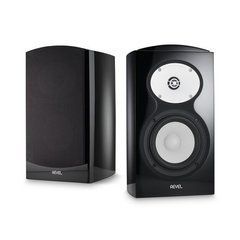
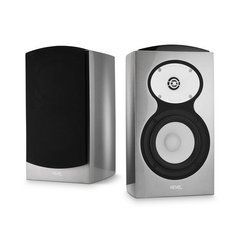
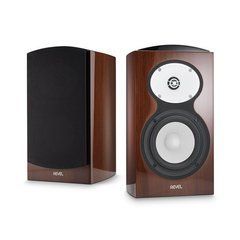
A bookshelf stereo pair within a home system
Passive bookshelf speakers suit installations needing separate left and right loudspeakers without large floorstanding cabinets. They allow a stereo system to be built around a chosen amplifier, retain existing sources or support gradual electronics upgrades. Before selecting a pair, establish the listening position, available spacing between speakers and actual listening distance. A compact cabinet does not mean placement is unrestricted.
Listening at a desk, from a living-room armchair or across a large open space involves different demands. Required output, headroom for musical peaks and suitable driver height all matter. If television sound is also planned, check the television's compatibility with the amplifier. The speaker terminals of a passive model cannot receive digital or line-level audio directly; the source connects through the appropriate electronics.
Cabinet design and bass behaviour
Bookshelf systems differ in driver size, enclosure design and crossover implementation. ELAC describes DBR62, for example, as a two-way bass-reflex loudspeaker with a slot port. Such construction details help explain placement requirements but cannot by themselves identify the best model for a particular room.
Do not judge bass solely by the lowest number in a frequency specification. Consider the measurement conditions and behaviour at the intended listening level. A small cabinet may work effectively at close range while a large room imposes different output demands. Port position does not remove wall effects either: a forward-facing opening does not make every enclosed shelf acoustically neutral. Start with the exact model's recommendations and then assess the practical positions available. Leave enough room to try small adjustments rather than locking the installation into the first convenient arrangement.
Amplification: a suitable load matters more than a headline rating
Check nominal speaker impedance, amplification recommendations and the amplifier's permitted load. A loudspeaker's impedance is not constant across all frequencies, so comparing front-panel labels is insufficient. The electronics should operate reliably with the selected pair and provide the desired level without overload.
Compare power under equivalent conditions, including load, active channel count and permitted distortion. Do not choose an amplifier only for its largest advertised figure or assume a low-powered unit automatically protects the speakers. Audible distortion is a reason to reduce output and investigate the signal chain. If an amplifier is already owned, provide its exact model and intended listening distance. That information is more useful than a general description such as powerful or suitable for a small room, particularly when assessing whether an existing component can remain in service.
Height, symmetry and the supporting surface
Supports should establish the recommended listening-axis position, rather than simply lift cabinets off the floor. Check the top-plate area, speaker weight and stability of the complete arrangement. On furniture, keep a clear path between drivers and listener and avoid placing one speaker significantly farther back than the other. Reflections from the surface and nearby side walls influence the result.
For initial adjustment, use a mono voice recording to assess the centre image with correct wiring and symmetrical placement. If it shifts to one side, check channels, levels and physical positions before changing equalisation. Then assess a stereo recording and refine toe-in according to guidance and listening results. Record a successful position so accidental movement during cleaning does not become an unexplained change in sound. Consistent placement makes later comparisons between sources and settings more meaningful.
Cables, terminals and adding a subwoofer
Speaker cable connects the amplifier's power outputs to the loudspeaker terminals. Select conductor size for the run length and equipment recommendations, leaving enough slack for movement without strain. Maintain consistent polarity between channels and prevent loose strands from bridging adjacent contacts. Make connections with the equipment switched off, following the supplied instructions.
If a model has several terminal pairs, establish the intended arrangement and purpose of the links first. Do not confuse dual wiring facilities with permission to join arbitrary amplifier outputs. For a subwoofer, check the relevant inputs and outputs throughout the system and how crossover alignment will be achieved. A subwoofer output does not always mean the main stereo pair is automatically high-pass filtered. Confirm that function before purchase if it forms part of the planned setup, rather than discovering the limitation after everything has been connected.
Comparing models and ordering a complete package
Prepare familiar recordings with vocals, acoustic instruments and varied bass notes. Match playback levels and consider comfort over time as well as the first impression. REVEL M16, JBL Classic, JBL Studio, PIEGA and ELAC options in this category should be compared as exact models in feasible placements, rather than through general claims about a brand.
Confirm whether the speakers are sold as a pair, along with the exact finish, generation and supplied items. Include amplification, necessary source inputs, cables and supports in the quotation. After installation, test both channels and every source at moderate volume. Keep the wiring diagram and initial settings. If expansion is planned, specify it in advance so the electronics can provide the required facilities without an unnecessary replacement of the whole system. A clearly defined complete package is easier to compare than a collection of individual prices.
SoundsGood supplies sound equipment for educational institutions, studios, concert halls, conference rooms, and public and private organisations. A technical brief can be used to agree on system components, specifications, a commercial quotation, documentation and delivery arrangements.