

|
Quantity
|
Cost
|
||
|
|
|||
|
|
|||
Safe support at rehearsal, on stage, in the classroom and studio
Stands for Woodwind Instruments — Buy at SoundsGood
An instrument stand provides a safe place during a short break, a part change or a performance involving several instruments. SoundsGood can match folding peg stands for flute, clarinet, oboe and soprano saxophone, cradle stands for alto, tenor and baritone saxophone, bassoon stands and combination systems. Before ordering, confirm the exact instrument, support diameter and shape, rated load, base width and protective material on every contact surface.
Official warrantyFrom the manufacturer or importer
Installment paymentsPrivatBank and monobank
Delivery across UkraineNova Poshta and store pickup
Professional matchingFor your level and playing style
Main woodwind stand types
Peg stands
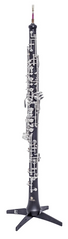
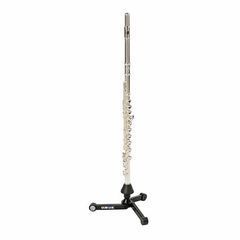
A vertical peg enters the bell or lower bore of a compatible instrument. This format is used for flute, piccolo, clarinet, oboe, recorder and some soprano saxophones.
Cradle stands for saxophone
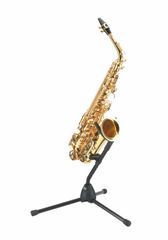
A lower support and upper yoke hold the body or bell without loading the keys. Geometry must match soprano, alto, tenor or baritone saxophone.
Bassoon stands
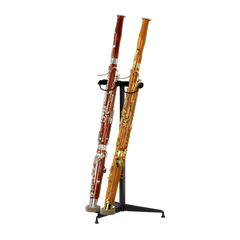
Combine a lower cup with an adjustable upper support. Height, base width, contact material and stability with the instrument are essential.
Combination systems
One base can carry several pegs and holders for a primary instrument and doubles. Check total rated load and balance in the complete configuration.
Folding travel models
Legs or supports fold for transport; some pegs store inside the base. Fully open and lock every part before placing the instrument.
Stationary orchestral stands
A heavier base and larger footprint suit studios, classrooms, orchestra pits and stages. Extra mass can improve stability but reduces portability.
Stands by instrument type
Flute and piccolo
Use a peg with the exact diameter, sufficient height and a soft contact surface. Confirm C-foot/B-foot compatibility and a dedicated size for piccolo.
Clarinet
E♭, Bb/A and bass clarinet bells differ in size. A peg must not expand the bell, contact keys or create a concentrated pressure point.
Oboe and cor anglais
The narrow bore and bell shape require a dedicated support. Do not use a clarinet peg based on similar outside dimensions alone.
Saxophone
Straight soprano uses a dedicated peg or support; alto and tenor need a compatible cradle, while baritone requires a reinforced wide base.
Bassoon
A lower cup supports the boot joint while an upper yoke retains the body without pressing the mechanism. Adjustment must match instrument length and centre of gravity.
Doublers and multi-instrumentalists
A modular base with several compatible holders saves floor space. Place the heaviest instrument near the centre and follow the maker’s configuration diagram.
How to choose the right stand
A generic “wind instrument” label is not enough. A safe stand is selected for the exact instrument type and size, support design and actual working environment.
Exact compatibility
Provide instrument, pitch, size and model. Saxophone type and body geometry matter; a peg stand must match internal bell diameter and depth.
Base and centre of gravity
A wide base and non-slip feet reduce tipping risk. Instrument weight must remain within the support footprint even with several holders installed.
Contact surfaces
Rubber, felt or another protective material must not mark lacquer, plating, wood or plastic. The maker defines finish compatibility.
Rated load
Never place baritone saxophone, bass clarinet or bassoon on a model not rated for that weight. Do not hang bags or cables from the stand.
Locks and adjustment
Legs, hinges, upper supports and clamps must open fully and lock without play. Adjustment hardware must remain clear of the keys.
Stage conditions
A compact footprint is useful on a tight stage but not at the expense of stability. Consider cables, traffic, lighting, floor vibration and instrument-change speed.
Quick comparison
| Type | Instruments | Portability | Stability | Check before buying |
|---|---|---|---|---|
| Folding peg stand | Flute, clarinet, oboe, soprano | High | Footprint-dependent | Peg diameter and fully opened base |
| Folding cradle stand | Alto or tenor saxophone | High | Medium to high | Lower support and upper yoke geometry |
| Reinforced baritone stand | Baritone saxophone | Low to medium | High | Rated load, base width and height |
| Bassoon stand | Bassoon; dedicated contrabassoon models separately | Medium | High with correct adjustment | Lower cup, upper yoke and centre of gravity |
| Modular multi-stand | Primary instrument and doubles | Medium | Configuration-dependent | Combined weight and holder positions |
Safe use
Set the stand only on a level, dry surface, fully open the legs and check every lock before use. Keep the instrument away from walkways, stage edges, cables, doors and vibration. No stand eliminates the risk of a fall, so do not leave a valuable instrument unattended or use a stand instead of a case for long-term storage or transport.
Inspection and care
Inspect rubber feet, support padding, threads, clamps and hinges regularly. Sand or metal particles on a soft contact can scratch an instrument. Replace worn pads and loose hardware with original or explicitly compatible parts. Do not lubricate a joint with a product that could transfer to lacquer, wood, pads or the floor.
What determines stand price
Price depends on base material and mass, leg count, cradle precision, rated load, hinge quality, height adjustment, modularity, folding design and an included travel bag. Exact compatibility and stability should lead the decision for professional stage or institutional use.
Woodwind stand and instrument brands
Below is a broad reference list of international stand, holder and woodwind instrument brands. Not every company makes stands for every instrument type, and the list does not mean every brand is permanently stocked by SoundsGood. Current models, compatibility and prices are shown in the catalogue.
K&MHERCULES StandsWoodWindDesignSAXRAXAIDAHamilton StandsOn-StageStaggGEWAGator FrameworksGravityUltimate SupportSoundkingBoston Musical ProductsThomannMilleniumBelmonteNomadProlineRockStandYAMAHAHenri SELMER ParisBuffet CramponYanagisawaJupiterKeilwerthP. MauriatCannonballAntigua WindsEastmanTrevor JamesPearl FlutesMuramatsuMiyazawaAltusHaynesPowell FlutesAzumiSankyoBurkartHowarth of LondonMarigauxF. LoréeRigoutatFossatiFox ProductsPüchnerMoosmannSchreiberAdler
Stands by instrument and related categories
Supply for music schools, orchestras and Prozorro tenders
SoundsGood can prepare a stand specification for music schools, colleges, orchestras, theatres and public institutions: instrument types and models, quantities, rated load, folding or stationary construction and warranty requirements. Bank-transfer supply and participation in Prozorro procurement are available.
Commercial and public Prozorro tenders→Frequently asked questions
How do I know a peg fits my flute or clarinet?
Check the maker’s explicit instrument marking, peg diameter and height, and compatibility with the exact instrument. Similar outside bell dimensions are not enough.
Can one stand fit alto and tenor saxophone?
Some adjustable models support both, but the maker must state this explicitly. Set the lower support and upper yoke separately for each instrument.
Is it safe to place an instrument bell on a peg?
Yes, when the peg is designed for that instrument, has a protective surface and does not expand the bell or bore. An incorrect diameter can cause damage.
Can I store an instrument permanently on a stand?
For long-term storage, place a clean, dry instrument in its compatible case. A stand is primarily intended for short breaks in a controlled area.
Which is better: a light folding or heavy stationary stand?
A folding model is easier to travel with; a heavy wide base is generally more stable in a classroom or studio. Choose for instrument weight and working conditions.
Can an institution order stands in quantity?
Yes. SoundsGood can confirm instruments, stand types, quantities and technical specifications for bank-transfer orders or Prozorro procurement.
Need to match a stand to your instrument?Call +380 (73) 060-01-01