

|
Quantity
|
Cost
|
||
|
|
|||
|
|
|||
Bass Guitar Stands & Hangers — buy with discount at SoundsGood
A bass stand must account for instrument length, weight and balance. An ordinary guitar stand may be too low or have unsuitable supports even when the bass fits its width. Long instruments need sufficient height and a stable base; five- and six-string models need an appropriately wide yoke. Headless basses require support that does not rely on suspension beneath a headstock.
Advantages of a correctly selected stand
Ready access
A defined position between practice, recording and performances.
Designed support
The body or headstock rests on purpose-designed contact points.
Organized space
Placement can suit a classroom, room or stage layout.
Format choice
Floor, wall and multi-instrument designs serve different needs.
Adjustment
A suitable range allows supports to match the instrument.
Stage access
A planned position makes instrument changes easier.
Portability
A folding design can simplify transport where provided.
Checkable compatibility
Dimensions, load ratings and pads give concrete selection criteria.
Total length and floor clearance
Scale length is not overall bass length. For a suspended stand, measure from the headstock support to the body’s lowest point and strap button. The bass must remain clear of the floor. With lower body arms, check neck-support height and overall balance.
Bass weight and load ratings
A heavy instrument needs an appropriate load rating, but a large rating alone does not establish stability. Base width, fully opened feet and support geometry matter. Wall mounting requires both a suitable hanger and suitable fixings. Do not add bags or equipment without designed attachment points.
Extended-range and multiscale basses
String count does not specify neck width. Check the actual yoke range and headstock shape. A multiscale bass may have an unusual lower-body outline and must sit without pressure on its controls. Do not force the holder beyond its designed adjustment range.
Headless and short-scale basses
A headless bass needs body support or another specifically compatible design, leaving bridge-end tuners clear. A short-scale bass may need a lower support position, but its balance still requires checking. Compact size does not automatically make it suitable for an ukulele or small-guitar stand.
Key selection specifications
Support type
Body support, headstock suspension, wall mount or multi-instrument construction.
Geometry
Height, yoke width, lower-support depth and clearance from floor or wall.
Load rating
Permitted weight for the individual product and each multi-instrument position.
Contact and retention
Pad material, retention mechanism, clamps and anti-slip feet.
Floor stand, wall hanger or multi-instrument rack
A floor stand needs no installation and is easy to move, but occupies floor space and requires an even surface. A wall hanger depends on a sound supporting structure and appropriate fixing. A rack organizes a collection or stage setup, but instrument spacing and each position’s load must be considered. Choose for the actual room and foot traffic.
Stability and placement
Fully open the legs and lock adjustments according to the instructions. All feet should contact the surface and the instrument should sit in the intended position. Avoid stage edges, walkways and places where a cable can be snagged. A retaining mechanism keeps the instrument in its holder; it does not prevent the entire stand from tipping.
Contact materials and finish compatibility
Check the stand maker’s material guidance and the instrument manufacturer’s recommendations. Nitrocellulose, French polish and recently applied finishes need particular care. “Soft” or “non-scratch” does not establish chemical compatibility. Follow the instrument’s long-term storage guidance instead of assuming that every rubber or foam contact is suitable.
Wall mounting and substrate
Fixings depend on the supporting structure: solid masonry, framing and hollow partitions require different solutions. Supplied screws are not universal for every wall. Follow hanger and fixing instructions; use a qualified installer when the structure is uncertain. Check the installation before hanging an instrument and stay within the stated load rating.
Transport and maintenance
Remove the instrument or equipment before folding. Inspect joints, threaded clamps, contact pads and feet: wear can alter fit and stability. Remove dust and hard particles from contact surfaces and avoid unapproved aggressive cleaners. Recheck all adjustment locks after transport even when the height appears unchanged.
Construction comparison
| Construction | What to check | When to consider it |
|---|---|---|
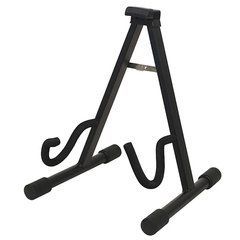
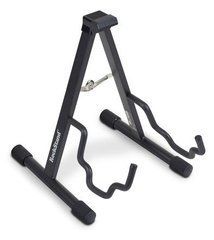
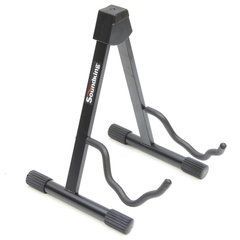
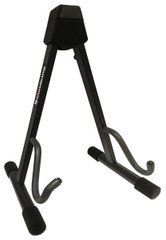
| Compact floor stand | Body and lower-arm geometry | A single home or rehearsal position |
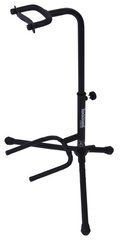
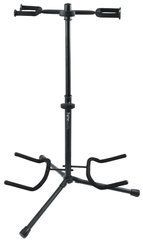
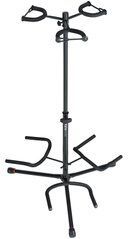
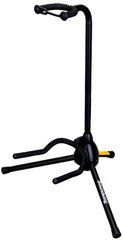
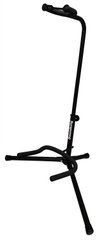
| Suspended floor stand | Headstock, neck width, height | Accessible storage with compatible geometry |
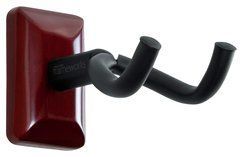
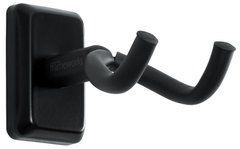
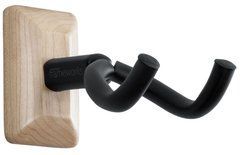
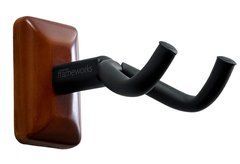
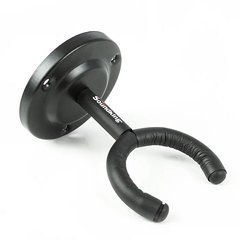
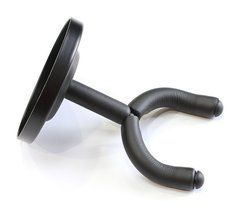
| Wall hanger | Substrate, fixing, projection, load | Freeing floor space |
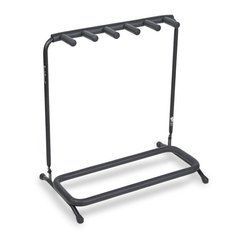
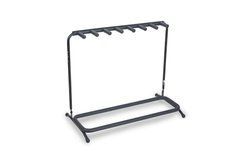
| Multi-instrument rack | Position count and body spacing | Classroom, collection, studio or stage |
Before you buy
- Check model, shape, weight and required support range.
- Verify contact materials and installation requirements.
- Assess location, access and cable or foot snag hazards.
- Confirm included items, warranty and delivery terms.
International stand and hanger brands
A reference list of international stand and hanger brands. It does not represent current SoundsGood stock or imply that every model fits every instrument. Check individual product pages for current products, prices and specifications.
König & MeyerHercules StandsGravityUltimate SupportOn-StageString SwingGator FrameworksFenderD’AddarioIbanezRockStandWarwickQuik LokStaggHamiltonHöfnerGEWAKinsmanBostonProelBespecoAdam HallRTXFzoneJoyoDonnerHarley BentonMilleniumDixonGuittoOrtega
Tenders, Prozorro and corporate procurement
SoundsGood selects stands for music schools, studios, theatres, orchestras and cultural institutions. Specifications start with instrument or amplifier models, required positions, installation conditions and material requirements. We prepare corporate and public procurement quotations, including Prozorro. Included items, pricing and delivery timing are agreed for the individual order.
Frequently asked questions
Does scale length determine stand height?
No. Use total instrument length and distance from support point to its lowest edge.
Does a high load rating ensure stability?
No. Base design, support geometry and locked adjustments must also be checked.
Can a headless bass use a hanging stand?
Not one relying only on a headstock. Use specifically compatible body support.
Can a four-string holder take a six-string bass?
Only if the actual neck width, headstock shape and weight fall within its specifications.
Does every stand fit every guitar?
No. Check body and headstock shape, neck width, weight and contact-material compatibility.
Does automatic retention prevent tipping?
It retains the instrument in its holder. Whole-stand stability depends on the base, adjustment and location.
Are all soft pads safe for a finish?
No. Sensitive finishes need confirmed material compatibility and adherence to instrument guidance.
Can a music school order stands through a tender?
Yes. Supply instrument models, required positions and placement requirements. SoundsGood can prepare a specification and procurement quotation, including Prozorro.
Related categories
Why SoundsGood
Official warranty
Manufacturer or importer warranty according to the individual product terms.
Installment payments
PrivatBank and monobank; availability and payment counts are shown on the product page.
Delivery across Ukraine
Free delivery from UAH 4,000, Nova Poshta and collection under store terms.
Professional selection
Based on model, shape, load, finish and installation location.
Where to buy and how to order
Buy a stand or hanger from SoundsGood. Provide the instrument or amplifier model, weight, dimensions and intended floor, wall or multi-position arrangement to guide selection. Confirm the current discount, availability and dispatch timing for the chosen product.
+380 (73) 060 01 01