What a distributed-sound power amplifier does
A distributed-sound power amplifier drives speaker lines in a shop, educational building, office or another facility. Unlike amplification for one stereo pair, the design must account for many speakers, cable distances, zones and daily operation. The system may carry background music, speech or different signals to separate rooms. These requirements define its architecture rather than a single total wattage figure.
Distinguish a power amplifier from a mixer amplifier and a zone processor. A power amplifier does not necessarily include microphone inputs, announcement priority or source selection; external devices may perform those tasks. Prepare a room plan, source list, independent level requirements and control locations. This establishes the channels needed without expecting an ordinary amplifier to act as a complete routing matrix. Also identify which parts must operate simultaneously and what staff need for everyday use.
Calculating a 70 V or 100 V speaker line
For transformer-equipped speakers, calculate each channel’s load by adding the selected power taps. Record the actual switch position on every speaker rather than its maximum published rating. Ten speakers set to 6 W provide a starting total of 60 W. Then account for reserve, losses and planned expansion according to manufacturer guidance and the system design.
The line, amplifier output and speaker transformers must match the selected operating mode. A series description mentioning 70/100 V does not guarantee every combination on all channels simultaneously: check the exact model and any global settings. A conventional low-impedance cabinet must not be connected to this line without appropriate matching. In a mixed installation, establish which outputs support Low-Z and Hi-Z and whether bridging is required. Record these conditions before installation. Changing a tap later also changes the calculation even if speaker quantity remains unchanged.
Channels, zones and announcement priority
One speaker line can pass through several rooms, but that does not create independent music selection in each room. Different programmes require suitable routing and amplification. A zone selector may only switch connections, while a volume control adjusts level within its own compatibility limits. The number of zone buttons should not be confused with the number of independent amplifier channels.
Decide which messages should interrupt music and where. Identify the component providing priority, ducking and control: a mixer, matrix or dedicated controller. General sound reinforcement and emergency voice applications have different system requirements; 100 V capability alone does not establish suitability for every task. Where special requirements apply, coordinate the complete configuration with the project specification. Give staff clear daily controls and manage access to critical parameters so accidental changes do not disrupt every room. Source routing should be documented as carefully as speaker wiring.
Why the complete Crown CDi or DCi model matters
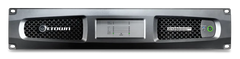
Within Crown CDi and DCi families, channel count, power, processing and interfaces can differ. The complete model designation matters more than the family name. For example, DCi 8|300 and network variants should not be treated as identical in control and signal transport. Digital audio, remote setup and status monitoring are separate capabilities to verify independently.
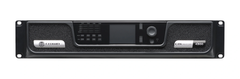
For CDi DriveCore 4|600, compare its output table and operating modes with the intended load. Do not infer support for an arbitrary network protocol from a similar-looking connector. With an external matrix or processor, check levels, inputs and configuration storage. Record software versions and working parameters where relevant. Replacing a component requires checking the signal path, not merely matching the old and new channel counts. Confirm required accessories, connection methods and the current package for the individual product before ordering.
Filtering, cable routes and equipment cabinets
Check the recommended low-frequency filtering for transformer-equipped speakers. Content outside the useful operating range does not improve intelligibility and can create unwanted demand. Settings depend on the amplifier, transformers and speakers, so one universal filter frequency is inappropriate for every line. Coordinate levels and limiting with the design, and apply equalisation after correct speaker placement rather than using it as a substitute for adequate coverage.
Select cable according to length, load and installation conditions. Label lines by zone and make connections with equipment switched off. The cabinet must provide ventilation, terminal access and serviceability for individual channels. Account for shared power and heat generation during actual multichannel operation. Protection does not justify continuous overload. If indicators show a problem, investigate the line and operating mode instead of increasing source level. Plan inspection and cleaning access during installation, before room finishes or other equipment make servicing difficult.
Commissioning, documentation and expansion
Before startup, compare the installed speaker taps with each channel’s calculation. Test zones individually for the correct signal, level control and priorities. Then assess simultaneous operation, music, announcements and behaviour after restart. Listen where people actually use the space, not only beside the equipment cabinet. Intelligibility and consistent coverage matter more than maximum loudness from the nearest speaker. Evaluate the result under the facility’s typical background-noise conditions.
Retain the tap schedule, cable routes, channel allocation and processing settings. Record actual spare capacity for each line: an unused terminal does not imply available power. Added speakers or changed taps require a new load check. Before ordering from SoundsGood, provide the zone plan, speaker quantities, selected taps and required sources. This supports compatible amplification and control choices, accounts for installation components and helps avoid rebuilding an already installed system. Clear records also make maintenance easier when a different technician works on the site.
SoundsGood supplies sound equipment for educational institutions, studios, concert halls, conference rooms, and public and private organisations. A technical brief can be used to agree on system components, specifications, a commercial quotation, documentation and delivery arrangements.