Recorder —
from classroom to Bach
Despite its classroom image, the recorder is just as challenging to play well as most other instruments. From sopranino to bass, from Renaissance to the present day.
🔗 Table of Contents
Why Learn the Recorder?

Despite its infamous classroom image, the recorder is in fact just as difficult to play well as most other instruments. The most demanding recorder works were written in the Baroque period, including Bach's Brandenburg Concertos and Vivaldi's solo concertos.
Accessible entry point
The most affordable woodwind instrument. A maple descant recorder starts from a very modest price.
Music reading and ear training
Teaches note reading and develops musical hearing. Used in schools for over 100 years.
No embouchure required
Unlike the flute or brass instruments, no complex embouchure is needed — you simply blow.
Consort playing
Ideal for ensemble playing — recorder consorts from sopranino to contrabass. A unique experience for children and adults.
A Brief History
During the Renaissance the recorder played an important role in ensemble music — mainly consort playing. The Baroque period (c.1600–1750) saw the recorder develop as a solo instrument, with the iconic works of Bach and Vivaldi. Boxwood was the principal material of both eras. The rise of the transverse flute in the 18th century largely displaced the recorder, but the 20th century brought a revival, especially in England and Germany, and it was during this time that classroom teaching began.
"Despite its infamous classroom or beginners image, the recorder is in fact just as difficult to play well as most other instruments."— Thomann Recorder Online Guide
Sizes and Models
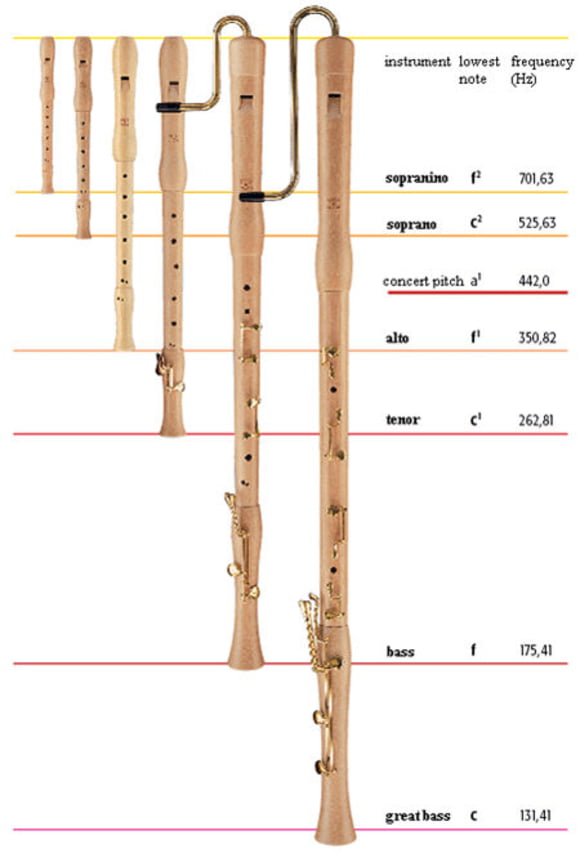
| Name | Lowest note | Sections | Best for |
|---|---|---|---|
| Sopranino | F | 2 | Consort, experienced |
| Descant (Soprano) | C | 3 | ★ Beginners, children, school |
| Treble (Alto) | F | 3 | Most versatile repertoire, Baroque |
| Tenor | C | 3 + key | Ensemble, experienced |
| Bass | F | 3 + keys | Consort, large hands |
Important: The lowest note alternates between C and F according to size. Players of neighbouring sizes effectively learn two sets of fingering. Recorders have a full chromatic range of two octaves.
Fingering: Baroque or German?
Baroque Fingering
More demanding for beginners, but far superior for chromatic music. Recommended for serious learning. The standard for Baroque and contemporary music.
German Fingering
Simplest for absolute beginners — lifting fingers in sequence produces the C or F scale. But limited for complex chromatic music.
SoundsGood recommendation: If you plan to study seriously, choose Baroque fingering from the start. It is much harder to re-learn than to learn correctly in the first place.
Playing Technique
The aim is to produce a vocal sound through a steady, well-controlled airstream. Diaphragm breathing is an acquired skill. A common mistake is overblowing to reach the upper octave; instead, the upper register is accessed by partially opening the thumb hole. Maintaining a careful thumbnail is essential for this control.
Materials and Makers



| Material | Density | Tone character | Care |
|---|---|---|---|
| Plastic (ABS) | — | Bright, practical; less warm | Easy — no oiling needed |
| Maple | Light | Gentle, warm tone | Easy |
| Pear | Light | Gentle, warm tone | Easy |
| Boxwood | Medium | Warm, classic | Moderate |
| Olive | Medium-high | Distinctive, bright | Regular oiling |
| Grenadilla | High | Dense, bright, powerful | Longer break-in |
General rule: Less dense (lighter) woods — gentler, warmer tone, easier care. Denser (darker) woods — stronger, brighter sound but require a longer break-in and regular oiling. Some recorders have a plastic head joint with a wooden body — no break-in needed, but retaining some wooden warmth.
Moeck
One of the leading makers. Wide range from student to concert level. Hand-crafted in Germany.
Mollenhauer
Premium brand. The Dream series is especially popular with amateurs and professionals alike.
Yamaha
Reliable student instruments, especially plastic models. The school teaching standard in many countries.
Küng
Swiss maker of concert-level recorders. Hand-crafted with outstanding sound and workmanship.
Repertoire and Instrument Types
Renaissance recorders: wide bore and large finger holes — open, fairly loud sound. Often played in consorts.
Baroque recorders: narrower tapered bore — the upper octave is more reliable, though the general dynamic is quieter. A wider dynamic range is achievable through specialised alternative fingering techniques.
What to choose for a start? Descant (Soprano) with Baroque fingering — the standard for children and beginners. Treble (Alto) with Baroque fingering — the most versatile repertoire; the best next step, or the choice for adult beginners with some musical background.
Choosing a Recorder
Home use and ensemble
Less dense wood — maple, pear. Gentle, warm tone; easier to care for.
Solo and public performance
Denser wood — boxwood, olive, grenadilla. Stronger, brighter sound for projection.
For children
Plastic or maple. Plastic withstands knocks and requires no breaking in. Maple — the first "real" wooden recorder.
Higher price ≠ better instrument
Spending more does not always mean a better result. A good mid-range instrument is the ideal starting point.
Essential: Make sure the recorder comes with a protective case — a lined wallet, padded roll-up bag or hard box. Recorders are vulnerable to mechanical damage and sudden temperature changes.
Breaking in a New Recorder
Wood is a living material. A new instrument must be broken in properly so that the wood can adapt to moisture and warmth gradually.
| Week | Maximum playing time per day |
|---|---|
| 1 | No more than 10 minutes |
| 2 | No more than 20 minutes |
| 3 | No more than 30 minutes |
| 4+ | Gradually increase to full playing time |
- Play every day in the first weeks — regular cycles of humidifying and drying matter more than duration
- Always start in the lower register; move to higher notes as the instrument warms up
- After playing: disassemble and wipe moisture from the bore with a cleaning mop
- Leave the recorder to dry overnight in an open case
- Never leave in extreme conditions: on a radiator, in direct sunlight or in very cold environments
- Keep away from chemicals
Care and Maintenance
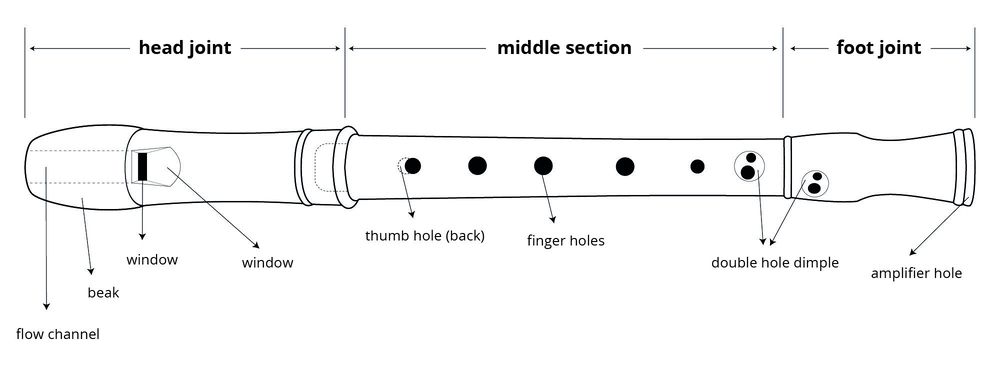

- After every session: disassemble, wipe moisture from the bore with a cleaning mop
- Keep the cork or thread joints greased with cork grease — ensures easy assembly and disassembly
- Once a month: oil the bore with almond oil — protects the wood from drying out
- The recorder must be completely dry before oiling (1–2 days without playing)
- After oiling: do not play for at least one day
The recorder sounds muffled or clogged — what to do?
The most common problem after breaking in — clogging from moisture. The block inside the mouthpiece swells. Solution: a few drops of anticondensant — hold the recorder upside-down and squeeze into the windway via the window (labium).
Intonation is uneven — can it be corrected?
Yes. A technician can enlarge finger holes to raise pitch, or drip and mould wax to lower it. Some makers do this free of charge within the first year.
Does the recorder need revoicing?
This is a job for a professional. The process involves removing and reshaping the block inside the mouthpiece. Many makers offer this at a reduced rate or free within the first year of purchase.
🏆 Why Choose SoundsGood
Official Distributor
Direct supply from leading manufacturers
Manufacturer Warranty
Only genuine products with full documentation
Delivery Across Ukraine
Nova Poshta, Ukrposhta or transport companies
Flexible Payment
Cash, bank transfer, instalments, invoicing
Prozorro Tenders
Supply to music schools via Prozorro
Wind Instrument Service
Repair and maintenance of wind instruments
Expert Advice
We help you choose the right recorder for age, level and purpose
100% Original
Yamaha, Moeck, Mollenhauer, Küng — genuine products only
📞 Order or Get a Consultation
📍 Showroom
15 Olzhycha St., Kyiv
Metro: Dorohozhychi
🕐 Hours
Mon–Fri: 11:00–18:00
Sat–Sun: closed