Bassoon —
the "sausage bassoon" that became symphonic
From the medieval Dulzian to the Heckel system — the essential bass woodwind of the orchestra. Five sections, double reed, bocal (S-bend), ~24 keys and a range of 3.5 octaves.
From the Dulzian to the Heckel System


Double-reed bass instruments existed in the Middle Ages — the Bass Pommer and Dulzian. The significant evolution of the modern bassoon began in the 17th century with "bundle-like" construction of deep double-reed instruments, initially keyless. One of the most unusual precursors is the Racket, also known as the "sausage bassoon" (Wurstfagott) for its many coils packed into a very confined space. The Heckel (German) system, established in the 19th century, is the standard today worldwide.
Overview
Material — Mountain Maple
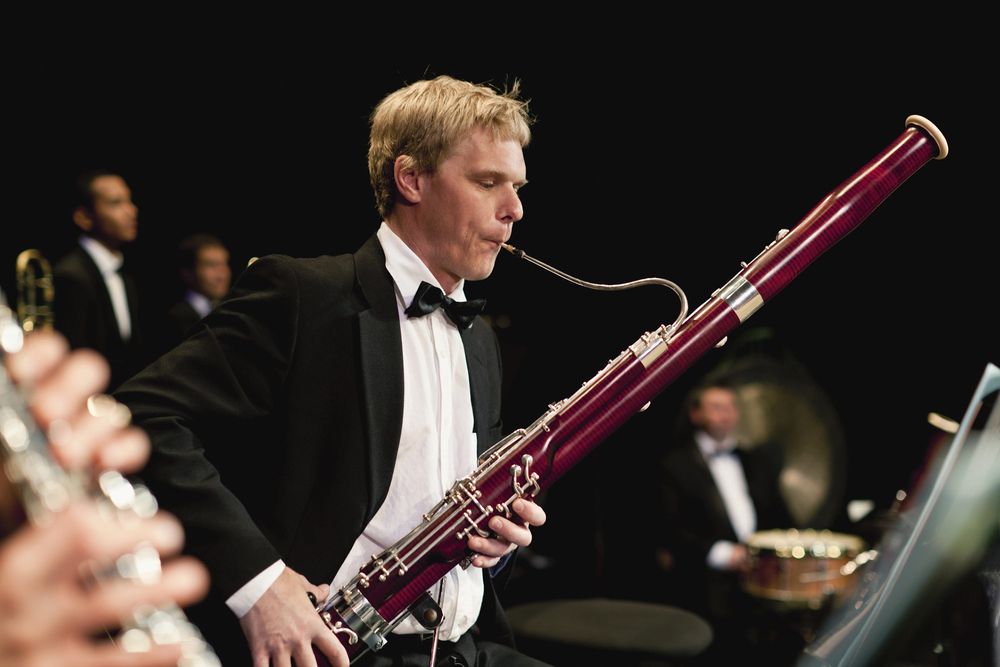
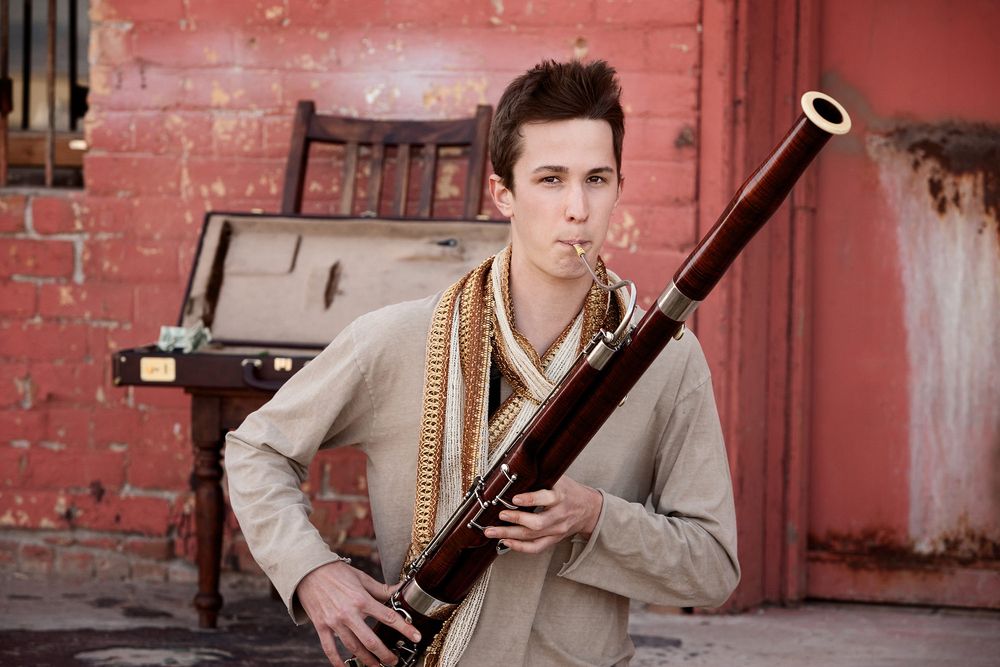
The bassoon is made from mountain maple (Bergahorn), growing at altitudes up to 2,000 m. The sparse mountain soil means slow growth and tight annual rings — ideal for bassoon construction. The peeled wood is almost white. During manufacture it is "flamed" (surface-scorched) and then stained in the characteristic reddish tones, which reveals the beautiful grain of the finished instrument.
Construction — Five Sections


Bocal (S-bend)
Conical metal tube in an S-shape. First element transferring vibration. Available in thin-walled and thick-walled versions, and in various metals.
Wing Joint
Upper section. Right thumb is heavily involved here. Interior walls lined with rubber to protect against condensation.
Boot Joint
U-shaped section. Right side more exposed to moisture. A hand rest ensures independent finger movement on the right hand.
Bass/Long Joint
The longest straight section. Left thumb works almost as many keys here as all other fingers combined.
Bell
The final, upward-pointing section. Shapes the lowest notes and overall sound projection.
Unique fingering system: Unlike other woodwind instruments where the thumb typically operates just one octave key, on the bassoon fingering extends to both sides of the instrument. The thumbs handle almost half of all the key work!
The Bocal (S-Bend) — a Critical Component
The bocal is the first element that transfers the tube's vibration to the bassoon. It is a conically hand-crafted metal tube available in two wall thicknesses — thin-walled (light, responsive) and thick-walled (powerful, stable). The most common metals are silver-plated nickel silver, solid sterling silver and silver-plated brass — each affecting the tonal response. Bocals also come in various lengths, which affects the basic pitch.
Key criteria when choosing a bocal: Easy, precise response across all tones, a full sound and stable intonation. It is advisable to test a bocal with an average-quality instrument, where the differences between bocals are most clearly audible.
The Double Reed


Sound is produced in exactly the same way as the oboe: the double reed is fitted onto the bocal and sealed firmly with the lips (airtight). Lips lightly drawn over the teeth, lower jaw slightly set back, oral cavity shaped as for the vowel "O." This interaction is called the embouchure.
No two reeds are alike. Thin reeds require adjustment to suit the bassoonist. The goal is a reed that can be blown without pressure but with adequate support. A reed's lifespan is roughly two months. Advanced bassoonists make their own reeds — a meticulous process requiring considerable practice.
For beginners: At the start, focus less on reed-making and rely more on your teacher. Good-quality commercially made reeds are widely available.
Playing Technique and Notes for Young Players
The bassoon has approximately 24 keys made of nickel silver, silver-plated or hard nickel-plated metal. Tone holes in the wing and boot joints are angled along the bore — to make them physically reachable for the player's fingers (straight bores would require impossibly wide stretches). Interior walls are lined with rubber sleeves to protect the wood from continuous condensation.
Body Size
Critical. Fingers must be large enough to cover the tone holes. Minimum hand span (thumb to little finger) approximately 17 cm.
Starting Age
Usually age 11–13. Every child develops individually. The teacher should assess each child in person before making a recommendation.
Student / Children's Model
Reduced key spacing, lower weight, fewer keys. Allows earlier access to the instrument before the hands are fully grown.
Instrument Cost
The bassoon is more expensive than most woodwind instruments. Renting for beginners is a sensible approach.
Tuning and range: The bassoon is tuned to C and covers approximately 3.5 octaves — from low B-flat (contrabass register) to high E. Notation uses two clefs: bass clef and tenor clef (for the highest register). After a short adjustment period, switching between clefs feels natural and is actually a great help.
Maintenance and Care
- After every session: thorough cleaning. Remove sweat from the mechanism and woodwork with a soft cloth
- The bocal, wing joint and right boot bore are most prone to condensation. Use suede swabs with pull-cords for the wing and boot joints, and a dedicated bocal brush for the bocal
- For the bass joint and bell: a soft bottle-brush-style swab
- Periodically clean the mechanism with a silver polishing cloth
- Avoid sudden temperature and humidity changes — the wood is a living material
Why is the bassoon so expensive?
It is a complex and labour-intensive instrument: ~24 keys, mountain maple with precisely machined bores, hand-fitted bocal, rubber sleeves throughout. Even student models start at a significant price. Renting is a sensible starting option.
Is the bassoon suitable for children?
Yes — provided the hand span is sufficient (min. 17 cm) and the child is old enough (typically 11–13). Children's models with reduced key spacing allow earlier access to the instrument.
Which system — Heckel or French?
In modern teaching: exclusively the Heckel (German) system. The French system is extremely rare today.
Is it true that reeds drive players crazy?
That's an old legend! In the past, the lack of proper tools for reed adjustment made the work genuinely difficult. Today's technology produces reeds that respond freely without pressure. No madness required.
🏆 Why Choose SoundsGood
Official Distributor
Direct supply from leading manufacturers
Manufacturer Warranty
Only genuine products with full documentation
Delivery Across Ukraine
Nova Poshta, Ukrposhta or transport companies
Flexible Payment
Cash, bank transfer, instalments, invoicing
Prozorro Tenders
Supply to music schools and orchestras
Wind Instrument Service
Repair and maintenance of wind instruments
Expert Advice
We help you choose the right bassoon for age, level and budget
100% Original
Oscar Adler, Schreiber, Buffet — genuine products only
📞 Order or Get a Consultation
📍 Showroom
15 Olzhycha St., Kyiv
Metro: Dorohozhychi
🕐 Hours
Mon–Fri: 11:00–18:00
Sat–Sun: closed