Clarinet —
the velvet voice of the woodwinds
From Denner to Boehm — history, construction, fingering systems, choosing, care and mouthpieces. Everything you need to know before buying a clarinet.
History of the Clarinet
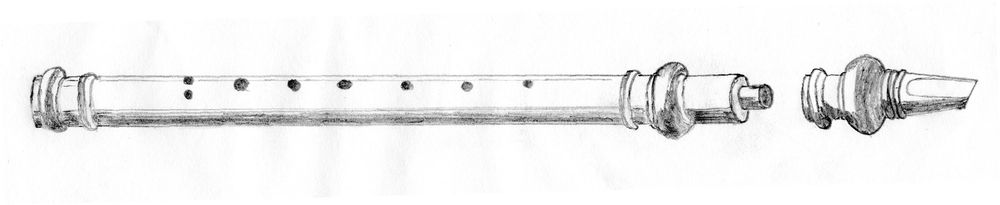
The clarinet is a unique wind instrument: when overblown it produces not an octave but a twelfth (an octave plus a fifth). This required an entirely different approach to tone-hole spacing, which only became possible in the 17th century.
The clarinet's ancestor was the chalumeau. Nuremberg instrument maker Johann Christian Denner took the chalumeau as his starting point and around 1700 created the first clarinet. Mozart wrote his clarinet concertos for an instrument with five keys.
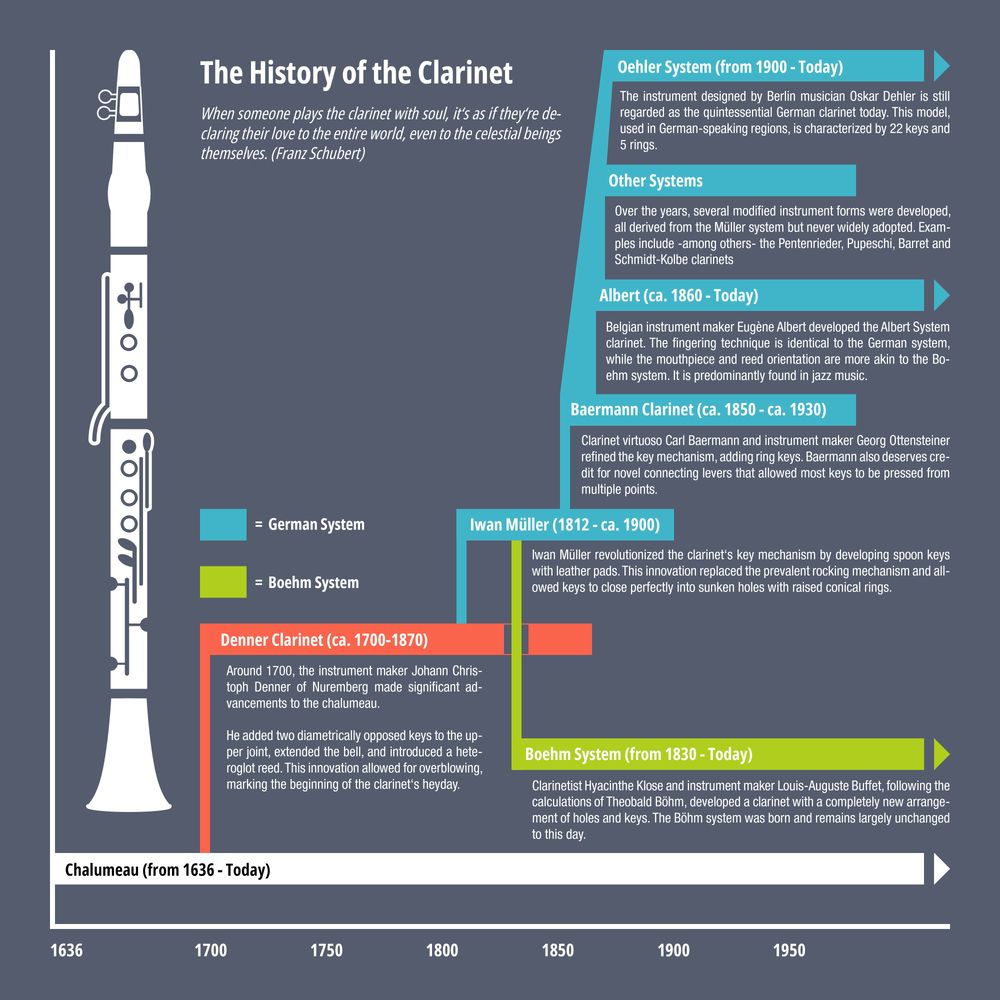
In 1812 I. Müller created a 13-key model — the foundation of the German system. In 1844 Klosé and Buffet adapted the Boehm system to the clarinet. In the late 19th century Berlin maker Oskar Oehler built a 22-key clarinet — an aristocratic, tone-focused alternative.
The Clarinet Today
The clarinet features in classical music, jazz and folk — and plays a prominent role in all three genres thanks to its extraordinary tonal variety. From a soft, quiet, velvety tone to a brash, trumpet-like fortissimo — no other woodwind offers such a range of expression.
"The clarinet can be played very fast but also smoothly, as if it were singing."— Thomann Clarinet Online Guide
Classical Music
Concertos by Mozart, Weber, Brahms. An indispensable voice in the symphony orchestra and chamber music.
Jazz and Swing
Benny Goodman, Artie Shaw — the clarinet defined the sound of 1930s–40s jazz. Still very much alive today.
Folk Music
Balkan music, klezmer, Greek laïká — the clarinet is inseparable from the traditional culture of many peoples.
Wind Orchestras
The clarinet is the "violin" of the wind orchestra — a key voice in both melody and harmony.
The Clarinet Family
Piccolo (Eb)
The highest and most piercing member. Used in symphony orchestras. Extremely penetrating tone.
Soprano Bb ★
"The" clarinet. The most common. When people say "I play clarinet," this is what they mean.
Soprano A
The Bb's partner. Most professionals own both. More convenient for flat keys.
Soprano C
Non-transposing. Sounds as written — can be played with a pianist without transposition.
Alto (Eb or F)
Larger and lower. Straight or upward-curved bell. Rarely used as a solo instrument.
Bass Clarinet (Bb)
Deep, rich tone. Distinctive curved bell. Indispensable in orchestral and ensemble settings.
Basset Horn
An alto clarinet once built in a curved shape. Mozart had a particular affection for this instrument.
Contrabass
The largest and lowest member. Rare but indispensable in full wind orchestras.
For beginners — the Bb clarinet. It is the standard, with the largest body of educational material and sheet music available.
Structure of the Clarinet

Mouthpiece
Has the greatest influence on sound of any component. Visually resembles a flattened tube opening with a reed attached.
Barrel
Connects the mouthpiece to the upper joint. Responsible for coarse tuning. Many models come with two barrels of different lengths.
Upper Joint
Played with the left hand. The number of keys varies by model.
Lower Joint
Played with the right hand. Also features keys and rings.
Bell
Plays a significant role in the acoustics of the low notes. Deserves the same careful handling as any other part.


Important: Mouthpieces of the two systems are not interchangeable — the Boehm mouthpiece has a larger bore. Always check compatibility when replacing a mouthpiece.
Body Materials
Grenadilla (African Blackwood)
The standard for concert instruments. Dark, dense, heavy. Produces a warm "woody" tone. Sensitive to temperature changes.
Ebony
Another premium option with similar properties to grenadilla. Rarer and more expensive.
Plastic (ABS)
Ideal for beginners and outdoor performances. Unaffected by sudden temperature changes. Slightly less warm tone in the upper register.
Key Mechanism
Keys and rings are nickel silver, often silver-plated. Expensive models use forged rather than cast metal — more resistant to breaking.
Advice: If you mainly play indoors and study seriously — choose wood. For outdoor performances, marching and children — a plastic clarinet is more practical and more durable.
Fingering Systems


Boehm System (French)
Developed by Klosé and Buffet in 1844. The standard in France, the UK, the USA and most of the world. Designed for technical virtuosity — fingers rarely need to slide from key to key. Wider mouthpiece bore. Widely used in jazz and classical music.
German System (Oehler)
A development of Müller's model, refined by Oehler in the late 19th century. Standard in Germany, Austria and Switzerland. Designed for a noble, refined tone with a large number of correction keys.
| Feature | Boehm (French) | Oehler (German) |
|---|---|---|
| Prevalence | Worldwide except DACH | Germany, Austria, Switzerland |
| Focus | Technical speed | Noble tone quality |
| Keys | 17 keys, 6 rings | 20–22 keys |
| Mouthpiece | Larger bore | Smaller bore |
| Repertoire | Jazz, classical, pop | Classical, symphonic music |
Which to choose? Ask your teacher — the choice of system depends on your environment, repertoire and musical tradition.
Choosing a Clarinet


Entry Level
€200–500 — plastic or composite body. The priority is ease of playing from the very first lesson.
Intermediate
€500–1,500 — grenadilla wood, stable mechanics, good tone for serious study.
Concert Level
From €1,500 — premium grenadilla, forged mechanics, precise intonation. F.A. Uebel, Schreiber, Buffet.
The key principle for beginners: ease of playing matters more than tone. A clarinet with a wonderful sound but a difficult mouthpiece or reed is demotivating. Comfort from the first lesson is the key to progress.
Mouthpiece and Reed
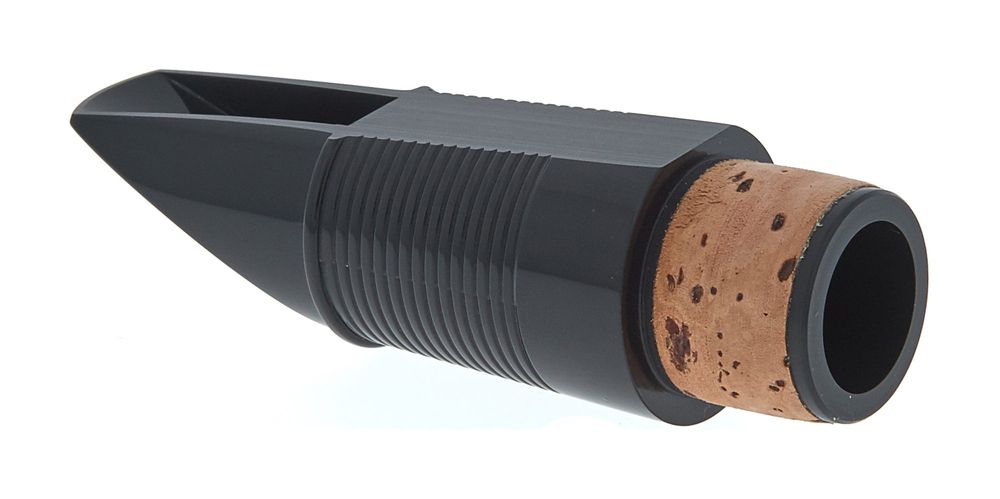
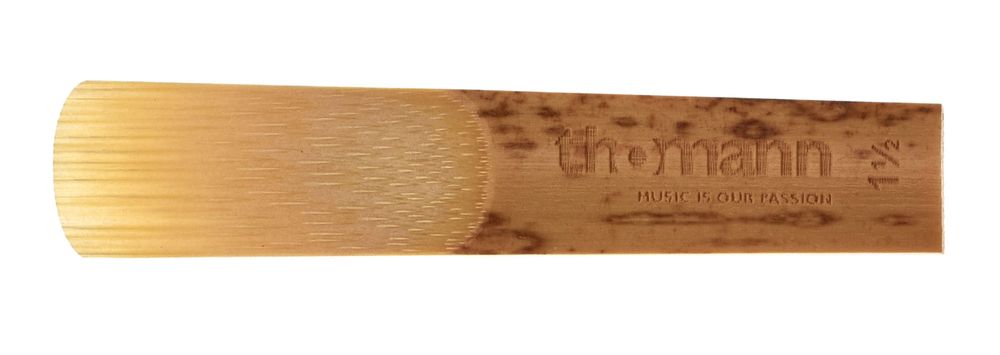
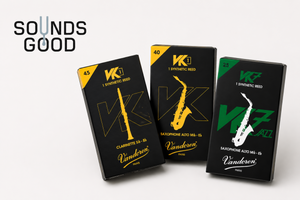
The mouthpiece has the greatest influence on the sound of a clarinet of any component. Advanced players often use two different mouthpieces. The best way to find the right one is to try various models.
Facing Length
The surface on which the reed rests. Influences vibrato and ease of playing in the upper register.
Tip Opening
The gap between the reed tip and the mouthpiece. Determines tone character and the required reed strength.
Material
Ebonite — warm tone. Plastic — brighter. Crystal — ringing. Wood — exceptionally soft sound.
Ligature
Holds the reed to the mouthpiece. Metal, leather or string. Affects reed response and freedom of vibration.
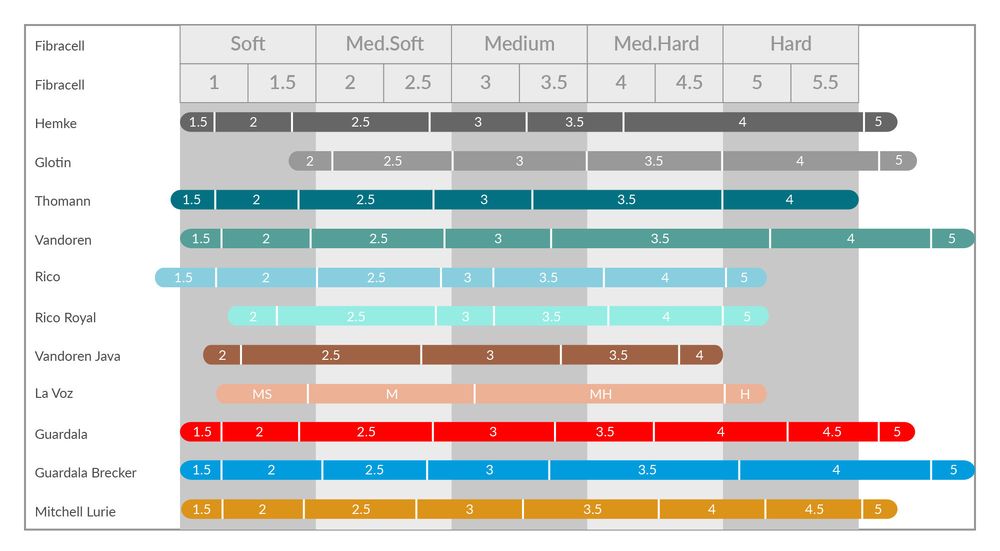
| Strength | Best for |
|---|---|
| 1½ — 2 | Absolute beginners — minimal resistance, easy tone production |
| 2½ | Beginners after 3–6 months — balance of ease and control |
| 3 | Confident amateurs — more even intonation |
| 3½ — 4 | Experienced players — maximum control |
Reed storage: After playing, remove the reed from the mouthpiece and allow it to dry separately — on a flat, hard surface (ideally glass). Store in dedicated reed cases to prevent warping and damage.
Care and Maintenance
Treat the clarinet like a person: it does not like standing in a draught without a coat or in the sun without protection. Extreme temperatures — near a radiator, an open window or in a humid environment — are all harmful.
Swab after every session
Pull a swab through each section after playing to remove moisture. Then allow the clarinet to dry in open air — never go straight into the case.
Keys and rings
Wipe the key mechanism with a soft cloth after playing — perspiration attacks the nickel silver over time.
Bore oil for wooden bodies
Regularly treat the bore with oil — but be careful: oil must not contact the key pads or the keys themselves.
Temperature
Never leave a wooden clarinet in a cold car in winter. Sudden temperature changes cause cracks in the body.
Corks and pads
Apply cork grease to the tenon corks regularly. If air is leaking around a key pad — take it to a technician.
Case
Store the clarinet in its case on a dedicated stand — never simply leave it lying on a table.
Minimum Starter Accessory Kit
- Pull-through swab — one for each section
- Soft cloth for polishing the key mechanism
- Cork grease for tenon joints
- Bore oil for wooden clarinets
- Reed case (reed holder)
- Spare reeds — at least 5–10
- Hard case or sturdy gig bag
Frequently Asked Questions
Are the fingerings the same as on saxophone?
Largely yes for the first and second octaves. However, the clarinet overblows a twelfth rather than an octave — so the upper register fingerings differ significantly.
What is the minimum age to start?
Usually from age 8–10. Sufficient lip and breath strength are required. Simplified "junior" clarinets exist for younger children.
Which system should I choose — Boehm or Oehler?
Ask your teacher. If you are in Germany/Austria/Switzerland and play classical music — likely Oehler. Elsewhere in the world, or if you plan to play jazz — Boehm.
Does a new wooden clarinet need breaking in?
Yes. A new wooden clarinet must be introduced to moisture gradually — practice in 15–20 minute sessions during the first few weeks to allow the wood to adapt and avoid cracking.
How often should reeds be replaced?
With 30–60 minutes of practice per day, a reed lasts 1–3 weeks. Replace immediately at the first sign of cracks or chips.
Plastic or wood for a beginner?
For children and outdoor use — plastic is more practical. For serious indoor study — a wooden clarinet will yield better results. Both are perfectly valid starting points.
🏆 Why Choose SoundsGood
Official Distributor
Direct supply from leading world manufacturers
Manufacturer Warranty
Official warranty. Only genuine products with full documentation
Delivery Across Ukraine
Nova Poshta, Ukrposhta or transport companies. End-to-end delivery
Flexible Payment
Cash, bank transfer, instalment plans, invoicing for legal entities
Prozorro Tenders
Supply to music schools, conservatories and orchestras via Prozorro
Wind Instrument Service
Repair and maintenance of wind instruments in Kyiv
Expert Advice
We help you choose the right clarinet for your level, system and budget
100% Original
Manufacturer certificates — genuine products only
📞 Order or Get a Consultation
📍 Showroom
15 Olzhycha St., Kyiv
Metro: Dorohozhychi
🕐 Hours
Mon–Fri: 11:00–18:00
Sat–Sun: closed