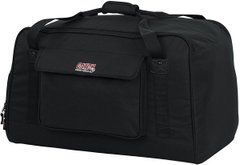
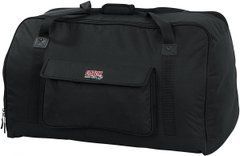
Choose the Gator protection format first
Gator offers several speaker transport formats, including slip-on covers, carrying bags and rigid cases. Compare them against your working routine. A cabinet carried by its own handles needs convenient access to those handles. A fully enclosed bag requires suitable opening, fit and carrying arrangements. For shared vehicle loading, assess the complete placement of equipment rather than one accessory in isolation.
Do not treat Cover and Tote as interchangeable product descriptions. Gator distinguishes, for example, the GPA-CVR and GPA-TOTE ranges. Read the exact product description and inspect views from all sides. Similar-looking black accessories can have different bottoms, closures and purposes. The brand name does not establish the same protection level for every item.
Internal dimensions matter more than driver class
A category based on driver diameter starts the search but does not finish the compatibility check. Measure your speaker’s height, width and depth, including handles, feet and protrusions that remain attached. Gator specifications may list interior, exterior and shipping dimensions separately. Use the correct figures for fit, and consider the packed external size when planning vehicle space.
A compatibility list is helpful, but the speaker generation matters as well. Do not shorten the model name to a number. If the exact product is not listed, compare shape and measurements and clarify suitability. Do not plan to stretch the bag or force its zipper to compensate for a mismatch. An overly loose fit also needs checking because the cabinet may move during carrying.
Lining, the base and opening the bag
Lining separates the cabinet from the outer material, but its presence does not establish protection from every fall. Check which surfaces are covered and how the bottom is supported. Regular use requires easy loading without catching the finish or protrusions against a zipper. Compare the fully opened arrangement rather than only the appearance of a closed bag.
For GPA-TOTE10, the manufacturer describes a soft-lined interior and a dual-zipper top opening. These are product-specific features rather than a universal description of every Gator item. Before packing, straighten the lining and remove hard objects. Where two people handle the speaker, test loading and unloading in the actual working position. Consider whether the opening remains convenient when the bag is placed beside other equipment.
Handles and accessories in one setup
Assess carrying arrangements with the full load in mind. External handles, straps and their attachments must be used as intended. Do not lift a loaded bag by an accessory pocket or zipper tab. Check closure and cabinet position before tackling stairs, a narrow turn or a high vehicle loading edge. Include the grip you will use when the bag is fully packed.
A cable pocket reduces the number of loose items, but should not become storage for every heavy component. Arrange plugs, adapters and power supplies so they do not press against the cabinet through the wall. For two speakers, confirm the compartment count and permitted arrangement. Large external volume alone does not establish that a bag is intended to hold a pair without separation.
Weather, storage and the limits of soft protection
Water-repellent material does not make a bag sealed. Openings, seams and closures may have different properties, so check conditions for the exact product. Do not place packed equipment on a wet surface solely because of a general fabric description. After moisture exposure, inspect both the bag and speaker before prolonged storage.
Keep the interior clean and remove small sharp accessories. When loading beside rigid cases, provide a position where a heavy item cannot crush the soft bag. A transport design does not establish permission to operate an active speaker inside it. Remove the protection before use unless the manufacturer explicitly supplies an operating arrangement with suitable access to the required parts.
Ordering the correct Gator accessory
Prepare the full speaker name, dimensions, quantity and transport routine. Confirm the accessory code, sales unit and supplied components. For rental equipment, record which bag belongs to each cabinet. This simplifies repeat purchasing and packing a mixed setup after a performance. Clear identification also helps when different people handle the equipment.
On delivery, check the fit on a level surface, operate the closures and try a short carry. Compare the result with your usual route. A suitable Gator accessory should protect the intended surfaces and simplify work without excessive fabric tension, an awkward grip or constant rearrangement of accessories. Inspect seams and closures during regular use and establish service options for damaged parts.
Include transport space in the budget comparison. A compact bag and rigid case can require different loading arrangements. Compare packing time, the number of people needed for handling and storage between events as well as the accessory price. The useful choice is the one that suits the complete routine, not merely a nominal speaker size.
SoundsGood supplies sound equipment for educational institutions, studios, concert halls, conference rooms, and public and private organisations. A technical brief can be used to agree on system components, specifications, a commercial quotation, documentation and delivery arrangements.