



|
Quantity
|
Cost
|
||
|
|
|||
|
|
|||
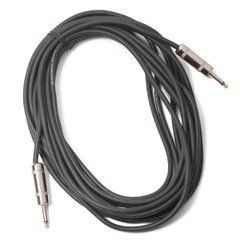
Ready-made speaker cables for amplifiers and passive cabinets
A ready-made speaker cable connects a power amplifier output to a passive loudspeaker, or a guitar amplifier head to its cabinet. It arrives with connectors fitted to a specified length of cable, making it convenient when you need a defined connection without assembling plugs yourself. However, a finished cable is not automatically universal. Similar connectors can carry different signals, and the number of visible contacts does not establish the actual wiring inside the assembly.
The SoundsGood category includes TS–TS, speakON–speakON and speakON–TS assemblies in different lengths. A suitable direct cable can avoid an unnecessary adapter, provided both connected devices support that connection. Compare the exact model, conductor size, length, connector arrangement and pin assignment. The phrase “audio cable” alone is too broad to identify a safe and useful link between an amplifier and a passive speaker.
Speaker cable versus instrument cable
The cable between a guitar and an amplifier input carries a small signal. The cable between a power amplifier output and a passive cabinet carries the electrical power that drives the loudspeaker. These jobs require different cable construction. Yamaha's PA guide explicitly distinguishes instrument and speaker cables even where both use similar jack plugs. You cannot reliably identify their purpose from the connector shape, jacket colour or apparent thickness alone.
Use a dedicated speaker assembly with suitable conductors for the amplifier-to-cabinet link. A screened guitar lead is not a substitute simply because its TS plugs fit. Conversely, a speaker cable is not the normal choice for the low-level signal from a guitar pickup. If both types live in the same equipment bag, label them clearly at both ends. Visible “speaker” and “instrument” labels are more useful during a hurried setup than relying on memory or tiny jacket printing.
Check whether the loudspeaker is active or passive
A passive loudspeaker needs an external power amplifier. An active loudspeaker includes its own amplifier and normally accepts a suitable signal from a mixer or other line-level source. The connection from a mixer to that line input therefore calls for the appropriate signal cable. Do not connect an external power amplifier's speaker output to a line input just because an available plug fits. Physical compatibility does not establish electrical compatibility.
Write down the complete labels on both panels. Speaker Out, Line Out, Input and Link can describe different parts of a system, and the meaning of Link depends on the equipment. Some systems combine an active main unit with a passive extension loudspeaker powered from a dedicated output. Follow that system's instructions when selecting its extension cable. A description such as “cable for an active PA” does not identify which particular connection needs to be made.
Choosing TS, speakON or a mixed assembly
Speaker TS–TS assemblies are used with compatible guitar heads and cabinets. Examples in the category include D'Addario Classic speaker cables and the MXR DCSTHD3. speakON connections are common in PA applications and include a locking mechanism. A speakON–TS assembly may be appropriate where the two devices provide different, compatible speaker connectors. It should be selected for that documented connection rather than treated as a universal adapter between any amplifier and speaker.
A four-contact speakON body does not prove that all four contacts are wired or that an assembly supports a particular bi-amp arrangement. Confirm which contacts the cable uses and which the equipment requires. Bridged amplifier operation may also require a specific pin assignment. Changing connector shape does not change signal level, combine amplifier channels or correct an incompatible load. The equipment instructions remain the deciding reference even with a factory-finished cable.
Measure the actual cable route
Measure from socket to socket along the intended path: down from the amplifier rack, around obstacles, along the stage edge and up to the loudspeaker panel. The straight-line distance is often too short. Allow a modest amount of slack for positioning and access, without leaving an unnecessarily long run. A stretched cable puts strain on the sockets; excessive spare length makes deployment harder and adds conductor resistance.
A short assembly may suit a head sitting directly on its cabinet. A rack at the side of a stage can require a much longer run. The category contains short MXR and D'Addario options as well as longer RockCable and Soundking assemblies. Read the precise length and units for the selected item. For example, 25 feet is approximately 7.62 metres, not 25 metres. A number in a model name should not replace the specification.
Conductor size and resistance
For the same conductor material and construction, a longer conductor has more resistance, while a larger cross-sectional area reduces it. The electrical loop includes the path to the speaker and the return path. This means the distance between the two devices is not the complete conductor length involved in the circuit. A short cabinet connection and a long stage run can therefore need different cable choices even when their connectors match.
D'Addario specifies 16 AWG stranded copper conductors for its Classic speaker cable series. That information belongs to the specified series and should not be assumed for every other model or brand. Look for the actual AWG or cross-sectional area of the assembly you are considering, then check the equipment manufacturer's recommendations for cable length and load. A thick jacket or the word “professional” is not a substitute for conductor specifications.
Multiple cabinets and channel identification
A cable does not turn a speaker's nominal impedance into an arbitrary value required by the amplifier. Adding another cabinet changes the total load according to the connection arrangement. Two identical cabinets connected in parallel present a different load from one cabinet. Check the permitted configuration in the amplifier and loudspeaker manuals. The presence of a second socket does not grant permission to connect an unlimited number of additional speakers.
For a stereo system, label the left and right cables at both ends. For a multichannel amplifier, include the channel number and cabinet destination. This helps rebuild a known arrangement after transport and makes troubleshooting more systematic. If a bridged configuration is used, record the required contacts and permitted load separately. Do not transfer a normal single-channel wiring assumption to a bridged output without checking the manual.
Mechanical details that matter in a finished cable
Inspect the plug housings, cable exit protection and strain relief. Consider whether you can comfortably connect and disconnect the assembly in the actual space behind the rack. A speakON lock helps prevent accidental unplugging, but it is not a suspension point for equipment or a long hanging cable. Leave access to the release mechanism and support the run so its weight does not continually pull on the loudspeaker socket.
A factory-assembled lead still needs inspection after transport. A damaged jacket, loose housing or intermittent connection should take the cable out of service until it is checked. Increasing the volume will not repair a mechanical fault. A tested spare of the correct length and wiring is a useful backup. An unidentified adapter from a miscellaneous accessory bag is not an equivalent substitute when its internal connections are unknown.
Connecting, testing and storing the assembly
Switch equipment off before changing speaker connections, following the sequence specified in its instructions. Insert plugs fully and engage the locking mechanism where provided. Start the system check at a low level. If one channel is silent, check the route, channel settings and a known working cable in a controlled sequence. Do not make improvised links between amplifier outputs. Continuity testing should be performed on the cable after it has been disconnected from the equipment.
After use, coil the lead without tight kinks and remove plugs by their housings rather than pulling the jacket. A reusable tie can carry a label showing length, connector types and purpose. Larger equipment inventories can also record the contact arrangement and the last inspection date. This is particularly useful where speaker, instrument and special adapter leads look similar. Clear identification saves time without requiring changes to the audio system itself.
Two practical selection examples
For a guitar head placed on its cabinet, confirm the amplifier's permitted load and the purpose of both sockets first. Then measure the short route with a little slack. If both are compatible TS speaker ports, choose a speaker TS–TS assembly rather than an ordinary guitar input lead. The small distance does not remove the need for the correct cable construction or a reliable plug connection.
For a passive PA speaker some distance from an amplifier rack, consider the entire floor route, conductor size and protection at any crossing point. A touring kit may benefit from several sensible lengths instead of one maximum-length assembly used everywhere. Before ordering, collect the equipment model names, panel photographs and required pin assignments. If the product listing does not state a necessary conductor size or wiring detail, clarify it rather than assuming all matching plugs are equivalent.
Frequently asked questions
Can I use a normal guitar lead? Matching plugs are not enough. The power amplifier-to-passive-speaker connection needs a dedicated speaker cable of suitable construction and conductor size. The guitar-to-amplifier-input lead performs a different job.
Should I always choose speakON? Choose the connector supported by the equipment. The locking mechanism is useful, but the contact assignment still has to match. An adapter does not correct incompatible electrical requirements.
Is extra length harmless? Select enough length for the real route and practical positioning. Unnecessary length adds resistance and complicates handling. Confirm conductor size particularly carefully for longer connections.
Where can I check the basics? Consult the Yamaha PA cable guide, the specifications for D'Addario Classic speaker cables, and the manuals for your exact amplifier and loudspeaker models.