Define the complete kit before choosing its carrier
Start with everything that travels alongside the microphone. A singer may need space for a handheld microphone, clip, cable and spare windscreen. An event presenter may also carry a wireless receiver, power supply and transmitter. A drum microphone kit needs room for several differently shaped bodies, instrument mounts and short cables. Two sets containing the same number of microphones can therefore require quite different luggage.
Lay the equipment on a table in the arrangement you intend to pack. Identify heavy power supplies, sharp fittings and vulnerable grilles separately. Note the length and maximum width of each item. Include any protruding parts that remain attached to a handheld transmitter during transport. For a studio microphone, include its original protective box if that box will travel inside the larger case. This inventory is more useful than judging capacity from an exterior photograph.
Do not rely on the lid squeezing the last few items into place. A closed carrier should not press against a grille, switch, antenna or connector. Excessive empty space is also undesirable because equipment can move and strike neighbouring items. A useful fit combines sufficient room, an appropriate compartment shape and restraint for each part of the system. Check all three rather than looking only at overall volume.
Choosing between a soft bag, rigid case and equipment backpack
A soft bag is convenient for short journeys where you personally carry and position the equipment. It can be easier to put aside after unpacking, but its walls should not be treated as supports for heavy luggage. If the microphones travel with speakers, stands and other cases, assess the shell and internal support separately. The word “case” in a product name does not itself define the loads it can withstand.
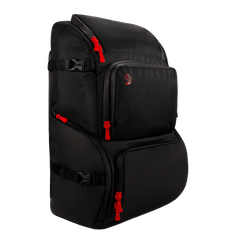
A backpack becomes useful when the kit also includes cables, small pedals, a tablet or other personal working equipment. The D’Addario Backline Gear Transport Pack provides dedicated storage for different items, including microphones and cables. It is an approach to organising a complete travelling setup, rather than an automatic substitute for individual protection around every possible microphone. Compare each device with the compartment intended to hold it.
Consider how you actually carry the load. A shoulder strap frees your hands only if its adjustment and position remain comfortable with the complete kit packed. A handle helps with short movements around a stage, while a compact shape is useful in narrow passages and on public transport. A short walk from a car and a daily journey with several connections place different demands on the carrier.
Microphone slots and separate accessory storage
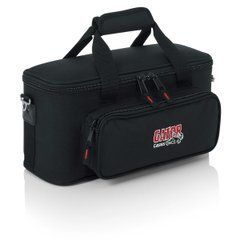
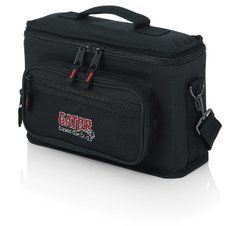
The Gator GM-4 and GM-12B are designed for four and twelve microphones respectively. Those capacities help distinguish the formats, but they do not establish a fit for every unusually shaped model. A large studio body, extended transmitter or microphone with a permanent mount needs an individual check. Compare the usable slot space with the widest parts of the device, not just its handle diameter.
Check how the equipment comes out of its insert. The grille should not be the only accessible part to grip, and a snug fit should not require forceful pulling. A padded divider is useful only if it stays where it belongs through repeated opening and closing. With a mixed microphone kit, assign each device a particular compartment in advance. This makes it easier to pack correctly after a performance and notice an empty position.
Put cables in a dedicated pocket or separate compartment. Do not leave metal connectors loose beside microphone grilles. Position power supplies so their plugs cannot press against the receiver housing. Keep small adapters and threaded inserts together in a closed pocket or small container. Searching for a tiny fitting at the bottom of a large bag is an avoidable interruption during soundcheck.
Packing a wireless system as one working kit
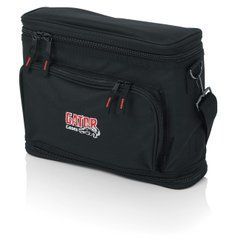
A wireless system contains more than its microphones. The receiver, power supply, bodypack, lavalier, mixer connection cable and removable antennas all need assigned places. Consult the equipment instructions to determine which parts should be disconnected for transport. Do not bend protruding components simply to make the equipment fit a smaller bag. A carrier that only accommodates the receiver itself may leave essential accessories unprotected.
If you intend to operate a receiver while it remains inside its bag, the particular carrier must be designed for that arrangement. Controls and connections need to remain accessible, and ventilation and antenna positioning must meet the equipment requirements. An ordinary transport pocket does not become an operating enclosure merely because its zipper can be left partly open. Check this use explicitly before planning the stage setup around it.
Keep the empty carrier in one designated location after setup. At the end of the event, check off the receiver, transmitters, power supply, cables and mounts. Small adapters left in a mixer or clips left on stands are easy to overlook. Numbered pockets and a short contents card often help more than an additional empty compartment. They also let a colleague pack the equipment without guessing where each item belongs.
Storage between events and routine carrier checks
Before packing, make sure the equipment and carrier interior are clean and dry. Microphone cleaning methods come from the microphone manufacturer; a transport bag does not replace care of a grille or windscreen. After outdoor use, inspect the bottom of the bag and pockets where moisture may remain. Water-resistant fabric should not be interpreted as a sealed waterproof enclosure for the complete product.
Inspect stitching near handles, strap attachment points, fasteners and the insert periodically. A damaged divider can allow items to touch even when the exterior still looks serviceable. For longer storage, also follow the equipment manufacturer's guidance on batteries and environmental conditions. Recheck the arrangement whenever the kit changes: a new power supply or larger transmitter can affect the protection of neighbouring equipment as well as its own fit.
Questions to resolve before ordering
Is the microphone count enough to choose a bag? No. Supply the models, dimensions and accessory list. Four compact vocal microphones and four studio microphone kits with suspension mounts need different internal arrangements.
Are microphones shown in photographs included? Check the contents list for the exact item. Photography can demonstrate how a carrier is used without making the illustrated equipment part of the purchase.
Can I choose extra capacity for future equipment? Yes, provided empty compartments do not weaken the restraint of the current kit. Plan spare capacity around a specific addition rather than using a larger overall size as a substitute for checking individual dimensions.
What information helps with selection? Provide the equipment models, quantities, transport method and accessories that must remain together. Those details make it easier to compare practical formats and confirm a suitable fit before purchase.
SoundsGood supplies sound equipment for educational institutions, studios, concert halls, conference rooms, and public and private organisations. A technical brief can be used to agree on system components, specifications, a commercial quotation, documentation and delivery arrangements.