Clips, rims and nearby cymbals
Mount securely without obstructing the player. Adjust the angle towards the head while assessing tom tone and cymbal spill. Listen to fills across the toms so channel levels and character form a coherent part of the kit.
Headroom and attack
Choose a microphone and preamp with headroom for the hardest hits. Frequency response, distance and angle affect the balance of attack, fundamental tone and decay. Adjust drum tuning and placement before applying processing.
Interaction between channels
Listen to each channel separately and with the other microphones. Moving a microphone changes sound arrival time: check the combined tone and mono compatibility, especially after repositioning stands.
Unobstructed mounting
Leave clearance for sticks, cymbals and the player’s movements. Check rim-clip compatibility, stand stability and cable routing. Contact with moving parts can produce unwanted noise.
Inputs and power
Count the microphone inputs and cables required. Condenser models may need phantom power; consult the manufacturer for exact requirements. Check power for every channel and the contents of the selected package.
Attack, fundamental tone and decay
Choose around the tom's role in the kit. Low-frequency weight matters alongside clear attack and natural movement between hits. A small rack tom and a large floor tom have different characters, so identical presentation is not the goal. Compare a complete fill for pitch and dynamic progression. Each drum should retain its identity rather than disappear when the rest of the rhythm-section channels are added.
Check head tuning, hoops and unwanted vibration before testing. A long decay may be intentional. Do not apply heavy gating simply because the tom resonates between hits. Assess the acoustic instrument and musical role first. This separates changes best made through placement from changes to the drum itself. Keep conditions consistent so microphone differences are not confused with tuning changes or a different performance intensity.
Placement near the head and adjacent cymbals
Compare angle and distance while preserving the stick path. Direction changes the balance of attack and body. Do not mechanically transfer one position to every size. Begin with a consistent approach, then hear each tom and the complete fill. Adjust placement as well as gain. This preserves useful differences while avoiding the impression that one drum was captured in an entirely unrelated way.
Cymbals affect the channel, particularly during energetic playing. Test their contribution in a full groove. Directionality helps manage spill but does not remove it completely. Check the model's pattern and orientation relative to neighbouring sources. An attractive isolated hit may not produce a good fill with a crash cymbal. Judge the actual playing style and the tonal quality of spill, especially if the tom channel will receive further processing.
AKG D40, AUDIX MicroD and power requirements
This category contains different operating principles. AKG D40 is a dynamic instrument microphone, while AUDIX MicroD is a miniature condenser. Check their connections separately. MicroD documentation describes its power adapter; an arbitrary mechanical miniature-connector adapter is not an equivalent substitute. Confirm the package and entire route to the mixer. A tom-microphone application alone does not establish the required power or output arrangement.
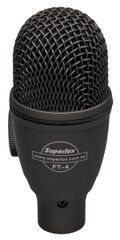
For Superlux FT4, use the specifications of the exact item. Compare dimensions, pattern, mounting and headroom rather than brand names alone. With several toms, check inputs and power for the complete setup. A small capsule is convenient in tight spaces, but adapters, cables and holders also need room. Evaluate the finished configuration before purchase so the microphones can actually operate together with the equipment already available.
Clamps, hoops and playing freedom
A clip must fit the hoop, hold securely and leave tuning screws accessible. Check mechanical noise transmitted through the mount. A stand needs a stable base and space between kit components. Keep the microphone outside stick paths and clear of moving cymbals. Test fast fills rather than only a slow hit. The working position should support normal performance without requiring the drummer to restrict familiar techniques.
Leave cable slack without pulling on the capsule. Recheck after changing tom height or angle. Label channels and mounts for touring. Plan removal before packing so thin cables and goosenecks are not loaded inside the case. A clear setup procedure improves repeatability. Inspect contacts and clamps after transport, since previously successful settings do not reveal a new mechanical problem introduced while moving the equipment.
Balancing several toms and using processing
Set inputs from strong real hits with headroom, then listen across the fill. Levels follow the music rather than identical gain-knob positions. Check overheads because close and overall microphones hear the same hit from different locations. If body is lost, compare positions, levels and polarity. A solo channel cannot describe the whole result; make final decisions with the complete kit and intended overhead balance.
Apply gating and compression after assessing the performance. Abrupt closure can remove decay or quiet notes. Do not disguise a cable or mounting fault with processing. Check fills and pauses in recordings and the full ensemble on stage. Retain a simple version without extensive processing as a reference. Each change should provide a clear benefit rather than only make an isolated channel impressive outside its musical context.
Questions about a tom-microphone kit
Does every tom need its own microphone? That depends on input count and control requirements; an overall arrangement may cover several sources differently. Must all models match? Not necessarily, if their combined character suits the kit. Is the clamp supplied? Check the exact package. Is phantom power required? The design and adapter determine that, not the body size or category name. Confirm the complete electrical route before ordering.
Tell SoundsGood the tom count and sizes, hoop types, cymbal positions and mixer. Include existing overheads, cables and holders. Selection should account for tone, channels and convenience. Test a complete fill after final assembly. A useful kit preserves individual drum character and overall coherence without obstructing technique. Planning the complete signal and mounting arrangement also makes the budget and readiness for regular use easier to assess.
Buy sound equipment at SoundsGood
We can help match sources, channels, speakers, connections and budget. Provide a list of existing devices and describe where the system will operate. Confirm the warranty period and included accessories for each product.
Free delivery applies to online-paid orders from UAH 4,000. Promotional items, promo codes, special-order items and instalment payments are excluded. See the payment and delivery page for full conditions.
SoundsGood supplies sound equipment for educational institutions, studios, concert halls, conference rooms, and public and private organisations. A technical brief can be used to agree on system components, specifications, a commercial quotation, documentation and delivery arrangements.