STUDIO / REVIEW & PRACTICE
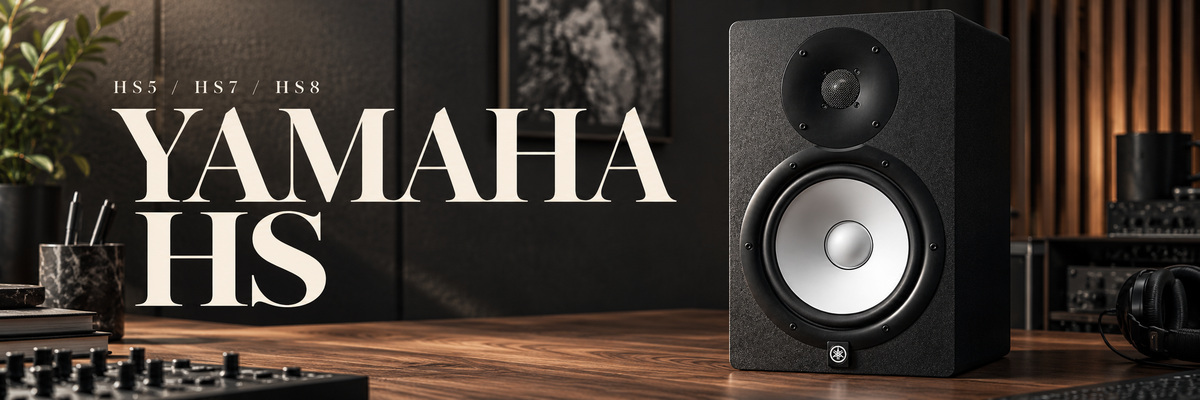
Yamaha's white woofer is instantly recognisable in a studio photograph. Choosing between HS5, HS7 and HS8, however, starts with more than appearance or a desire for the largest model. Where will the speakers stand, what music will you produce, and what do you need to hear while working? This review examines the HS range as a working tool, from differences in bass extension to connections, placement and a useful listening comparison.
7 September 2026 · 11 min read
Why the HS range remains relevant
Yamaha connects the HS design philosophy with accurate studio monitoring. For the buyer, that means evaluating speakers through a different set of questions: how easily can you identify excess bass, an awkward vocal balance or a reverb tail that lasts too long? Monitors support decisions that should translate beyond the desk, to headphones, cars and ordinary playback systems. An impressive first impression does not guarantee that translation.
The distinctive appearance and the range's established place in Yamaha's studio catalogue make HS a natural candidate for comparison. A white cone does not mean that a modern HS is the same loudspeaker as the historic NS-10, though. Judge the current models by their own design and specifications. Equally, familiarity should not become a promise of perfect results in every room. The speaker and listening space work together. The useful buying question is whether a system helps you make clearer decisions on your projects, rather than whether a recognisable badge looks professional in a photograph.
Three sizes, one straightforward concept
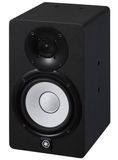
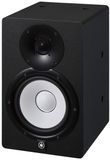
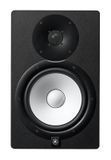
HS5, HS7 and HS8 are active two-way monitors with separate amplification for their low- and high-frequency sections. They need power and an appropriate audio signal, without an external power amplifier. Each uses a one-inch tweeter, while the woofers measure five, 6.5 and eight inches respectively. Cabinet size and specified low-frequency extension increase across the range.
This is not a simple beginner-to-professional ladder. A smaller model may fit a compact workspace better, while a larger one may be useful where deeper bass information is required and suitable placement is possible. HS7 occupies the middle ground, but its name does not indicate a seven-inch woofer. Check the actual dimensions rather than relying on model numbers. A paper template showing the cabinet footprint can be more informative than a product photograph without scale. Allow space for the display, keyboard, stands and cable connections before deciding which size your desk can accommodate comfortably.

Reading the specifications correctly
Yamaha specifies the low-frequency limits at −10 dB as 54 Hz for HS5, 43 Hz for HS7 and 38 Hz for HS8. At −3 dB, the corresponding figures are 74, 55 and 47 Hz. These are different points on a response curve and cannot be treated as interchangeable. A comparison with another speaker is incomplete when the other manufacturer's frequency limit has no stated tolerance.
The combined amplifier ratings are 70, 95 and 120 watts respectively. These are neither wall-socket consumption figures nor a universal measure of sound quality. The practical question is whether the system provides comfortable working level without unwanted overload at your listening position. Dimensions matter as well: HS8 occupies considerably more space than HS5. Include plug clearance and the rear port when planning depth, and check the support's load rating against the weight of the exact version. A specification table is most valuable when it helps build a workable installation rather than simply identify the largest number.
| Specification | HS5 | HS7 | HS8 |
|---|---|---|---|
| Woofer / tweeter | 5″ / 1″ | 6.5″ / 1″ | 8″ / 1″ |
| Lower limit, −10 dB | 54 Hz | 43 Hz | 38 Hz |
| Lower limit, −3 dB | 74 Hz | 55 Hz | 47 Hz |
| Amplifier output | 70 W | 95 W | 120 W |
| W × H × D, mm | 170 × 285 × 222 | 210 × 332 × 284 | 250 × 390 × 334 |
| Standard-version weight | 5.3 kg | 8.2 kg | 10.2 kg |
HS5: compact, with understandable limits
Consider HS5 when space is restricted, listening is close and much of the work involves speech, acoustic instruments or the middle of an arrangement. Smaller cabinets are easier to position without blocking a screen or forcing an excessively wide stereo layout. For editing podcasts and dialogue, they can form a convenient system if the room itself supports clear listening.
Do not expect the same low-frequency extension as HS8. Electronic music and deep bass parts benefit from an additional check on suitable headphones or another familiar system. Avoid adding a large amount of bass to a mix simply because you cannot clearly hear its lowest notes on the smaller speakers. A system with greater extension may reveal excessive low-frequency energy later. Compact size also does not make HS5 automatically correct for every small room. Desk reflections and poor placement remain relevant with a five-inch woofer. Establish a sensible listening position first, then identify where additional low-frequency checking is necessary.

HS7: a useful middle ground
HS7 is worth auditioning if you want more low-frequency information but cannot comfortably accommodate the largest cabinets. For home production involving pop, rock, songwriting and arrangements, it provides a logical alternative to compare. Use the same passages as with HS5 and focus on the relationship between kick drum and bass guitar, rather than simply a fuller overall impression.
Before buying, check whether a symmetrical workspace is possible. A larger speaker cannot by itself solve the imbalance created when one channel sits in a corner and the other opens into a large space. HS7 is a compromise in physical size and bass extension, not an automatic best choice for everyone. What matters is how confidently you can follow changes in equalisation, level and panning in your own music. An unfinished project is particularly useful here: see whether the system helps identify a specific problem and then makes the effect of your correction easy to judge.
HS8: when deeper bass information matters
HS8 provides a lower specified frequency limit and a larger cabinet. It is a sensible candidate when the low-frequency foundation is important to the material and the workspace supports proper speaker positioning. Additional extension may reveal problems that a smaller monitor presents less clearly. It does not remove the need to check the very lowest octave through other appropriate means.
The key question is whether the room lets you use that capability. At an unsuitable position, some bass notes may be reinforced while others seem to disappear, encouraging mix changes that compensate for the room rather than the recording. Do not select HS8 simply because extra capacity seems harmless. Check stand stability, tweeter height and listening geometry. A controlled workspace with a smaller speaker can be more useful than a large cabinet squeezed into an awkward corner. If your room layout is still changing, establish the desk and listening position before committing to the monitor size.

Placement matters more than a floor-area rule
Rules that assign one speaker size to a fixed number of square metres oversimplify the decision. Rooms with the same floor area can have different proportions, furniture, acoustic treatment and listening positions. Begin with symmetry: similar conditions around left and right speakers support reliable stereo judgement. Aim the tweeters around ear height and use an approximately equilateral triangle between the speakers and listener as an initial layout.
Avoid placing the cabinets directly in corners or obstructing the rear ports. Instead of searching for one magic distance, make controlled changes: move both speakers consistently and listen to a familiar bass passage. Separate stands can simplify positioning; desktop supports can raise tweeters but do not eliminate every reflection. For serious mixing, room measurements and appropriate treatment provide a clearer basis for decisions than endlessly changing rear-panel switches. Alter one condition at a time so you can understand why the result improved or deteriorated. Keep notes of positions that work, especially if the desk also serves other purposes.
ROOM CONTROL and HIGH TRIM
ROOM CONTROL provides 0, −2 and −4 dB settings for the low-frequency region below 500 Hz; HIGH TRIM adjusts the high frequencies by ±2 dB. These switches help adapt the speakers to installation conditions. They do not measure the room automatically or remove every resonance. Distinguish broad excess bass from a narrow cancellation at one particular listening position.
Start with neutral settings and change one parameter at a time. Record the switch positions so you can return to your baseline. If a change sounds more pleasant, test several recordings; you may otherwise be tuning the system around one track. Similarly placed speakers should begin with symmetrical settings. Different corrections for the two channels should address an identified issue, not an isolated listening impression. After adjustment, allow time to learn the system and compare a mix made on it across other playback devices. The aim is dependable judgement, not constantly changing the monitor response to suit each song.
Connections and the i versions
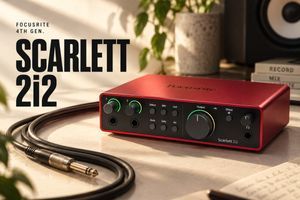
The range offers balanced XLR and jack inputs. Feed the left and right line outputs of an audio interface separately to the two powered speakers. With a Scarlett 2i2, a practical setup uses two appropriate balanced cables between the interface outputs and the monitors, leaving everyday volume control within reach on the desk. HS5, HS7 and HS8 are not USB speakers with an integrated computer audio interface.
HS5i, HS7i and HS8i identify versions with mounting points for compatible installation accessories. They are relevant to classrooms and installations where speakers must be supported from walls or ceilings. The i suffix does not indicate a new digital generation or Bluetooth connectivity. Check bracket compatibility, speaker weight and installation requirements in the documentation. For ordinary desktop work, evaluate placement first and decide whether mounting provisions are actually useful. A secure support and suitable hardware are more important than reproducing the appearance of a studio photograph. Do not assume every bracket suits every cabinet in the range.

Should you add an HS8S subwoofer?
A subwoofer can extend low-frequency monitoring, but it also introduces another source that needs to work properly with the main speakers. That may be valuable for bass-focused electronic production and secondary for speech editing. The question is whether you can judge bass quantity and its relationship to the arrangement more accurately, rather than simply make the room sound bigger.
Begin with a correctly positioned pair and familiar recordings. If low-frequency monitoring remains a clear limitation, compare a subwoofer setup while paying attention to level, phase and crossover settings. A sub that is too loud may be enjoyable but encourage mixes with too little bass. Check results on other systems and at moderate listening levels. Adding a subwoofer should address a specific monitoring need rather than complete a shopping list. A properly integrated system is useful; an extra cabinet without adjustment may introduce more uncertainty than information. Take time to compare before and after with similar perceived overall level.
A useful audition before deciding
Prepare three contrasting passages: a familiar voice, a rhythmic track with kick and bass, and a dense arrangement with reverberation. Compare models at similar playback levels so the louder pair does not win by volume alone. Listen for how easily you can follow individual instruments, place the vocal and identify unwanted low-frequency energy.
Add an unfinished mix of your own. A working monitor earns its place when it helps explain what to change, not only when it makes a favourite album impressive. After a short break, return to the first model to reduce the influence of novelty. With HS5, plan an additional check of deep bass; with HS8, pay close attention to room interaction; with HS7, assess both sides of the compromise. The final choice should give you a system you can learn and use consistently. Include comfort over a realistic working period at sensible volume, rather than relying entirely on the excitement of the first minute.
Questions before buying
Is the price for one speaker or a pair?
Yamaha specifies single-unit packaging for HS5, HS7 and HS8. Check the exact store offer: stereo work normally needs two matching speakers, while a pair may also be offered as a separate package.
Is an external power amplifier required?
No. These are active monitors. Each needs mains power, an appropriate line-level signal and a suitable cable. A power amplifier's speaker output is not a substitute for a line-level connection.
Does HS7 have a seven-inch woofer?
No. Its specified woofer diameter is 6.5 inches. The model number should not replace checking the technical data.
Which model is the best starting point?
Base the choice on placement, material and the complete budget for a pair, supports and cables. Compare HS5 for a compact workspace, HS7 as a middle-sized option and HS8 for deeper bass monitoring under suitable conditions.
Models at SoundsGood
Open the specific product to check its current price, availability and package contents. For a studio, classroom or institution, we can help select a compatible system and prepare a commercial quotation, including for tender procurement.
Free delivery across Ukraine from UAH 4,000 · Instalments with PrivatBank and monobank · Official manufacturer or importer warranty
Sources and manufacturer resources
Editorial review based on manufacturer documentation and practical recording scenarios. No independent laboratory measurements or personal testing of these samples is claimed. The magazine cover is an AI composition; product photographs within the article are manufacturer originals.