A child's guitar should be a real musical instrument that can be tuned, produce clear notes and support gradual progress through suitable repertoire. A bright colour, a small box and the word educational do not establish those qualities. A useful purchase begins with three questions: what music will the child study, which instrument feels manageable now, and who can check that it is prepared for playing? This guide explains half-size, three-quarter and full-size labels, distinguishes scale length from overall length, and covers physical trials, strings and accessories. Yamaha CS40 provides a concrete example of a compact classical guitar. Official Yamaha school-series and Córdoba specifications illustrate why a size label cannot replace actual dimensions and an individual assessment.

1. Start with the teaching programme
If the child is entering a music school, ask the teacher about instrument type and approximate size before buying. A classical programme uses particular positioning and fingerplaying techniques. Another musical direction may call for a different instrument. Do not choose solely because another pupil of the same age owns something similar. Children differ in height, arm length, coordination and experience.
For independent learning, define a practical aim: accompanying songs, learning classical pieces or studying rock with a teacher. Ask the child to share a few favourite musical examples. This turns a general wish for a guitar into a useful direction. The first purchase need not cover every interest that might develop later. Choose a working instrument for the next stage. Before ordering, send the teacher the exact model, size and specification link rather than only an attractive photograph. Ask whether a particular support or footstool is expected, because these are easier to assess with the guitar than to select afterwards without trying the complete playing position.
2. A small instrument is not necessarily a toy
A learning instrument needs functional tuners, properly installed frets, a workable string arrangement and a construction that can hold an appropriate playing setup. Small guitars can be serious musical instruments. The problem is not reduced size but an appearance that promises more than the object can deliver. If a listing describes only colour, age and songs included in the box, ask about scale length, string type and tuning.
During inspection, request open strings and a short melody. Notice whether clear notes can be produced without obviously excessive pressure. A decorative guitar with poor geometry can make a child seem insufficiently determined when the instrument is the obstacle. Price alone does not prove suitability either. Look for an identifiable model, accessible specifications and a seller who can discuss preparation in practical terms. Ask who checks the instrument before handover and how questions are handled after the first lesson. A useful consultation explains what the child will actually be able to do, rather than insisting that absolutely anything is good enough for a beginner.

3. What half-size, three-quarter and full-size mean
These labels describe size categories, not an exact mathematical fraction of every dimension. A half-size guitar is not automatically half the overall length of an adult instrument. Manufacturers combine scale length, neck width and body dimensions differently. Meaningful comparison therefore begins with numbers and ends with a physical trial.
Official specifications provide a clear example: Yamaha CGS102AII is labelled half-size and has a 535 mm scale, while Córdoba C1M 1/2 has a 580 mm scale. The category name is similar, but fret spacing differs. This is neither an error nor evidence that one brand is superior. It demonstrates why the specification table matters. When ordering online, record the exact version rather than borrowing measurements from a related model. Fractional labels help with an initial search, but cannot settle the decision. The same applies to cases: a three-quarter label does not prove that a particular guitar will fit correctly inside. Check the actual dimensions instead of treating the fraction as a universal standard.
4. Scale length and overall length answer different questions
Scale length describes the working string length, while overall length includes the body, neck and headstock. The fretting hand experiences fret spacing and the reach to first position. Transport and the way the guitar sits against the player depend on overall dimensions. Two similar-looking photographs cannot reveal all of these relationships.
Write both measurements separately. Add nut width and the widest body measurement if the manufacturer provides them. Do not measure an on-screen photograph with a ruler: image scale and perspective vary. If the child already uses a borrowed instrument, ask the teacher to record its model and dimensions. That creates a real reference point. A request for something slightly smaller becomes more useful when you know whether the difficulty involves neck reach, the body beneath the picking arm or spacing between strings. Moving to another size category will not necessarily solve all three. Sometimes a different model of similar overall size offers a more suitable combination, so measurements should guide the search rather than become the only rule.

5. Why an age chart cannot make the final choice
An age guideline can narrow the first search, but cannot replace an individual playing position. Children in the same school year can have different proportions. Comfort also depends on the chair, support and way the guitar is held. A model that seems oversized on a high shop stool may feel different on an appropriate seat; the reverse is possible too.
Ask the child to sit as they will during lessons. Their feet need stable support consistent with the teacher's positioning advice, and the guitar should not require constant support from the fretting hand. Notice a raised shoulder or an awkward reach towards the first frets. Do not make medical conclusions from this short check. The aim is to identify obvious difficulty and discuss it with the teacher. If every note requires a complete change of body position, compare another geometry. Age alone cannot explain why an individual instrument fits. A description of the actual movement is more useful than a universal rule for every seven-year-old or ten-year-old.
6. Buying room to grow can create problems now
Wanting a guitar to last several years is understandable. However, the child will practise on it today, not only after a future growth spurt. If the body forces an awkward arm position or the first frets are difficult to reach, a supposed saving can make the beginning harder. The instrument should support current learning tasks without a continual struggle with its dimensions.
Discuss the signs of needing another size with the teacher, rather than simply asking which size comes next. Changes in posture or new technical requirements may matter. Do not schedule replacement solely by the calendar. With a limited budget, compare a checked used instrument, a rental where available and a new compact model with clear selling conditions. Preserving condition and accessories can make later transfer to another pupil easier, but cannot guarantee resale value. Choose a size that works for present lessons and review it when circumstances change. The largest option is not automatically the most economical when it makes the instrument difficult to use during the very period for which it was purchased.
7. Nylon strings and the musical direction
Traditional classical teaching uses guitars designed for nylon-string sets. Their response and string spacing suit particular fingerplaying approaches. However, saying that every child must use nylon without discussing the programme is too simple. For another musical direction, agree the instrument type with the teacher who will be teaching it.
Do not convert a conventional classical guitar to steel strings by changing the packet alone. Construction and attachments must suit the load and intended string type. Equally, a softer nylon feel cannot correct unsuitable action or posture. Assess the complete instrument. Before the first replacement, record the guitar type, scale length and recommended set. Short-scale instruments require attention to appropriate strings; any packet marked classical is not a universal answer. Keep the label from a successful set so that the next purchase is precise. This also makes communication easier if another adult orders accessories: the choice can be based on an exact name rather than packaging colour or an approximate memory of what felt comfortable.
8. Neck width and space between strings
A wider neck offers more room for separate fingers, but requires a suitable hand position. Narrower does not automatically mean easier. If fingers keep touching adjacent strings, more space can help. Nut width is only one measurement; neck profile, depth, action and technique also influence the experience.
Let the child perform an action they understand. A new pupil might try one note on several strings, while a more experienced learner can use a familiar phrase. Do not demand a difficult barre chord as a test of readiness for an adult guitar. Compare identical actions and write observations: a finger lands easily, a position is difficult to reach, or the body needs extra support. A conclusion based solely on palm size is too crude. If comfort remains unclear, return with the teacher instead of ordering a random size. Repeat the trial after a break as well, because fatigue and unfamiliar positioning can change the first impression. Several simple actions provide a better basis than one successful chord.

9. Yamaha CS40 as a compact classical example
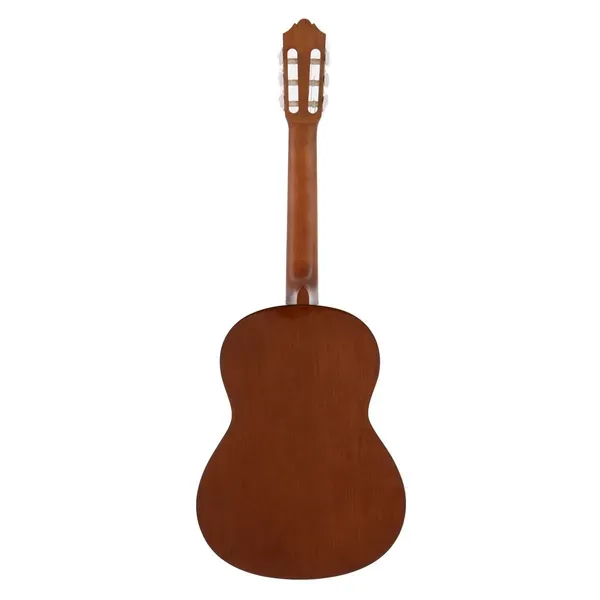
Yamaha describes CS40 as a compact classical instrument for young learners. Official materials give a 580 mm scale, and Yamaha specifications also list a 48 mm nut width. These figures explain geometry; they do not automatically prescribe the instrument for a particular age. The product photographs in this guide show CS40 rather than an unspecified small guitar.
During a trial, assess the body beneath the picking arm, access to first position and the neck feel. Do not generalise from the condition of one example to every CS40: preparation and fitted strings matter. Check included accessories separately from promotional photographs. If a retailer's specification differs from official documentation, clarify the version before purchasing. Manufacturer information is the basis for the measurements used here. CS40 is an illustrative candidate, not a universal recommendation or a promise of current availability. The final decision still requires physical fit, a playing trial and a clear understanding of the actual instrument that will be supplied.

10. Why compare a compact guitar with a full-size example?
The purpose is not to push a child towards a larger instrument sooner. A comparison shows how geometry changes the playing position. The full-size Yamaha CG102 photographs provide a contrasting construction example. Do not treat separate product pictures as a scale drawing: camera angles and image sizes differ.
Try the instruments under the same conditions. Check shoulder position, the same notes and whether the fretting hand must support the body instead of playing. Sometimes neck width matters more than the visible length difference; sometimes the body creates the main difficulty. Record observations separately instead of calling everything too big. A consultant can then suggest another model with relevant dimensions. If the larger instrument already feels comfortable, rejecting it solely because of age is unnecessary too; a proper trial should establish that. The useful result is a connection between geometry and the learner's movements. That knowledge will help again when the child's proportions and musical tasks change in the future.

11. A short trial without turning the shop into an examination
Begin with an adult or adviser tuning the instrument. Give the child time to sit, place their hands and check stability without continuously gripping the neck. Try open strings, one simple note and a familiar rhythm. This is enough to notice obvious difficulties during an initial meeting.
Take a break and repeat on another guitar. Avoid making the purchase an examination in front of strangers. Nerves, tiredness and a wish to please parents can affect answers. Instead of asking whether this one is better, ask what felt comfortable and what got in the way. If the child cannot explain, invite them to show the point where they changed position. Finish by returning to the first candidate. This helps distinguish a repeatable advantage from novelty. Write down models and observations immediately, before they blend with colour, price and the sales conversation. A calm, consistent trial can provide more useful information than a long performance demonstrating the adviser's own ability.
12. Preparation: string height and clear notes
An appropriately sized guitar can still feel difficult because of its condition or setup. Excessive string height for that instrument's intended operation demands unnecessary effort. An unwanted noise might involve technique, fret condition or another factor. Do not jump to a conclusion without checking.
Ask an experienced player to repeat the problem note. Test several strings and positions rather than a single chord. Clarify what preparation before sale includes. A child should not be told to overcome an obvious construction problem through determination. At the same time, different guitar types do not require identical action measurements: setup depends on design and touch. Random neck adjustment or filing a saddle is not a sensible first response. Establish the cause first. For a remote purchase, ask how preparation details can be shared with the teacher and where questions should go after delivery. A description of a specific note and action is much easier to investigate than a general complaint that the new guitar is difficult.

13. Frets, tuners and a visual inspection
Inspect the body in good light. Look for obvious cracks, lifting parts, bridge damage and signs of unexplained repair. Cosmetic wear and a structural issue are different, so they should not be judged identically. With a new instrument, check that condition and contents match what was agreed.
Ask for a demonstration of the tuners without excessive string tension. Notice rough fret ends and whether normal movement along the neck feels unobstructed. Do not pull on the bridge or test strength by force. If something is unclear, photograph the area and discuss it with a technician or seller. Parents without playing experience often gain more from a short inspection with a teacher than from a long theoretical defect list. The aim is a usable learning instrument, not an independent repair diagnosis. If work has previously been done, ask what changed and whether it affects future servicing. An uncertain history is best clarified before purchase rather than during the first lesson.

14. Tuning and the adult's role
Even a good guitar requires tuning. A beginner cannot develop a reliable sense of intervals when the open strings continually differ from the intended tuning. Ask the teacher to show the adults how to use a tuner and identify which machine controls each string. Make the first attempts calmly, without large hurried turns.
Record the string sequence in a convenient form. Do not trust an app's random mode: check that the intended tuning is selected. New strings can need repeated tuning, but that is not a reason to keep tightening an unidentified string by guesswork. If the display is confusing, stop and ask. Adult support means creating usable conditions rather than supervising every note. As the child learns the procedure, gradually transfer responsibility. Independence develops through clear, repeatable actions. Keep the tuner in a consistent place and check that it works, so practice does not begin with a frustrating search. A short predictable preparation routine is easier to maintain than a complicated ritual whose purpose the child does not understand.
15. A bag must fit the actual guitar
A bag should match the individual instrument. Too tight can create pressure; too loose allows movement. A size-category label does not guarantee compatibility. Compare internal length, width and depth with the guitar, or try the combination in the shop.
For the journey to lessons, assess total weight, handle comfort and strap adjustment. Padding does not make every soft bag resistant to heavy impact. Think about public transport and where the instrument will sit in class. Music, a water bottle and heavy accessories should not press against the body through a pocket. Show the child how to open the zip fully before removing the guitar and confirm closure before carrying it. These habits are more practical than numerous unfamiliar extras. When comparing two bags, consider whether the child can operate the fastening and handle comfortably, not only the thickness described in the catalogue. Protection must work with the instrument and the daily route to be useful.
16. The minimum starting setup
A suitable bag, tuner and simple care materials usually belong beside the instrument. Choose a footstool, support, music stand, picks or capo according to the programme and teacher's advice. An accessory is not essential merely because a bundle contains it. Confirm both purpose and compatibility.
Buy spare strings after identifying the correct set. If a bag is not supplied, include it in the budget from the beginning. Make two lists: what the first lesson requires and what might become useful after a month. This preserves money for preparation and avoids unnecessary purchases. Do not suggest that one device will independently solve rhythm, posture or consistency. The starting setup should be simple, understandable and sufficient for actual tasks. Also check what the teacher supplies during lessons and what is needed at home. There is no need to duplicate every classroom item, but home practice should remain practical without continually improvising unsuitable substitutes for the basic equipment.
17. Compare the cost of a complete setup
Compare ready-to-use packages, not only guitar prices. One offer may include a bag while another contains the instrument alone. Preparation may be included or arranged separately. A photograph showing an accessory does not establish that it comes with the order.
Write down contents and service arrangements before payment. Consider the journey for a trial, replacement strings and introductory lessons where separately charged. A budget should not become a contest to find the cheapest box. Suitable geometry and preparation can be more useful than an impressive collection of small extras. Equally, there is no need to pay for features the child will not use. Ask for concrete differences in construction, fit, contents or service. Check current prices on product pages because they change. If a price increase is substantial, identify the benefit it provides now. This separates a meaningful improvement from an attractive addition that has no role in the current learning programme.
18. Used instruments and rental
A used guitar can be suitable if its condition is checked. Request an exact model, photographs of important areas and a trial at normal tuning. Ask about replaced parts, previous strings and storage. The owner's account is helpful, but cannot replace inspection.
Add likely servicing to the purchase price. If necessary repairs remove the saving, the offer is less attractive than it first appeared. Rental can help establish size, but requires clear terms, contents and responsibility for condition. Do not assume every school or shop offers it. In either case, the teacher should ideally assess the guitar before extended use. An old family instrument should not automatically become the child's learning guitar simply because it is already available. Its dimensions and condition may be unsuitable. If the history is unknown, identify construction and appropriate strings first. Six strings and a familiar outline do not prove that an instrument is ready for lessons without additional work.
19. Buying online without a physical trial
When a personal trial is impossible, collect specific information. Request current photographs of the intended version, verify official dimensions and discuss the model with the teacher. Compare it with an instrument the child has held before. Suitable for beginners is not a replacement for that comparison.
Clarify inspection, servicing and any return arrangements with the actual seller rather than assuming they match a previous purchase. On delivery, check identity, contents and condition, then arrange a calm trial. Avoid irreversible alterations before establishing suitability. Keep documents and packaging as required by the selling arrangements. Useful questions describe the string, position and action involved. This helps distinguish setup, technique and a possible defect. If the receiving adult does not play, prepare a short checklist beforehand. It can cover obvious identity and condition checks without pretending that a complete musical assessment can be carried out in a few hurried minutes at a collection point.
20. Practice space and storage
Prepare a stable chair, adequate light and a place for music. The instrument should be accessible without being left where it can fall or obstruct a walkway. A stand must suit its shape and be used appropriately. Households with younger children or pets should plan protected storage separately.
Avoid heaters, direct sunlight and prolonged storage in a car. Use suitable care products and a clean soft cloth. Do not add humidity automatically without understanding the room conditions. After transport from cold surroundings, follow guidance on gradual acclimatisation. Teach a simple end-of-session routine: put away the guitar, organise the music and leave the essentials ready. Practice should not start every day with searching for a tuner and clearing a random chair. The arrangement must be manageable for the child as well as the adult. An excessively complicated storage system can encourage leaving the guitar somewhere convenient but unsuitable instead of using the intended place.
21. Assessing the first month
The first month is not measured only by songs learned. Consider whether the child can sit comfortably, prepare the instrument with adult help and complete a small task without struggling with its dimensions. Progress also depends on teaching, so neither the guitar nor the pupil's ability should be blamed automatically for every difficulty.
Keep specific questions for the teacher. If something interferes, assess one factor at a time: posture, support or strings. Changing everything simultaneously obscures the result. Let the child describe discomfort without assuming it means refusing to practise. Short regular sessions following the teaching plan are better assessed through attention than formal duration alone. The instrument supports that process. If a difficulty repeats, demonstrate it at the lesson rather than buying a more expensive guitar without a new trial and a clear reason. Brief notes about what worked and what needs clarification help identify changes that can disappear behind the overall impression of one difficult day.
22. When to change size
A change makes sense when current geometry no longer suits posture and learning tasks, and the replacement has been tried successfully. A birthday alone is not enough. Discuss the decision with a teacher who sees the child regularly and can compare playing on different models.
Repeat the original trial sequence: familiar music, body position, first-position reach and transitions. A larger guitar will not instantly improve technique. Some adjustment time may be reasonable, but obvious mismatch should not be excused indefinitely as something to get used to. Assess the previous instrument separately; it might serve another purpose or be passed on after its condition is checked. The transition is a considered equipment change, not proof of maturity. Compare several simple tasks and identify the new capabilities that matter. If the present instrument still supports lessons comfortably, an urgent replacement solely to obtain a full-size label may offer little practical benefit at that stage.

23. Common parent questions
Can a child begin on full-size? Yes, when it suits the programme and genuinely fits. Are all three-quarter guitars identical? No: compare scale, neck and body. Must the first guitar be expensive? No: usable condition, suitable geometry and a clear learning setup matter. Should it be a surprise gift? If size is unknown, a shared selection experience may be more useful than choosing blindly.
Do strings need replacement only when they break? Their playing condition matters too; discuss it with the teacher. Is a small guitar necessarily incomplete or toy-like? Size does not establish that, although the individual instrument should be heard. Does a famous logo guarantee comfort? It helps locate documentation; fit still needs checking. Can a friend's instrument guide the purchase? It can provide a starting reference, not a final answer. Children of the same age can experience it differently. The most useful advice explains what to check and why, rather than promising one model that suits everybody.
24. A practical order for the final decision
Define the musical direction and agree the instrument type. Shortlist models using actual dimensions, arrange a physical trial and inspect condition. Then calculate the complete setup, clarify selling arrangements and prepare the practice space. None of this requires memorising every wood species or series name.
A successful purchase is an instrument the child can hold comfortably, gradually learn to tune and use for real musical tasks. Yamaha CS40, Yamaha school models and the Córdoba example demonstrate the value of specific measurements without replacing individual selection. Keep trial notes, the correct string reference and a record of included accessories. They will help during servicing and any later size change. A thoughtful start consists of simple checks that make regular practice clearer for the child and calmer for the family. The guitar's job is to support making music now; that remains the central criterion after comparing specifications, photographs and price.