SOUNDSGOOD JOURNAL · JBL PROFESSIONAL
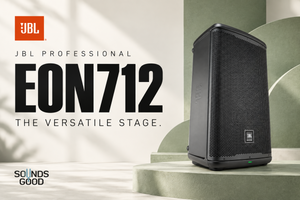
A compact PA speaker needs to do more than save weight. It should get into service quickly, carry a voice to the audience and avoid turning every small event into a complicated system build. That is the useful starting point for the JBL EON710.
An editorial review based on manufacturer documentation, not laboratory measurements or a claim of hands-on listening. Practical recommendations are editorial guidance; results depend on the venue, placement and signal level.
Specifications in context
| Woofer | 10″ |
|---|---|
| Continuous / peak power | 650 / 1300 W |
| Response ±3 dB | 65–20 000 Hz |
| Maximum peak SPL | 125 dB |
| Nominal coverage | 110° × 60° |
| Weight | 11.9 kg |
Who benefits from this format?
The first question is not whether the EON710 has enough bass in the abstract, but what you need to amplify. For a presenter, teacher, intimate vocal performance or rehearsal position, compactness can be a daily advantage: less vehicle space, easier carrying and more freedom to choose a position in a small room. That does not make a compact enclosure a substitute for an entire dance PA.
Time to the first clean signal matters in mobile work. A programme built around one voice and recorded accompaniment may not need a bulky rig. Several performers, independent monitor mixes or recording requirements change the equation and can justify an external mixer. Buy around the actual source list rather than an abstract count of features.

EON700 mixing and control
JBL specifies a three-channel digital mixer, Bluetooth 5.0, JBL Pro Connect control and a colour display for these full-range models. Processing includes automatic feedback suppression, eight-band output EQ, delay and ducking. Three mixer channels do not imply three identical microphone inputs: check the physical connections against your source list.
Ducking can help announcements by reducing music beneath speech. That behaviour may be unwanted during a vocal performance. Check which automatic functions are active before the show so an unexpected level change does not interrupt the programme.

What compactness means for listening
A small full-range system is a way of delivering the right bandwidth to the right place. For speech, assess consonants, natural tone and freedom from persistent boom. For acoustic guitar, listen for a readable attack without exaggerated resonances. These are audition criteria, not claimed listening-test results for this particular speaker.
There is no reason to make the balance deliberately thin simply because the enclosure is compact. Start neutrally and remove only what gets in the way. A nearby wall may increase the impression of bass while reducing clarity. Moving the speaker can be more productive than spending the afternoon reshaping the equaliser.

How to audition the EON710
Bring a speech recording, familiar music and, ideally, your own source. Match listening levels when comparing alternatives; a louder demonstration can seem more persuasive for the wrong reason. Check off-axis balance, access to the rear panel, carrying comfort and stand compatibility as well as the sound directly in front.
We would shortlist the EON710 first for smaller applications where portability and voice matter more than deep bass. For regular dance work, budget for the complete system: full-range speakers, low-frequency support, cabling and setup time. Thinking in systems is a better defence against buying an almost-suitable speaker than choosing by one impressive specification.
Power ratings, loudness and the back row
An amplifier wattage does not tell you whether people at the back of the room will understand a presenter. Peak and continuous ratings describe different conditions. Maximum SPL is also a limit under the manufacturer’s measurement conditions, not a promise of sustained comfortable output in every venue. Choosing by the largest number overlooks distance, intelligibility, headroom and the room itself.
Check ordinary speech as well as music. Walk through the centre, along the sides and to the furthest listening position. If the front is already loud while words blur at the back, turning up may simply excite more reflections. Revisit aiming and installation height first. A difficult, elongated venue may call for distributed loudspeakers with correctly aligned delay, rather than a larger pair at the front. Coverage is a system-design problem, not a wattage competition.
Connections: start at the source
For an important performance, a wired main signal path is a sensible starting point. Connect a mixer or audio-interface output to an appropriate line input on the powered loudspeaker. Balanced connections with suitable cables are particularly useful over longer runs. Never connect a power-amplifier output intended for passive speakers to a signal input on a powered speaker. A connector that physically fits is not proof of electrical compatibility.
Begin with output levels turned down. Confirm input sensitivity, play the loudest expected material and set the source without clipping. Then bring up the loudspeaker gradually. Turning down the last control cannot remove distortion already created upstream. A passive instrument pickup may need a DI box or preamp; determine this from the instrument output rather than assuming every quarter-inch socket is interchangeable. Label both ends of cables so a hurried changeover does not undo your routing.
DSP: placement before equalisation
Equalisation is useful for careful tonal adjustment, but it cannot turn an unsuitable location into a good one. Start from a neutral setting. For a boomy voice, examine nearby boundaries, microphone technique and unnecessary bass in the channel. For an aggressive sound, do not immediately remove the entire upper midrange: the real problem may be excessive level or a loudspeaker aimed straight at the nearest listener.
Automatic feedback suppression is a supporting tool, not permission to put a microphone in front of a loudspeaker. Consider the microphone’s pickup pattern and the performer’s actual working position when placing the system. Avoid deliberately generating prolonged loud feedback to experiment. If substantial correction seems necessary, return to physical placement and channel levels. A useful preset should make an already sensible arrangement easier to operate, rather than conceal a fundamental setup problem.
Bluetooth: convenient playback, not a universal stage cable
Wireless playback is convenient for background playlists, breaks and presentations. Playing an instrument through a processor, performing to backing tracks and monitoring a live source impose different latency requirements. Bluetooth availability alone does not establish suitability for those tasks. Test the playback device before the event, silence unwanted notifications and keep a local copy of the programme so your performance does not rely on mobile data.
Remote parameter control and audio transport are separate functions. Being able to adjust a speaker from a phone does not explain how the second speaker receives its signal. Verify both channels of a stereo system independently. For speech, feeding the same mono programme to each listening zone is often more useful than creating a narrow stereo sweet spot. Do not assume compatibility with consumer wireless-link modes from another JBL product family.
When adding a subwoofer makes sense
A subwoofer is a response to programme requirements, not proof that a full-range speaker is incomplete. A lecture, an acoustic singer and a dance set ask for different low-frequency performance. Trying to obtain deep bass through a large EQ boost in a small full-range speaker can consume its available headroom quickly. At higher levels, maintaining a stable overall mix matters as much as hearing extra bass.
Adding a sub requires coordination of crossover, level, polarity and, where necessary, delay. Confirm that the full-range speakers actually receive the intended high-pass filtering; merely passing cables through a sub does not guarantee it. Listen at several positions. A bass cancellation at one location is not sensibly corrected with a large boost. Establish the routing and placement first, then make restrained changes and listen again with familiar material.
Before the first event
Assess the whole package: stands with adequate load ratings, reliable signal leads, transport protection, power access and setup time. Route cables so they do not become trip hazards. Suspended installation requires manufacturer-approved hardware and competent professional rigging; a carrying handle is not a suspension point. A slightly smaller system that can be transported and deployed properly may be more useful than a larger one with improvised support.
Save a baseline setup, label cables and test an alternative playback route. Start with a familiar recording at moderate level, then check the actual programme. Reassess the balance when moving to a new room: a previous preset is a starting point, not a universal calibration. Where water protection is not specified, do not plan exposed operation in rain. Make safe deployment part of the purchasing decision rather than an afterthought.
Questions before buying
Do I need a separate power amplifier?
No. This is a powered speaker. Do not connect a power-amplifier output for passive speakers to its signal input.
Can it cover a fixed number of people?
Audience count alone is insufficient. A quiet lecture and an outdoor dance event require different performance, even with the same attendance.
One larger speaker or two smaller ones?
Define the listening zones first. Two suitably placed speakers can improve distribution, but their routing and aiming still need to be correct.
Official sources
JBL — JBL EON710
JBL EON700 owner’s manual
Manufacturer demonstrations are available in the Video Gallery section of the JBL product page. Open the manufacturer’s page.
Find the product
Check the SoundsGood product listing for current price, package contents, availability and local warranty terms. Include suitable stands, signal cables and protective covers in your system budget. US-market warranty statements should not be assumed to apply to a Ukrainian purchase.
Official JBL video
JBL Portable PA | EON700 Full Range Deep Dive