AUDIO EQUIPMENT / IN-DEPTH REVIEW
JBL Stage 220P is a powered 12-inch subwoofer for home cinema and stereo systems. A high-excursion Polycellulose driver, 250-watt RMS amplifier with 500-watt dynamic capability, and twin rear-firing ports cover a published 26–150 Hz range.
SoundsGood editorial team · 9 September 2026
A useful audio-equipment review is more than a list of watts and a Bluetooth version. What matters is how quickly the system becomes operational, whether it stays intelligible at different levels, how bass changes indoors and outdoors, and which features genuinely save time. The discussion below therefore separates published specifications from practical conclusions.
Design and positioning
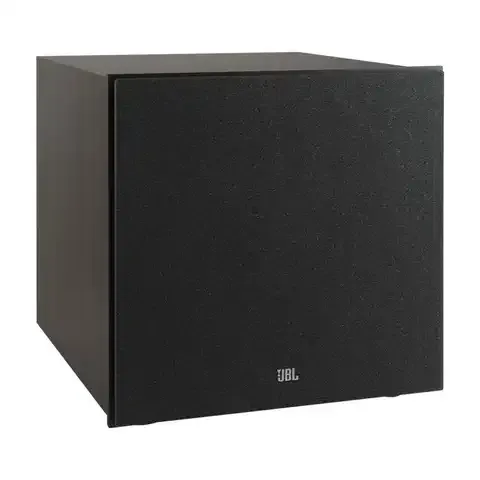
The cabinet uses two rear ports and therefore needs space from the wall. Its 12-inch cone is ribbed for stiffness, while level, crossover, phase and auto-power controls sit on the rear panel. At 18.7 kg it is stable but requires a planned position.

Sound in real-world use
Stage 220P adds energy below the useful range of the main speakers, giving impacts, film effects, double bass and electronic low end greater scale. The setup goal is not a separate bass effect but a seamless extension of the front channels.
Start an audition with neutral EQ and recordings you know well. Check spoken voice, acoustic instruments, dense electronic bass and music with wide dynamics. Do not judge the product only at maximum level: quiet and medium listening reveal midrange control, tonal realism and long-term treble comfort more clearly.
Use cases
Home cinema, stereo listening, gaming rooms and small-to-medium multimedia spaces. Large rooms may benefit from a second subwoofer or a higher-output alternative.
Placement changes the result as much as rated power. A nearby wall reinforces low frequencies, a corner can create boom, and outdoor use makes bass feel leaner. Keep vents and passive radiators clear, leave space for cooling, and reassess the tonal balance whenever the product is moved.

Connections and setup
Connect an AV receiver’s LFE output to the line-level input. If the receiver manages bass, use its crossover; around 80 Hz is a common starting point. Compare 0/180° phase, set level carefully, and optimise placement by listening or measurement.
Key strengths
- 12-inch Polycellulose driver
- Published extension to 26 Hz
- 250 W RMS and 500 W dynamic power
- Adjustable crossover and phase
- Automatic power mode
What to consider
Rear ports should not be pressed tightly against a wall. A single LFE input reflects its home-system focus. Excess level or poor placement creates boom even with a capable subwoofer.
Core specifications
| Type | Powered bass-reflex subwoofer |
|---|---|
| Low-frequency driver | 12″ / 300 mm Polycellulose |
| Amplifier power | 250 W RMS / 500 W dynamic |
| Frequency response | 26–150 Hz (±6 dB) |
| Crossover | 50–150 Hz, 24 dB/oct |
| Ports | dual rear-firing bass reflex |
| Controls | level, crossover, phase, auto power |
| Input | line-level LFE |
| Dimensions | 416 × 405 × 444 mm |
| Weight | 18.7 kg |
How to evaluate it before buying
Before buying, compare weight, dimensions, power options, required inputs and the actual area you need to cover. In mobile work, ergonomics and battery life may matter more than a few extra decibels. In a fixed system, integration with other components, placement and precise level adjustment become the priorities.
Measure the available space including cable clearance and wall distance. Walk through the room after setup; if bass disappears or booms in particular seats, move the subwoofer before applying heavy EQ.
SoundsGood practical advice: make a short list of the sources, cables and normal listening levels you actually use. Test with that setup rather than an unfamiliar demonstration track. Check the app, physical controls, inputs and power modes. A focused ten-minute routine quickly reveals whether the product fits everyday work and prevents paying for features that will remain unused.
A subwoofer is not another full-range speaker
Stage 220P handles the low-frequency part of an audio system. It does not replace full-range speakers or function as a portable Bluetooth music system. Its role is to supplement the main channels and reproduce cinema bass effects. Results also depend on the receiver, crossover, room placement and listening position.
An integrated amplifier simplifies the system, but the source still needs a compatible output. A television or conventional amplifier does not necessarily connect directly. Check subwoofer output and level control. Never connect amplified passive-speaker outputs to the subwoofer's line-level input.
Interpreting power and extension
JBL's official PDF specifies 250 watts RMS and 500 watts dynamic power. The product webpage also contains a different RMS figure. This review uses the technical PDF as its reference; confirm the documentation for the supplied unit. Dynamic power must not be represented as continuous output.
The 26–150 Hz range should be read with its published tolerance rather than treated as a promise of equal output at every frequency in your room. A lower limit does not describe maximum level, distortion or evenness. Similar headline figures can therefore conceal meaningful differences in system suitability.
Start with placement
Try an accessible front-of-room position, leaving space for rear ports and ventilation according to the manual. Corner placement can increase bass while worsening unevenness. If one note booms and another disappears, room resonances may be responsible. Moving the cabinet or seat can help more than increasing level.
Listen from the main seat and an adjacent chair. Bass beside the enclosure does not tell you what reaches the sofa. Use familiar music with varied bass notes rather than a single explosion. Receiver calibration is helpful, but verify integration afterwards instead of assuming an automated result is final.
Level, phase and crossover
The level control matches the subwoofer to the main speakers. If it attracts attention regardless of programme material, it may be too loud. For music, aim initially for a fuller foundation without detached boom. Cinema effects can be prominent without an overall imbalance that obscures dialogue.
Crossover choice depends on the main speakers. An AV receiver often handles bass management, so avoid unintended double filtering by checking both manuals. Evaluate phase from the listening seat around the crossover region, seeking coherent integration rather than an arbitrary switch position. Change one parameter at a time so improvements are understandable and repeatable.
Practical ownership and the final decision
The 416 × 405 × 444 mm enclosure and 18.7 kg weight require real space, including cable clearance, port breathing room and access to controls. Deep bass can travel to neighbouring apartments, so volume and listening hours matter. An isolation pad is not a guarantee of building soundproofing.
Choose Stage 220P as part of a home system with suitable connectivity and willingness to adjust it. Standalone battery-powered music is a different product category. Our conclusion is based on documentation and integration principles, not independent laboratory response measurements.
Video
Frequently asked questions
Which driver is used?
A 12-inch high-excursion Polycellulose driver.
What is the amplifier power?
250 W RMS with 500 W dynamic capability.
How far from a wall should it be?
There is no universal distance; leave clearance for the rear ports and optimise by room position.
View the product at SoundsGood
Specifications were checked against JBL information and the SoundsGood product page. Actual battery life, output and bass response depend on operating mode, programme material, room conditions and settings.