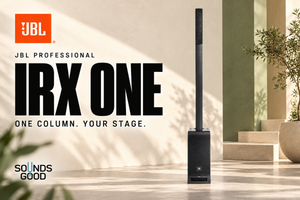
Not every event needs a large rig. IRX108BT combines two inputs, Bluetooth and practical processing in a 7.9 kg enclosure. Its appeal is the balance between easy transport and the flexibility of a conventional powered PA speaker.
Key specifications
| Woofer | 8″ |
|---|---|
| Maximum SPL, peak | 124 dB |
| Frequency response | 54 Hz–20 kHz (±3 dB) |
| Weight | 7.9 kg |
| Inputs and output | 2 × XLR/TRS; 1 × XLR out |
| Nominal coverage, H × V | 90° × 60° |
Where the small enclosure helps
IRX108BT makes sense for presenters, teachers, mobile performers and background music at events. The lighter enclosure is easier to carry and lift onto a suitable stand. It still needs mains power: mobility describes transportation, not battery operation. A power connection and a sensible cable route remain part of every setup.

Read the power figures in context
JBL lists 1300 W peak power and 124 dB maximum peak SPL. These are not a promise of 1300 W of continuous acoustic output. Listening distance, room noise and programme material also determine suitability. An 8-inch woofer does not turn this enclosure into a substitute for a subwoofer on bass-heavy dance music.
The 54 Hz–20 kHz response uses a ±3 dB tolerance. Compare it with specifications stated under comparable conditions. A lower number quoted at −10 dB for another speaker does not, by itself, establish stronger bass at the level you need.

Two inputs keep small setups simple
Two XLR/TRS combination inputs accept microphone and line sources, while an XLR output passes the signal onward. Add an external mixer when several performers or separate monitor mixes are involved. The onboard controls handle a basic balance conveniently, but they are not a replacement for a full mixing console.
There is no 48 V phantom power. A condenser microphone requiring it needs a compatible external supply or mixer. Check whether a passive guitar pickup needs a DI box or preamp too: a quarter-inch socket alone does not establish a dedicated high-impedance instrument input.

Processing helps; placement still matters
Four EQ presets, AFS feedback suppression and ducking reduce routine adjustments. Ducking lowers the music bed during speech; test its behaviour with the actual presenter. AFS provides useful support, but a poorly positioned microphone can still cause feedback. Keep the microphone pickup pattern and speaker direction in mind.
Bluetooth and the next step up
Bluetooth is convenient for playlists and breaks between performances. For timing-sensitive live playing, use a tested wired path because wireless playback can add latency. Compare IRX108BT and IRX112BT at matched listening levels. Choose the smaller unit when solo carrying matters most; evaluate the larger speaker or a subwoofer separately when music demands more headroom.
Official JBL video
JBL IRX Series Walk-through
View the product at SoundsGood →
An editorial review based on JBL documentation, not a hands-on test report. Specifications checked on 14 September 2026; consult the product listing for current price, package contents and warranty. Manufacturer documentation ↗