A shoulder rest may stay with you for years, yet choosing one often comes down to a photograph and two words in a description: comfortable and adjustable. That is not enough to explain Kun Bravo. It combines a laminated wooden base, a soft contact pad, metal adjustment components and Kun’s familiar attachment concept. The useful questions are what those features mean in daily use, how to assess the fit and whether the standard 800 is the version you need.
This review covers Kun Bravo 800 for 4/4 violin, SoundsGood item 200293. It is based on Kun documentation and product photographs. Complete your assessment of comfort and sound by trying it on your own instrument: the violin’s shape, your chinrest and your usual playing position all influence the result.
What distinguishes Bravo within the Kun range
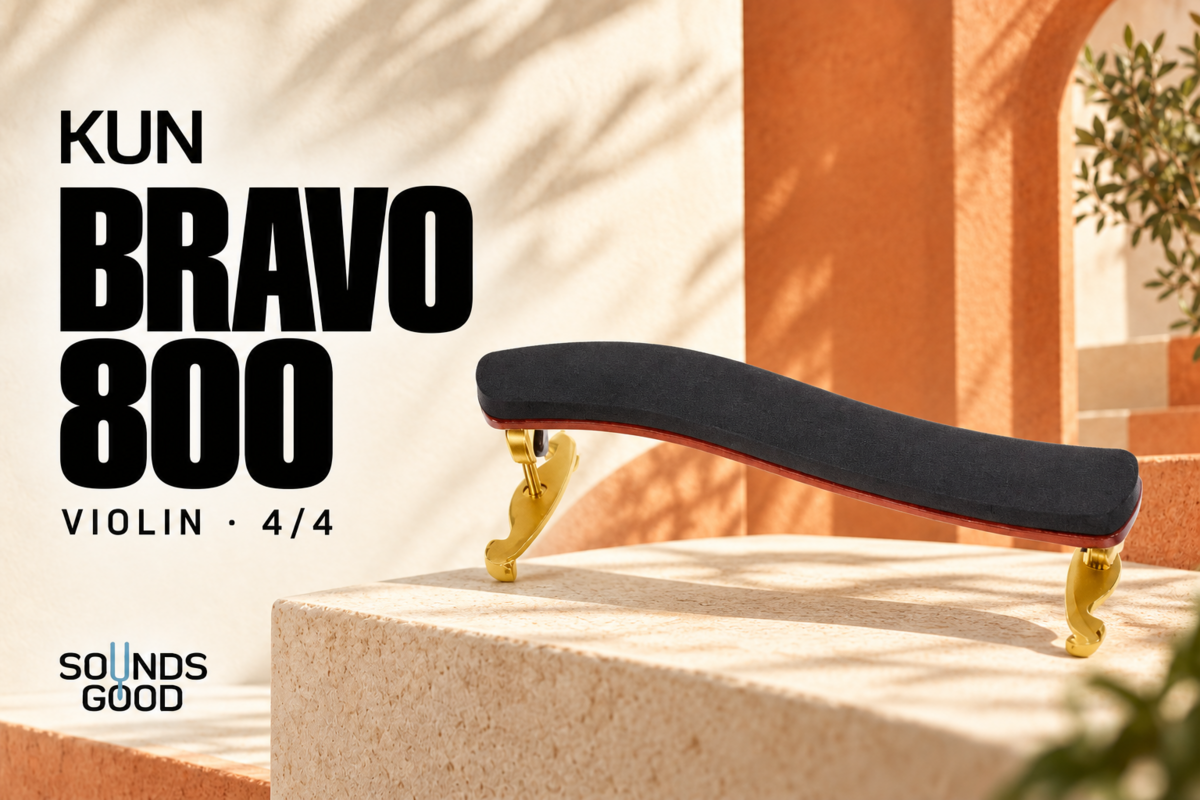
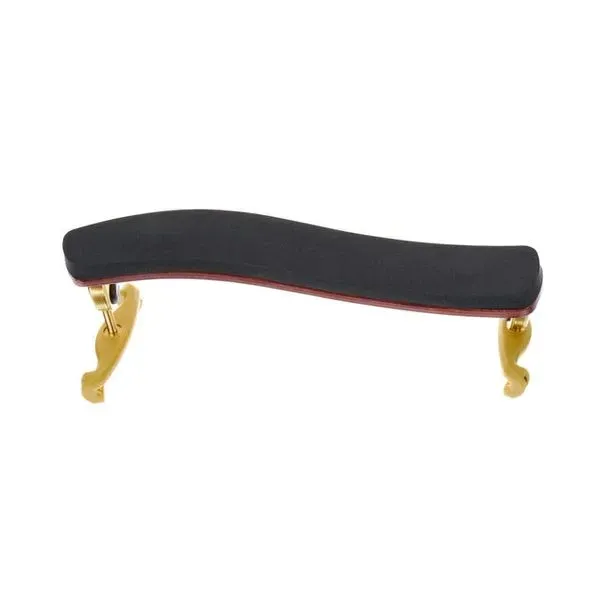
Bravo’s main structural feature is its bent laminated wooden base. Kun uses European curly maple, with the base made in Italy. Metal adjustment mechanisms complement the wooden section, while a soft pad covers the top. The photographs show that the wood forms the supporting structure beneath the pad rather than serving only as a decorative insert.
A wooden shoulder rest is not an obligatory next step after a plastic one. It is a different construction to assess through its support shape, available positions and feel during playing. If your current rest fits well, the new accessory’s material alone does not explain why you should replace it. Identify a specific task instead: a different shoulder contact, another instrument position or a comparison of two constructions under matching conditions.
Bravo 800 and Bravo 800C: identify the version
The range includes standard Bravo and Bravo Collapsible. The 800 covered here is the standard version; 800C has folding ends. The distinction primarily matters for storage. If your case has a narrow compartment, being able to fold the ends may become the deciding factor.
Check three things before ordering: model number, instrument and size. Kun Bravo alone is not a complete identifier because the maker also offers a viola version. SoundsGood’s relevant listing is the Kun 800 Bravo shoulder rest for 4/4 violin. Match that description and item 200293 rather than relying on a general photograph of the range.
How the adjustments work
Kun adjusts height through the threaded feet. Bravo’s width is changed by repositioning the end members along the base and securing them again. The official instructions highlight the need for clearance between adjustment components and the instrument’s back. Follow Kun’s illustrated procedure, particularly during the first setup.
Treat height and width as separate questions in practice. Increasing height does not necessarily resolve an unstable attachment. If the violin is held securely but sits uncomfortably, tightening the attachment further does not solve the positioning issue either. Identify what needs to change before using the corresponding adjustment.

Do not try to copy an ideal position directly from someone else’s photograph. It may explain the construction, but it does not account for your chinrest, instrument or habitual violin position. Photograph your starting setup, make one change and test it with a short passage. You can then return to the previous arrangement if the new one is less comfortable.
What to check during a fitting
Begin with repertoire you play every day. A short passage with neighbouring string crossings and familiar position changes makes a useful first assessment. Familiar music helps reveal differences: do you need to reposition the violin, does it move during a phrase, and is returning to lower positions comfortable?
Next, try the same passage both seated and standing if you normally play in both positions. Your experience may change with the position of your torso and arms. Ask a teacher to observe from the side. A musician concentrating on the left hand may not notice repeated instrument movement or a raised shoulder.
Comfort after a few notes is only a first impression. Reassess at the end of a normal practice session and write down specific observations. A note such as needing fewer violin adjustments in a particular passage is more useful for the next decision than a vague impression that an accessory feels more professional.

Should you expect a different sound?
Sound is a common reason for considering wooden rests, but a photograph and materials list cannot predict the result on a particular violin. A wooden base should not be equated with guaranteed extra volume, a warmer tone or better projection. This review does not present those findings from our own testing.
If acoustic differences matter to you, make the comparison consistent. Keep the strings, bow, rosin, room and microphone position unchanged. Play a short passage with the old rest and with Bravo, aiming for the same dynamics. Note the experience of playing separately from your impression of the recording. A more comfortable fit may change how you produce sound, which makes separating these observations worthwhile.
Storage and a check before practice
Check your case space in advance for the standard Bravo 800. The rest should sit in its intended compartment without pressing on the violin, bow or lid. Do not assume that the lid can press the accessory slightly and make everything fit. If space is insufficient, compare the folding version before buying.
Before practice, inspect the pad, foot coverings and adjustment components. On a new accessory, this helps you recognise its normal condition; on a used one, it helps identify changes. Match a lost or damaged component to the specific model when seeking a replacement. Similar appearance does not establish compatibility.

Who should consider Kun Bravo 800?
Shortlist Bravo 800 if you play a 4/4 violin, are looking for a wooden shoulder rest and do not need a folding design. It can be considered as a first quality accessory or as an alternative to a familiar support. A successful setup matters more than a playing level assigned by an advertising description.
If minimising case space is your main requirement, compare Bravo Collapsible. If you need another height or support shape, try other models too rather than restricting the choice to wood. A successful purchase lets you focus on music, with reasons for choosing it that make sense for your own needs.
Quick answers before ordering
Is this for violin or viola? This review and item 200293 cover the 4/4 violin version. Viola Bravo is a separate version.
Does Kun 800 fold? It is the standard model. For folding ends, look for Bravo Collapsible, including 800C for 4/4 violin.
Must the chinrest be changed at the same time? Not necessarily. For a clear comparison, assess the shoulder rest with your familiar chinrest first. Replacing both accessories simultaneously makes the result harder to interpret.
Can material alone decide the choice? The wooden base is an important structural feature, but the final decision depends on fit on the instrument, playing comfort and storage requirements.
View Kun Bravo 800 at SoundsGood
Sources: Kun Bravo description, Kun adjustment instructions. Photographs are from the SoundsGood catalog.