BOWED STRINGS / IN-DEPTH REVIEW
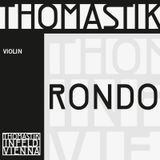
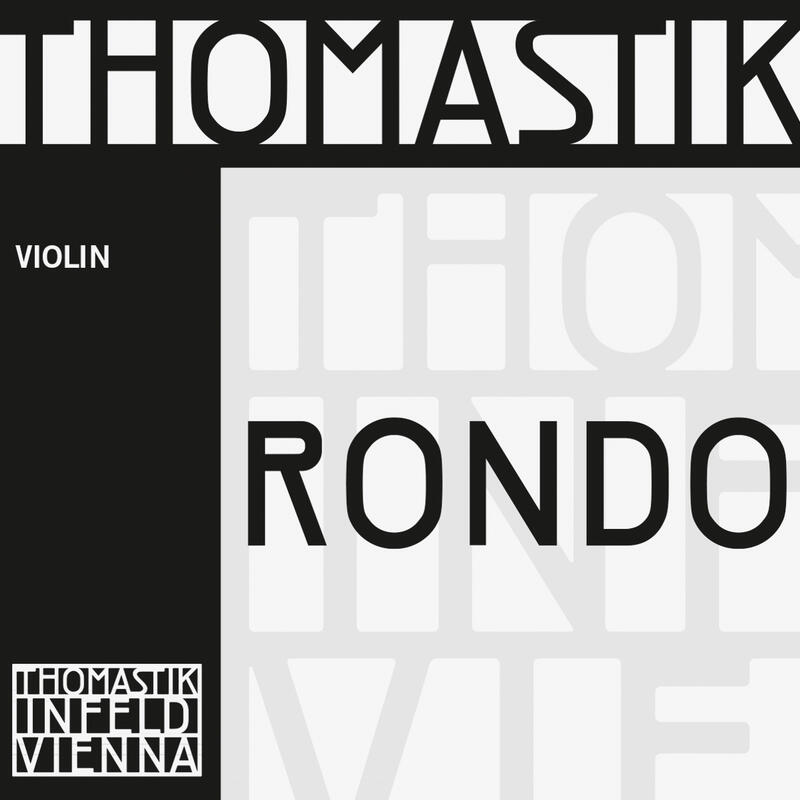
Rondo RO100 is built for the violinist who wants deep, singing tone, fast reaction, and concentrated projection without decorative brightness. This review examines every string, its 23.5 kp load, behaviour in a hall, and differences from Peter Infeld, Dominant Pro, and softer synthetic sets.
SoundsGood Editorial Team · September 8, 2026
Rondo's purist character
Rondo was designed as a direct, honest set without excessive tonal make-up. Notes begin with a clear centre, and overtones develop around the fundamental rather than replacing it. This presentation exposes both the violin's construction and the player's bow work.
Depth does not mean darkness. The family can produce brilliance and strength without smearing articulation. It supports clarity in chamber music, passage through dense texture in a solo part, and accuracy without a sharp edge in an orchestra.
RO100 construction
The tin-plated carbon-steel RO01 E has a removable ball and 8.2 kp tension. RO02 A uses a synthetic core with aluminium winding. RO03A D and RO04 G are synthetic with silver winding; the lower pair's equal 4.8 kp supports consistent resistance.
At 23.5 kp total, Rondo is a dense set. That load serves a stable attack: the bow has support and forte does not disintegrate. On a sensitive violin, the same pressure can become excessive.
Fast response without nervousness
Short strokes are a Rondo strength. The string speaks immediately after hair contact, so spiccato, sautillé, and rapid détaché need no extra pressure. Articulation is clear without becoming a dry click.
In legato, transitions remain integrated, especially between the silver D and G. Wide dynamics do not force a sudden colour change, helping a line pass through several registers.
Projection: what the hall hears
Rondo projects through a dense core, not maximum brilliance under the ear. It may seem calmer beside aggressive solo strings at the player's position, yet the note's outline survives at distance.
Record the same passage from three to five metres and ask a colleague to listen in a hall. An already narrow, highly focused violin may become dry; a broad or diffuse instrument often gains the centre it needs.
Suitable instruments and players
Rondo addresses experienced players who control contact point and understand their violin's response to pressure. It suits solo, leader, quartet, and professional orchestral work where speed and stability matter.
It is also useful to luthiers because its direct voice does not conceal setup problems. Resistance may be unnecessary for a beginner or a violin with high action; verify geometry or select moderate tension first.
Rondo, Peter Infeld, or Dominant
Peter Infeld offers a more luxurious sense of colour and overtone layering; Rondo is more direct. Dominant feels lighter and works as a neutral baseline. Dominant Pro adds modern consistency and power with another articulation texture.
Choose by problem: for centre and speed, begin with Rondo; for wider colour change, audition PI; if the violin closes under pressure, compare Dominant or a softer system.
Fitting, care, and verdict
Change one string at a time, watch the bridge, and allow several sessions for settling. Wipe silver windings with a dry cloth. Do not use household liquids over exposed violin varnish.
Rondo RO100 is a professional precision tool: deep, fast, and projective. We recommend it to a mature violin that needs definition and to a player seeking predictable response from pianissimo to forte.
Official video: the RONDO family from Thomastik-Infeld
This official Thomastik-Infeld video introduces the expanded RONDO family. It illustrates the engineering approach; use the table below for the exact RO100 violin composition.
Technical specifications
| Purpose | violin string set |
|---|---|
| Size | 4/4; 32.5 cm vibrating length |
| Tension | medium; 23.5 kp / 51.8 lb total |
| E | RO01; carbon steel, tin plated, removable ball, 8.2 kp |
| A | RO02; synthetic core, aluminium wound, 5.7 kp |
| D | RO03A; synthetic core, silver wound, 4.8 kp |
| G | RO04; synthetic core, silver wound, 4.8 kp |
| Set reference | Thomastik RO100 |
| Made in | Vienna, Austria |
Composition and tension apply to RO100 medium 4/4; verify the set reference when ordering.
Frequently asked questions
How does Rondo differ from Peter Infeld?
Rondo is more direct and focused; Peter Infeld generally offers a wider sense of colour. The result still depends on the violin.
Can Rondo suit an old violin?
Yes, if the instrument accepts the load. Have a valuable violin's geometry checked by a luthier.
Does the E have a removable ball?
Yes. RO01 uses a removable ball end.
How long does Rondo take to settle?
Most retuning occurs during the first sessions; assess final balance after pitch stabilises.
When should the set be replaced?
Use unstable fifths, slow articulation, lost overtones, or damaged winding as practical signs.
View the product at SoundsGood
The product page shows current price and availability. SoundsGood can compare Rondo with Peter Infeld, Dominant Pro, and other professional sets.
- genuine product with official warranty
- free delivery on orders over UAH 4,000 in Ukraine
- instalments from PrivatBank and monobank
- professional string-matching advice