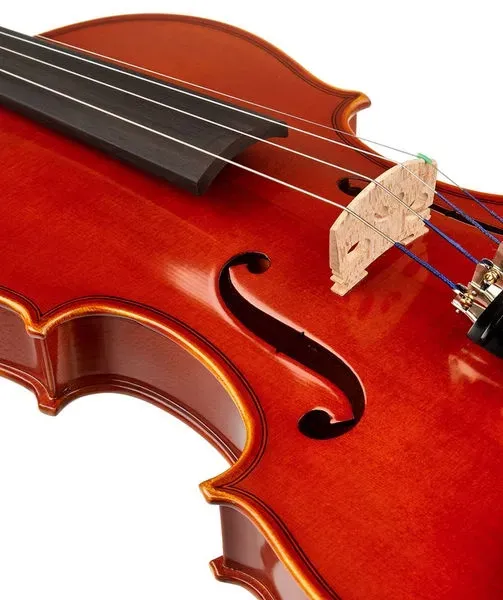
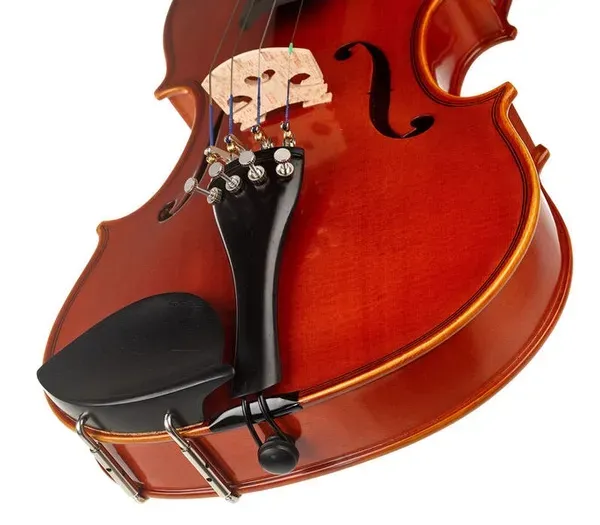
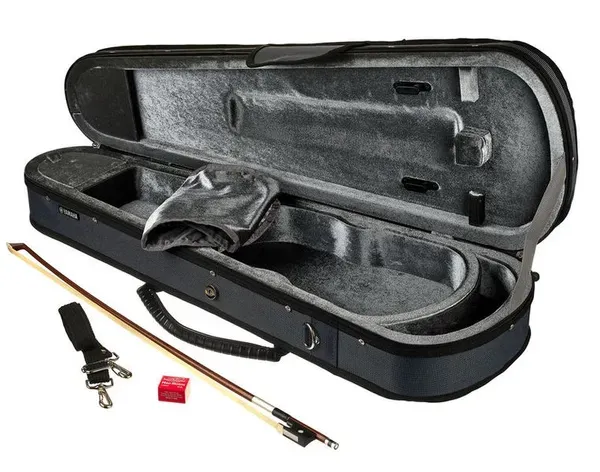
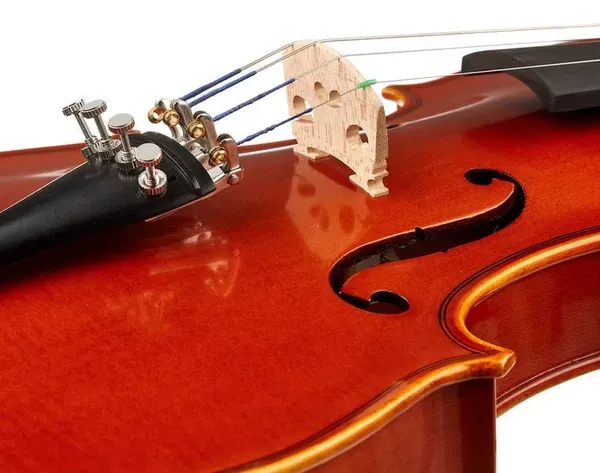
Choosing violin strings begins with a particular instrument and a musical task, rather than a ranking of expensive sets. Establish the violin size, E-string end fitting, previous set and the change you want: bow response, balance between strings, left-hand feel or dependable daily practice. The same set can behave differently on different instruments, so treat a manufacturer's description as guidance and assess the result on your own violin. This guide uses Pirastro Tonica 412021, Thomastik Alphayue AL100 and D'Addario Helicore H310 4/4M as examples of construction and identification. Photographs of the Yamaha V5SA illustrate contact points and setup components. They do not imply that any of the compared string sets is installed on that pictured violin. The aim is a reasoned choice followed by a useful practical comparison.

Establish the reason for replacement
Before ordering, write down what is happening now. Damaged winding, an old set, a disproportionately sharp register and difficulty starting a quiet note are different situations. If a video prompted the wish to change strings, first hear your own instrument played by a teacher. The current set may still suit the task, while the desired improvement concerns bow movement or the room's acoustics.
Separate a fault from a search for another tonal character. A damaged string needs attention regardless of whether its sound is attractive. Searching for a rounder sound can happen gradually without changing several components together. A clear reason makes the comparison meaningful: after installation, return to that question rather than judging only the excitement of something new. Also record what worked well before, so that an improvement in one area does not hide the loss of another useful quality.
Match instrument and size
Do not confuse violin and viola sets even when the range and packaging are similar. The instrument, size and version must all match. A 4/4 designation refers to the corresponding violin version. Fractional instruments require sizes specified by the manufacturer, rather than extra full-size string length wound onto a peg. The difference can involve construction and working tension as well as overall length.
If the violin's size is unknown, establish it from documentation or with a teacher before buying. Do not infer it from a photograph beside a case. In uncertain situations, the specified vibrating length may also be relevant. The actual order should identify the version clearly rather than relying only on a picture. Keep the instrument's complete details with your accessory notes. This prevents an otherwise correct range arriving in the wrong size and makes future purchases easier.
A complete set or one string
A full set provides a useful initial reference because you know which strings were installed together and when use began. An individual string can replace a damaged one or address one register deliberately. However, do not mistake the price of a single string for the cost of a complete set. Check terms such as SET and single, together with the note and product code.
For a standard four-string violin, confirm the contents and the included E version. Five-string sets and alternative versions of one range can look similar. Verify the quantity and specification before payment. Keep the packaging afterwards: it is a simple way to distinguish the exact set from a neighbouring variant. When adding one string to an existing setup, record its complete identification rather than only the brand and envelope colour. Accurate notes are particularly valuable if the setup later becomes mixed.

Core and winding are different
The core is the internal foundation, while the winding is material wrapped around it. Descriptions such as silver or aluminium often refer to the winding, not the whole construction. Read the complete specification line. Two strings with similar outer metal can have different internal structures and playing sensations. Equally, a shared core category does not make every range behave identically.
For comparison, list core, outer material and the selected tension separately. Avoid turning each word into a ready-made tonal ranking. Construction establishes what is being compared but cannot fully predict the result on your violin. Specifications and trial playing complement each other: one narrows the options, the other tests whether the change helps. This makes the conversation more precise than a general promise of a more beautiful or more expensive sound.
Understanding synthetic cores
Synthetic cores use different materials and manufacturing approaches. This is a broad category, not a single tonal recipe. Tonica and Alphayue illustrate sets with synthetic lower strings, but that shared feature does not make them identical. The exact range, size and supplied E remain important, together with the response of the individual instrument after installation.
If another set was installed previously, assess the change gradually. Notice note onset, movement between adjacent strings and the sensation under the fingers. Do not demand an immediate warmer sound merely because an online description associates warmth with the category. Control and balance matter more than matching an abstract adjective. Record observations in your own words and discuss them with a teacher, who can help distinguish construction differences from changes in technique as you adapt to the new set.
Steel cores are not all alike
A steel string can use a solid or stranded core. Helicore illustrates stranded construction, making the broad description “metal strings” insufficient. Do not generalise from one old steel set to every contemporary range. Internal structure, diameter, winding and tension contribute together to the playing response.
Identify what you want to examine: prompt note onset, short-stroke clarity, stability or the sensation of resistance. This is more useful than selecting by a genre label alone. A steel set may be used for classical study and a synthetic set for folk playing. Genre helps describe the task, but it does not replace checking the individual instrument and bowing approach. Instead of debating which material is universally correct, compare behaviour in the exercises and music that make up your actual practice.
Tension is not an achievement level
Medium, light and heavy identify versions within a manufacturer's range. Higher tension does not automatically mean better quality or a more advanced player. Do not buy heavy simply because lessons have become more serious. Understand what the change is intended to do for the balance and feel of your violin. Increasing tension is not a universal route to greater useful volume.
Compare numerical data with the conditions attached: note, vibrating length and exact version. The same medium label from two brands does not promise identical sensations. If the previous set was comfortable, retain its full identification as a reference. Discuss substantial changes with a teacher or technician, especially if the instrument's condition is uncertain. Strings should not be used to conceal a setup problem that needs a separate assessment. A clear baseline makes any experiment easier to interpret.
Diameter alone cannot decide
Visible thickness does not reliably reveal tension or perceived stiffness without knowing the construction. Different cores and windings have different properties, so visual comparisons can mislead. Rules such as thicker means louder or thinner means beginner-friendly are too crude for a violin system. They omit factors that appear only in normal playing.
First confirm suitability for the instrument, then try simple exercises. Can you begin a note with control, and does the movement require an abrupt change from your previous approach? Unfamiliarity deserves careful comparison, but an obvious installation problem should not be dismissed as adaptation. Diameter is a useful technical detail, not a complete purchasing criterion. If advice rests entirely on that measurement, ask how it relates to the specific task and string model being considered.
Check the E string separately
A set with synthetic lower strings may have a steel E. Calling a set synthetic therefore does not mean all four strings share the same construction. E strings may be offered with different coatings, windings or end fittings. Verify the supplied version separately, especially when using a particular fine tuner or an already preferred E. The complete designation matters more than the family name.
A whistle or harsh note onset is not automatic proof of an unsuitable string. Check installation, bow contact and the crossing from the neighbouring string with a teacher. If another E is appropriate, compare it deliberately while retaining the rest of the setup. This helps identify the cause of a change without buying an expensive complete set for every question involving one component. Use the same passage that previously revealed the problem so that the outcome can be judged clearly.
Ball ends, loop ends and fine tuners
Ball end and loop end describe the termination of the string. It must match the tailpiece or fine tuner. Similar range names do not guarantee the correct fitting. Some strings have a removable ball, but the manufacturer must explicitly provide for that feature. Do not modify an arbitrary string with pliers because another model allows the ball to be removed.
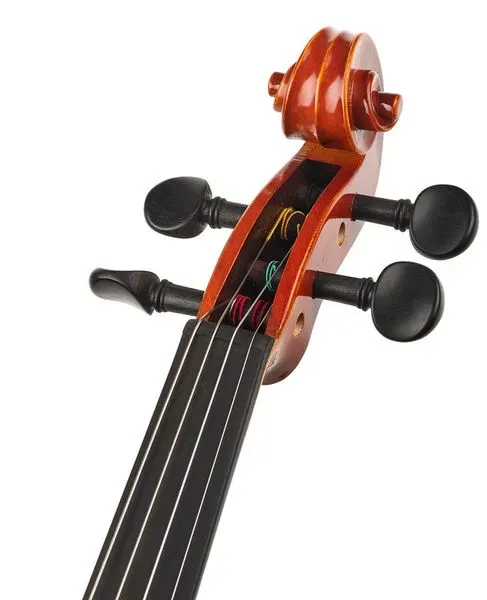
Before ordering, photograph the existing attachment and ask about compatibility if the terminology is unfamiliar. The V5SA photographs show the location of fine tuners, not compatibility with every possible string ending. The installed string should sit securely in its intended place without improvised knots or unwanted contact. A technician's check is preferable to damaging a new set through incorrect installation. Ask for a demonstration at the same time, so that the next order can identify the required fitting confidently.
Pirastro Tonica 412021
The 412021 code identifies a Tonica 4/4 medium violin set with a ball-end E. That information is more useful for ordering than the familiar Tonica name alone. Other versions exist, so check the code rather than only the white and red packaging. The lower strings and E should not be described as identical in construction.
This set can provide a starting point for exploring synthetic lower strings when size and fitting are suitable. It cannot be guaranteed as the best choice for every student violin. Ask a teacher to assess the balance after installation and repeat the exercises used with the previous set. If the product is unavailable, do not substitute a similar viola set or another end fitting without agreement. A useful alternative preserves the required compatibility rather than merely resembling the packaging.

Thomastik Alphayue AL100
AL100 identifies an Alphayue violin set, with size specified separately. For the illustrated 4/4 version, the manufacturer lists a steel E and synthetic lower strings. Its official table distinguishes individual string materials and fractional versions. Do not transfer every full-size specification to any package labelled Alphayue without checking.
This demonstrates why a shortened search title is insufficient. Verify size, medium designation and contents using current information. After installation, listen beyond the overall tone to crossings, quiet playing and control. A student benefits from a set whose behaviour can be discussed specifically. A recognised range provides a clear reference, but suitability is determined on the individual violin and within the current learning tasks. Precise identification is the foundation for that comparison, not a guarantee of the result.

D'Addario Helicore H310 4/4M
Every part of H310 4/4M matters: set identification, full-size version and medium tension. Helicore uses a stranded steel construction for the lower strings, while the standard H310 includes a plain steel E. Other versions exist, so the Helicore name or a similar package photograph alone does not confirm the exact selection.
Treat it as a distinct construction approach rather than the automatic opposite of warm synthetic strings. Examine note-onset control, short strokes and register balance. Keep the bow, rosin and room consistent during comparison. The outcome should meet your task rather than fit a simplified claim that one material belongs exclusively to one genre. If the sensation changes, describe the movement that became easier or harder instead of judging solely by the core label. This produces a more useful discussion with a teacher.

Build a short list
Begin with two or three compatible sets. Record each one's size, tension, E fitting, full code and reason for inclusion. One option may repeat a known working set, while another tests a different construction. If you cannot explain the distinction, another candidate may not yet help. Dozens of names without criteria increase uncertainty instead of improving the choice.
Next compare budget and availability. Consider whether you can repeat a successful set or obtain an individual replacement. Avoid ordering many options at once out of fear of missing the best. Sequential comparison provides more information when the previous condition is remembered and results are recorded. A beginner can build the list with a teacher who knows the violin and current exercises. That connects the purchase to learning rather than to a general popularity ranking.
Compare under consistent conditions
Before changing strings, play a few simple passages and record your impressions. Return to those tasks in the same room after installation. Do not change the bow, rosin, shoulder rest and recording method at the same time. Otherwise, the cause of the result is unclear. A familiar scale, slow crossing and short phrase are enough to create repeatable evidence.
Assess onset, sustained sound, balance and comfort separately. Do not compress everything into one score out of ten. A set may make quiet playing easier while requiring adaptation in short strokes. Those observations matter more than first-minute excitement. Ask another person to listen from a short distance because the sound under the ear differs from the room impression. Consider outside listening and the player's sensations together, rather than treating either as the sole answer.
Listening for balance
Compare neighbouring strings at similar dynamics, rather than focusing only on an impressive isolated note. Notice whether a crossing demands an abrupt change in bow movement. Different register colours are natural, but an unwanted weakness or excessive prominence deserves discussion. Balance concerns control of the complete set, not making every note sound identical.
Avoid replacing one string immediately after the first impression. Check tuning, installation and response in several exercises. If the problem repeats, identify the note, stroke and dynamic. This helps a teacher separate technique from the string setup. A repeatable example is more productive than a general statement that something sounds wrong. That phrase can start the conversation, but solving the issue requires an observation that another person can examine and reproduce.
Mixing different ranges
Combining strings from different sets can be a deliberate experiment, but it is not compulsory for a beginner. A complete set provides a clear baseline. If you want to change only the E or another string, state the expected benefit and preserve everything else. Do not assemble a random combination simply because every individual item has favourable reviews. Their combined behaviour matters more than adding together separate positive opinions.
After replacement, assess crossings and the whole musical phrase. A useful change should help the music overall. If the result is uncertain, revisit earlier notes and discuss the next step. Record the full identification of each installed string. Otherwise, a successful accidental combination becomes difficult to reproduce, and the next purchase again depends on silk colour. Good records become more important as a setup gradually moves away from a complete packaged set.
Preparing for installation
Prepare a clean surface, the correct strings and enough time without rushing. Check each envelope against the note and size before starting. If you lack experience, arrange help from a teacher or technician. They can also inspect contact points, fine tuners and bridge position. Independent installation does not have to be a test undertaken immediately after buying a new set.
Pirastro recommends replacing one string at a time to retain the instrument's working tension system. Do not remove the whole set for easier cleaning without understanding instrument servicing. Do not tune above the intended pitch in an attempt to speed settling. If the string will not sit properly or needs unusual force, stop and check compatibility and installation. Finishing at any cost is not success: the aim is secure placement and a clear route to tuning, rather than merely four tight strings.
Repeated breakage and contact points
A string works in contact with the instrument's components. Repeated failure at one location calls for checking that support point and installation rather than immediately blaming the entire range. A sharp edge, unsuitable groove or another fitting issue needs a technician's assessment. An expensive new string does not remove the mechanical cause that damaged the previous one.
Show the break location, retain the remaining string and provide the installation date. These details are more useful than a general complaint about frequent breakage. Do not enlarge grooves with an improvised tool or sand components without experience. The bridge illustrations help identify a location, not perform a repair. Address the cause before evaluating a new set's service life. Otherwise, successive purchases from different brands may reproduce the same problem without moving towards a solution.
Settling after installation
After replacement, monitor tuning and gradually return the strings to the correct pitch. Do not prescribe one universal number of hours for every construction and instrument. Installation and conditions also matter. The first few minutes may not give a complete picture, but visible damage or incorrect seating should not be dismissed as settling. If uncertain, have the instrument checked before continuing the experiment.
Schedule replacement with time to assess it before an important performance. A new range the night before a concert introduces uncertainties in tuning, feel and balance together. When time is limited, a familiar set is often more predictable than an experiment. After a first independent installation, ask the teacher to check the bridge and overall result. A calm review reduces surprises and clarifies which tasks are already understood and which still benefit from assistance.
Care without aggressive cleaning
After practice, gently remove rosin dust using a suitable dry cloth. Do not transfer cleaning methods for household metal equipment to a violin. An arbitrary solvent can reach varnish and other sensitive surfaces. For specialised cleaning, follow manufacturer guidance and seek a technician's help. Familiarity with a chemical in another context is not a reason to experiment beside the violin top.
Keep spares in their packaging without sharp bends or pressure from heavy objects. Do not leave loose strings among metal accessories in a case pocket. A labelled envelope preserves order and makes the required note easy to find. Care does not promise unlimited life, but it makes condition easier to monitor. A short inspection before practice can reveal damage early and requires less effort than urgently finding a replacement before a lesson or performance.
When replacement is appropriate
There is no single calendar interval suitable for both a lightly practising student and a musician with intensive rehearsals. Consider surface condition, stability, response and actual use. Mechanical integrity and retention of the desired musical behaviour are different questions. A string may remain unbroken while no longer providing familiar control. Conversely, age alone does not explain every change in sound.
Keep installation dates and brief observations. They help reveal gradual changes that are difficult to remember. When the cause is unclear, ask a teacher to confirm the assessment before buying. Do not wait for breakage as the only signal, but avoid replacing a functional set after one disappointing rehearsal. Base the decision on a repeated condition. Compare several sessions to distinguish a persistent change from fatigue, another room or an unfamiliar exercise.
Budget and the final decision
Treat strings as a recurring part of using the instrument. A successful set should be pleasant now and affordable to repeat. With limited funds, begin with a compatible known option and retain money for adjustment. The most expensive strings do not repair pegs, a bridge or an awkward playing arrangement. Sometimes servicing produces the needed improvement without changing the string price category.
Before ordering, verify instrument, size, code, tension, contents and E fitting. Preserve the previous setup details and prepare comparison exercises. A compatible spare and a clear way to obtain help are more useful than a disorganised collection of untested options. The final question is whether a specific musical task became easier on your violin. Another player's ranking can suggest a direction, but cannot replace that practical conclusion.
How phone recordings alter impressions
A phone is useful for notes when microphone position and room remain consistent. Automatic level control, noise reduction and other processing may hide or emphasise details. Do not judge projection solely from the loudness of two files. A small distance change may affect the recording more than the expected difference between sets. First establish that the conditions are comparable.
Mark the phone position, repeat a passage and avoid adding effects. Separately record sensations absent from audio: note-onset ease, resistance under the fingers and comfortable crossings. If these determine the choice, ask the teacher to listen in person. Recording supports memory but does not replace physical interaction with the strings. Separating listening from tactile observations improves assessment and explains why an attractive recording does not always correspond to convenient playing.
Reading reviews constructively
A useful review describes the instrument, previous set, conditions and a specific change. Calling something the best strings in the world supplies none of that context. Look for a similar task without expecting an identical outcome. Even the same violin model does not guarantee matching setup or bowing. Another player's experience is a suggestion to investigate rather than a promise.
Separate verifiable specifications from impressions. Code, size and end fitting can be checked against documentation; terms such as silky or noble need context. When accounts conflict, use the manufacturer and actual package for compatibility. Treat subjective descriptions as a reason to ask questions. Be particularly careful with reviews lacking the exact version: several variants of one range may be discussed as if they were one product. Curiosity is useful when it remains connected to accurate identification.
Information for a teacher or technician
Prepare the violin model and size, current strings and approximate installation date. Add a photograph of the E attachment and describe the specific issue. For a noise, identify the note and stroke; for breakage, show the location. This allows the consultation to begin with a cause rather than a random brand recommendation. Demonstrate a short repeatable example at the lesson when possible.
Ask what the proposed change should improve and how to assess it. A good recommendation leaves a clear criterion, such as easier quiet onset or a smoother crossing between two strings. Return after installation with brief observations. Over time, selection becomes a systematic understanding of your instrument. Before a performance, check the spare as well: its identity and E fitting should be known in advance. A small organised reserve supports a calm response to an unexpected failure instead of an urgent search for a random substitute.